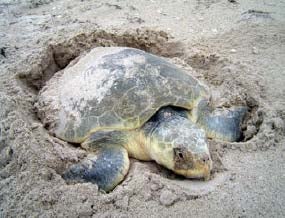
Tracks from Kemp's ridley sea turtles can be seen on a stretch of beach near Rancho Nuevo, Mexico earlier this year. Photo courtesy of LightHawk.
Kemp’s ridley sea turtle nesting season is winding down for the summer, and I'm happy to report that nest numbers are still on the rise! While the Kemp's ridleys still are the world's most critically endangered sea turtle, they are making a huge come back in recent years.
Until half a century ago, tens of thousands of Kemp’s ridleys would surge onto Mexico’s Gulf of Mexico beaches in a few large nesting events each year to lay their eggs. At the turn of the 20th century, turtle meat and eggs became popular delicacies, causing the turtle’s population to crash. Later, accidental catches in fishing gear kept their population from recovering.
Today, Kemp's ridleys are rebounding due to protections that government, fishing industry, EDF and other conservation groups helped win. These unprecedented actions included protecting Mexico beaches where the turtles nest, monitoring hatchlings at an incubation site, and establishing the headstart program and a second nesting site in Texas. The initial recovery program spanned from 1978-1988. During this time, over 22,000 eggs were transported from Playa de Rancho Nuevo in Mexico to Padre Island National Seashore in Texas. Once hatched, the turtles were exposed to the Padre Island sand and surf, and then captured and transported to the National Marine Fisheries Service Laboratory in Galveston, Texas, where they were reared in captivity for 9-11 months. This “head-start” program allowed the turtles to grow large enough to be tagged for future recognition and to avoid most natural predators. It was hoped that this exposure would imprint the turtles to the National Seashore so they would return year after year to nest at adulthood. Read More

Earlier this summer
Gulf of Mexico fisheries regulators recently closed down longline fishing (7-9 mile fishing lines with hundreds of hooks) in the Gulf of Mexico off west Florida for six months because the government reported that more threatened sea turtles were being caught than expected. The result of the closure is that turtles will be saved, but jobs will be lost.
In the midst of all this, our very own Dave McKinney came up with a solution to save turtles and jobs. We’ve started a grant program that provides financial assistance to longline fishermen who convert to vertical gear, which causes far fewer turtle interactions. We have already received almost 30 applications and the new gear has already been put on more than five vessels.
By Ryan Ono, Gulf Oceans Program Research and Outreach Associate
Subscribe via RSS