Tag Archives: Red Snapper

‘Fish on Fridays’: Gulf of Mexico Red Snapper, a tasty sustainability success story

Gulf Wild Red Snapper

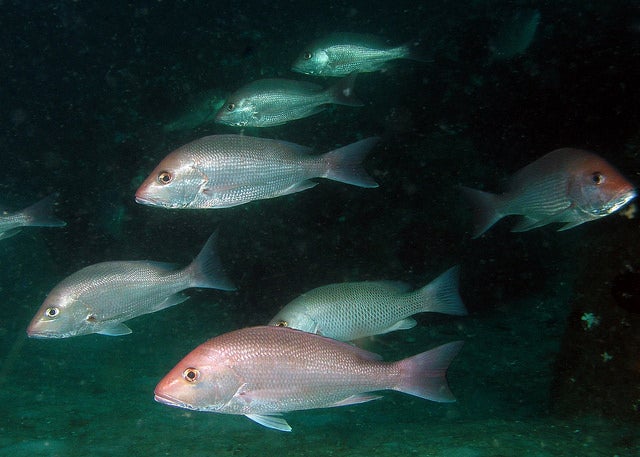
Gulf Wild tagged Red Snapper. GulfWild allows the consumer to trace their fish back to the boat and captain who caught it

Welcome to a blog series on sustainable, locally sourced seafood for Lent! This week, we are featuring Gulf of Mexico red snapper which is managed under the Gulf of Mexico Commercial Red Snapper IFQ program. We are also presenting a delicious recipe for snapper tacos from Chef Chris, the head chef at Yaga’s in Galveston.

Meet a Fisherman: Bubba Cochrane

Bubba Cochrane is a commercial fisherman and business owner in Galveston, TX. He began his career as a deck hand and saved enough to purchase a permit and boat of his own. His business is doing well now, but he remembers when red snapper were on the brink of collapse. At that time, he was restricted to fishing in just the first 10-15 days of each month, in a derby-style competition in which everyone got on the water at the same time and tried to catch as many fish as possible.

He told National Geographic, “A derby is really stressful – you’re worried about the weather or if you get sick or even hurt,” he said. “And it means you miss a lot of birthdays and holidays with your family, because when fishing is open you’d better be on the water.”

Cochrane was skeptical of the IFQ program until he went to a workshop and learned he could buy or lease additional quota if he didn’t have enough. Now, his business is doing well and he hopes that one day, his son will follow in his footsteps. “Catch shares taught me about stewardship. I know what sustainability means and I believe in it,” said Cochrane. “There’s a future for the fishery.”


The Gulf of Mexico Commercial Red Snapper IFQ program:

Gulf snapper are so popular that overfishing once threatened to devastate this species, reducing it to just 4% of its original population. Attempts to control the problem by shortening the fishing season year after year failed. Then in 2007, fishermen voted to introduce an Individual Fishing Quota (IFQ), a type of catch share, which put this species on the road to recovery. Since 2008, the fishing season has been extended to year-round, fishing quotas have been steadily rising and revenues have gone up, allowing fishermen to once more make a good living without harming the stock.

Some have even found creative ways to use the fishery’s new sustainability to market their catch. Gulf Wild, a registered program of the Gulf of Mexico Reef Fish Shareholder’s Alliance, allows consumers to track the fish they buy back to its supplier, so they can see who caught their snapper, what part of the Gulf it came from, the name of the ship’s captain, and even the port where it was landed. The program assures consumers that they are eating truly sustainable seafood. Check out mygulfwild.com for more information on how the program works and where to buy Gulf Wild fish.


Red Snapper:

Red snapper, with its firm texture and sweet, nutty flavor, is one of the most popular white fish on the market and can be found all over the world, though most are harvested in the Gulf of Mexico or Indonesia. We are advocating that you purchase the locally caught Gulf snapper, however, and support local fishermen like Bubba!

Care to cook some snapper? Try this recipe for fresh snapper tacos.


Chef Chris’ snapper tacos: 

Ingredients:

1/2 Gal sour cream
3 green onions, chopped
1 yellow onion, chopped
1/2 C capers
1 C white wine
1 lime, juiced
2 T mayonnaise
1 T black pepper
1 T salt
1 T blackening seasoning

Instructions:
Sauce: Combine above ingredients in a bowl & set aside.

2 8oz red snapper fillets, cut into 3oz strips
1 T salt
1 T pepper
1 T chili powder
1 T garlic powder

Combine seasonings and coat snapper with the mixture. Cover bottom of sauté pan with olive oil & cook fish until white and flaky.

Assemble tacos with corn tortillas, shredded cabbage, chopped cilantro, sautéed snapper, and prepared sauce. Layer two or three corn tortillas for stability.

Posted in Catch Shares, Gulf of Mexico, Seafood | Also tagged , , , , , | Comments closed

Recreational red snapper management system "stinks and punishes everyone"

Charter boats allow recreational fishermen who do not have their own boats to fish for iconic species such as this Gulf of Mexico Red Snapper. Photo Credit Gulf Wild™

As the Gulf of Mexico red snapper allocation becomes a hot topic for both recreational and commercial fishermen, I wrote to Saving Seafood to set the record straight about Environmental Defense Fund’s work in the Gulf of Mexico and views on the issues facing fishermen.  An excerpt can be found below:

“Gulf of Mexico states and their anglers are increasingly frustrated with short seasons for prized red snapper in federal waters.  They have every right to be angry. The management of the recreational share of the fishery is utterly failing. This year’s projected federal season of a few weeks at best, together with large over-harvests each year, are obvious signs.  The system stinks and punishes everyone including those who enjoy fishing on their own and fishermen and families who use for-hire guides to access the Gulf.

There are a lot of passionate voices advocating change. Open discussion should be respected and welcome – in fact, exploration of new ideas is the only way to get closer to solutions.  Unfortunately, the gossip and finger-pointing simply diverts attention from important issues and does nothing to help.

I am proud of the partnerships between Environmental Defense Fund and fishermen in the Gulf of Mexico.  I am convinced that cooperation between conservationists, fishermen and government are critical to the long term health of the Gulf.  I am also convinced that the progress of commercial red snapper management towards rebuilding the fish population and sustained financial viability is vital to success.”

Read the full piece here.

Posted in Catch Shares, Gulf of Mexico | Also tagged , , , , , , , , | Comments closed

Catch Shares Save Fishermen and Fish

Bubba Cochrane with his Boat the Chelsea Ann

Bubba Cochrane. Photo by Mark Thein of GulfWild.

This is a re-post of a National Geographic Blog posted by Miguel Jorge of National Geographic's Ocean Initiative on November 20, 2012

Bubba Cochrane always knew he wanted to be a fisherman. So, despite concerns from his family, he began his career as a deck-hand and eventually saved enough to buy a permit and boat of his own. He’s 43 years old now and owns a commercial fishing business out of Galveston, Texas. Business is good – but he can easily remember what fishing used to be like.

“When I got started, fishing was a race: when the season opened we fished every day until we were notified that the quota was caught. That meant lots of fishing all at once, a glut of fish in the market, and bad prices when we got back to the docks,” said Bubba, reminiscing about his early days in the fishery.

Through the mid-2000s, the red snapper fishery was on the brink of collapse. Even with so few fish in the population and a short season, the fishing derbies meant that the price at the dock stayed low, hurting the profits of commercial fishermen. Fishery managers tried to address the price problem by breaking up the season into the first 15, then 10 days of each month. Fishermen would fish for 10 days, and then wait until the next month to go out again.

These sporadic openings were not the solution fishermen like Bubba wanted. “It’s hard to run your business in just the first 15 days of a month; a lot can get in the way. I tell people to imagine a gas station only being able to sell gas for the first ten days of each month or a contractor only being able to build houses in that short window.” Read More »

Posted in Catch Shares, Gulf of Mexico | Also tagged , , , , , , | Comments closed

How Catch Shares are Working in the Gulf of Mexico

For over 20 years I’ve worked in the field of fisheries and ocean conservation, mostly in the Gulf of Mexico.  During that time I’ve been privileged to catch and enjoy the region’s red snapper, kingfish and flounder.  In my view, we can and should balance conservation of the region’s resources with people’s need for jobs, food, and enjoyment.  In fact, finding the balance is at the heart of the Gulf’s future.

Fisheries management – especially when commercial and recreational goals seem at odds – has been controversial since federal regulations came into play in the 1980s.  A newly used tool in the Gulf called “catch shares” is currently getting a lot of attention, some of it from anglers concerned that it is responsible for increasing recreational regulations and shrinking access.   This is a misconception.

Recently, an author on the Florida Sportsman’s Conservation Blog questioned whether Environmental Defense Fund is contradicting itself in supporting catch shares to solve overfishing problems in federal commercial fisheries.  The answer is:  “not at all.”  As an organization, EDF works in partnership with industry and communities to find solutions to environmental problems that are also good for the economy.  This is exactly what the Gulf’s catch share programs achieve.  They were implemented with industry leadership and support and are achieving the fishery’s conservation and economic goals. Read More »

Posted in Gulf of Mexico | Also tagged , | Comments closed

NOAA Releases Gulf of Mexico 2010 Red Snapper IFQ Annual Report

Gulf of Mexico Red Snapper

Gulf of Mexico Red Snapper

NOAA's National Marine Fisheries Service recently released the Gulf of Mexico 2010 Red Snapper Individual Fishing Quota (IFQ) Annual Report, and it provides a wealth of data and information collected during the fourth year of the IFQ program.  The report comes as the 5-year review of the IFQ is underway, and offers us a chance to use the latest data to evaluate the success of the program.

By all counts, the IFQ has been a success.  Back in 2006 when the Gulf Council was considering various management options in the red snapper fishery, fishermen had a short season each year, and had to go out even in dangerous conditions. The markets were flooded with fish for a short period of the year (and fishermen got low prices for their fish), and since the fishermen couldn't decide when, where, or how to fish, they had excessive bycatch of red snapper and everything else.  And to top it all off, they ended up going over quota anyway.

Then in 2007, the IFQ brought in a new way of doing things.  After getting approved overwhelmingly by local fishermen in not one but two referendums, the IFQ brought flexibility and stability to the fishing industry.  Fishing days increased from an average of 77 days before catch shares to 365 days a year.  Catch shares improved the stability of fishing employment; they allowed vessel owners the opportunity to provide full time jobs to qualified captains and deckhands, without the variability that results from short seasons.   In contrast, recreational fishermen only had 53 days to fish for red snapper (not including lost days due to the oil spill) under traditional management in 2010, and only 48 days in 2011. Read More »

Posted in Catch Shares, Gulf of Mexico | Also tagged , , , , | Comments closed

The Gulf of Mexico – The Fishermen's Success Story

Gulf of Mexico Red Snapper

Gulf of Mexico Red Snapper

If you read Food and Water Watch’s recently published report on the Gulf of Mexico Red Snapper fishery, you may be wondering why EDF is so supportive of catch shares as a tool for fishery managers. The report paints a pretty bleak picture for fishermen in the Gulf of Mexico. We could spend an entire blog post devoted to addressing the report’s flawed statistics and manufactured conclusions, or we can just tell you the story of the red snapper fishery and how it went from near closure to a rebuilding fishery on the path of recovery.

Anyone who grew up in a coastal community and who has seen the fishing industry struggle under the weight of restrictions and regulations understands the devastating impacts of size limits, trip limits, and short seasons.  Traditional management has been crushing both large and smaller scale fishermen to the point where their livelihoods – their ability to provide for their families – has been threatened.  Catch shares offer them a way out, and a choice.

When catch shares were being debated in the Gulf Council in 2006, fishermen came to the table to design them.  All fishermen who wanted to participate, could participate – the Council process provided plenty of access through Council meetings, Advisory Panels, public comment periods, and hearings.  Under the Magnuson-Stevens Act, which Congress passed as the fisheries law-of-the land, fishermen were guaranteed a referendum (red snapper got two!) to vote a catch share up or down.  That means the fishermen who historically made a living from fishing got the chance to decide how best to manage their fishery themselves. Read More »

Posted in Catch Shares, Gulf of Mexico | Also tagged , | Comments closed

A Lifeline for Gulf Fishermen: Catch Shares Cushion Blow for Commercial Snapper Fleet in Wake of BP Oil Disaster

At the time of the BP oil disaster, the once-failing Gulf commercial red snapper fishery was beginning to rebound, in large part due to a catch shares program called individual fishing quotas introduced in 2007.  Before catch shares, fishermen competed against each other in a dangerous race-to-fish before the short seasons ended. Now, fishermen are assigned a percentage of an annual sustainable catch and have a year round season. Individuals decide when to fish their secure amount, and can trade their allotments with other boats, providing incentives and accountability to save fish and the marine environment.

The system works for fishermen and fish. Before, regulations forced fishermen to throw out millions of fish, wasted and dying. Fish were caught during short seasons and were sold in the market all at once, pushing down quality and fishermen's earnings. Now, far fewer fish are wasted, fishing costs are dramatically lower, and fishing trips are timed when seafood demand is high.  In short, opportunities for a healthy Gulf and fishing industry are possible again.

While all Gulf fishing businesses have been harmed, catch shares have cushioned the blow for fishermen during the BP oil disaster in the following ways, as non-catch share fishermen – like red snapper charter fishermen – are stuck dealing with another huge blow to their industry.

  • Tangible assets to make loss recovery claims: Catch shares have a transparent market price, which may help fishermen calculate defensible claims for the loss of value of their business and assets from the oil disaster. In contrast, fishermen under old rules may find it difficult to prove the expected value of this year's and future catches. This case is likely the first in which disaster claims can be based on catch shares.
  • Ability to trade fish now to make ends meet: Catch share fishermen in areas closed by the spill can trade their shares to others in the open Gulf waters, giving them the means to survive in the short term. In contrast, fishermen under old rules are stuck at the docks with nothing to trade.
  • Security to wait and fish later in the year: Catch share fishermen have a year round seasons and secure amount of fish, allowing them to save their fish for later in the year. For those under old rules, like charter fishermen, important fishing seasons are often concentrated during summer months, so fishermen that have been closed in by oil from Louisiana to Alabama have missed out on fishing for some prized fish and substantial fishing income.  (Regulators may re-open some fisheries to alleviate hardship caused by the oil disaster.)

Overall, catch shares help make fishermen more resilient to man- made disasters like the BP oil disaster and natural disasters like hurricanes.

Now more than ever, we need to improve fishery resiliency, reduce waste and make every fish count — for the environment and for fishermen. Catch shares are the best way to make this happen.

Posted in BP Oil Disaster, Catch Shares, Gulf of Mexico | Also tagged , , , , , | Comments closed

Vote on Massive Southeast Fishing Closures Passes

Today in Orlando, Florida, the South Atlantic Fishery Management Council (Council) approved amendment 17A (17A) to the snapper grouper fishery management plan. Now it will go to U.S. Secretary of Commerce Gary Locke for approval. 17A closes the red snapper fishing season throughout the Southeast. It also closes a 5,000 square mile area for additional kinds of snapper and grouper fishing from Georgia to South Florida. A short-term ban was put in place in January to prevent red snapper fishing, until 17A could be finalized.

While today’s passage of 17A fulfills the Council’s legal requirements to end overfishing of red snapper, it does not provide an effective long-term strategy for a healthy fishery. In reality, it reinforces many other problems:

  • Commercial and charter fishermen going out of business;
  • Difficulty in finding local fish in restaurants and stores; and
  • Recreational fishermen – including tourists – not being able to fish as much, which hurts countless bait and tackle shops, boat dealers and mechanics, and tourist hotels and restaurants.

Catch shares allow fishing as fish populations rebuild
EDF believes that catch share management is the best option for the commercial and for-hire (charter and party boats) sectors of the snapper and grouper fishery. Catch shares could potentially replace 17A’s closures with fishing seasons and reduce closed areas while fish populations rebuild. Private anglers deserve an opportunity to catch red snapper too, and fishermen and the Council have an opportunity to improve the management by exploring new tools like a tagging program.

Growing numbers of Southeast fishermen agree that catch shares are the best way forward.

Catch shares set a scientifically-based limit on the total amount of fish that can be caught and then divide that amount among individual fishermen or groups of fishermen.  Studies have shown that catch shares bring fish populations back and benefit fishermen. With catch shares, fishermen have much more flexibility on when to fish, are held individually accountable for what they catch, are no longer forced to waste tons of fish by throwing them overboard, and fishing can be more profitable.

A looming disaster: Effort shift
When 17A is implemented, fishermen will focus on other kinds of fish, instead of red snapper. This can damage other fish populations or underwater habitat. Also, the uncontrolled BP Oil Disaster in the Gulf of Mexico may push Gulf fishermen into Southeast waters. Both situations will increase the amount of fishing pressure on an already distressed fishery. Catch shares reduce the need for season and area closures and the chance of damaging effort shift in fisheries.

Catch share success is proven
Successful catch share management is in place in the Gulf of Mexico’s red snapper, grouper and tilefish fisheries and hundreds of other fisheries worldwide. Just three years after the red snapper catch share in the Gulf of Mexico went into place, the amount of wasted fish was reduced significantly, fishermen made higher profits, and fish populations were rebounding. With the BP Oil Disaster, the flexibility of catch shares allows fishermen in areas closed to fishing to sell or lease their shares of fish to fishermen in open areas.

Never miss a post! Subscribe to EDFish via a email or a feed reader.

Posted in BP Oil Disaster, Gulf of Mexico, South Atlantic | Also tagged , , , , , | Comments closed