






Tag Archives: New England

Eating with the Ecosystem: Georges Bank


Eating with the EcosystemEating with the Ecosystem is a project created to help consumers learn about the marine waters from which New England seafood is harvested.  The project aims to build upon related efforts focused on sustainable seafood and eating local by urging consumers to think about the suite of species living together in a given place, and their ecological interactions and fluctuations in abundance.  In other words, their mission is to grow awareness of individual species to awareness of the entire ecosystem.

One important message of Eating with the Ecosystem is that consumers should focus on healthy stocks so that we benefit from abundance while allowing other resources to recover.  Today, this means being willing to try species that are unfamiliar to many seafood lovers.  As we work to recover well-known species like cod and flounder, species such as dogfish, skates, hake, pollock and redfish present opportunities to offset lost revenue for fishermen, and for diners to try some new tastes.  Fortunately, based on the results of a poll conducted collaboratively by EDF and the Center for Marketing Research at UMass-Dartmouth, consumers seem willing to give those species a chance.

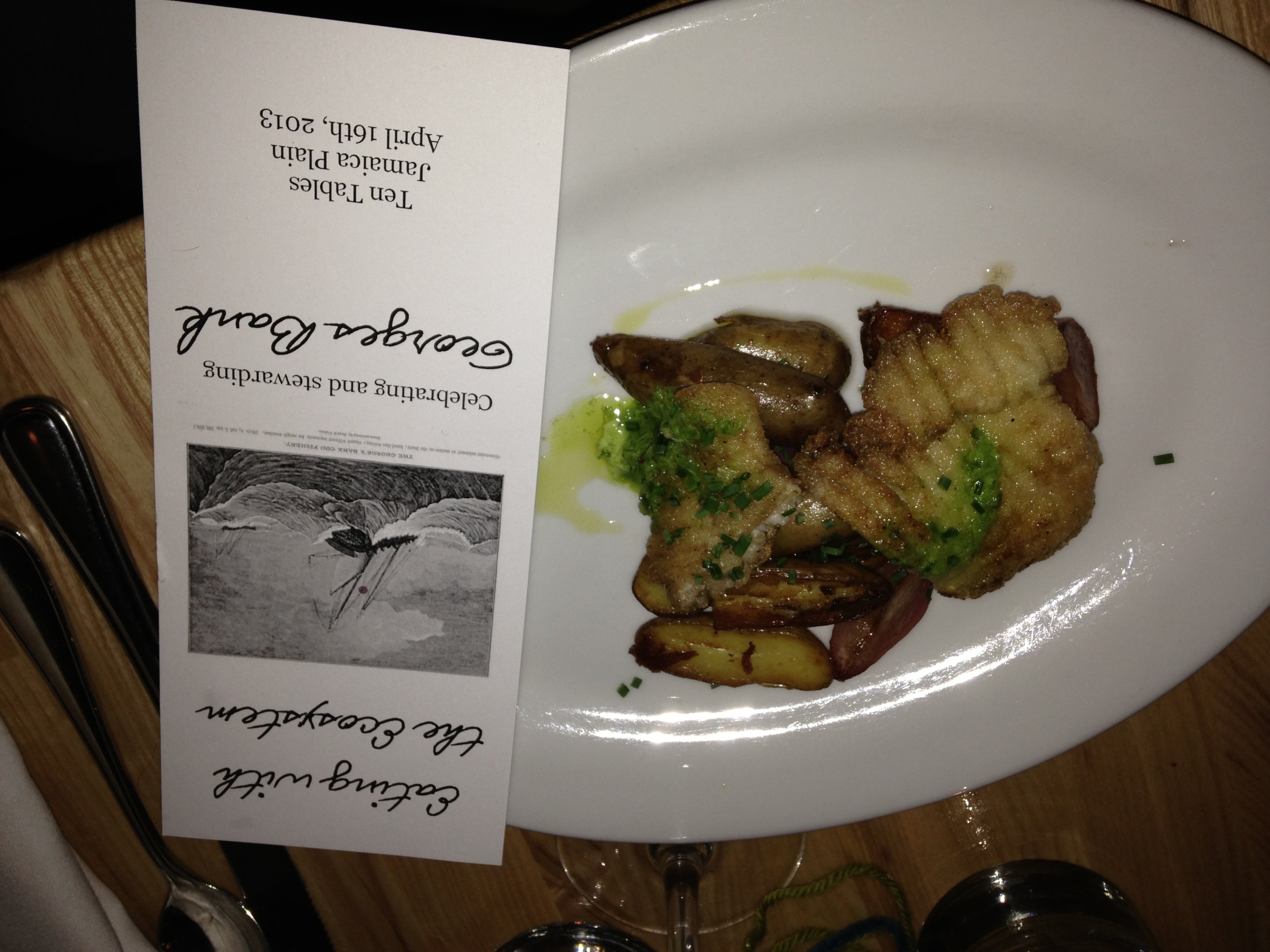
In the spirit of the “trash fish” dinner recently sponsored by the Chef’s Collaborative, Eating with the Ecosystem is hosting a series of dinners across New England to showcase underappreciated seafood and the ecosystems from which it comes. I was fortunate to attend their most recent event highlighting the Georges Bank ecosystem, which was held at one of my favorite restaurants: Ten Tables, located right in my own neighborhood, Boston’s Jamaica Plain.

The menu began with a simple sea scallop ceviche served with Hakurei turnip, green apple and arugula.  As the basis of the most valuable fishery in the United States, sea scallops are far from unknown in the market!  But the stock is abundant, and no meal focused on the Georges Bank would be complete without scallops on the menu.

Next up was a house cured hake brandade, served alongside pickles and mini toasts.  There are actually three different species of hake found on Georges Bank: white, red and silver.  An interesting ecological linkage between the first course and the second is that juvenile red hake take shelter inside adult sea scallops after beginning their lives as tiny larvae drifting among the plankton and then settling to the seafloor. Read More »

Posted in New England, Seafood | Also tagged , , , | Comments closed

Charting a Course for Gulf of Maine Cod: Part II

Atlantic cod

Atlantic Cod; Photo Credit: NOAA

Yesterday, I recounted the recent history of assessments of the Gulf of Maine (GOM) cod stock that has led to a looming crisis for many New England fishermen, and the management response underway in the form of emergency action.  Today, I discuss two major goals that will most effectively use the time before us to potentially change our understanding of cod status, and avoid or minimize socio-economic hardship.

Expand our scientific perspective
Before the 2011 assessment had even been reviewed, a barrage of criticisms began to be levied.  To be sure, many decisions made during the assessment could have gone a different direction, including data to include or exclude, values for key parameters, and determination of reference points.  Renowned ecologist E.O. Wilson once observed that ecology is far more complex than physics, and fisheries science is a close cousin of ecology.  There are few universal rules for how to assess fish stocks, and the discipline relies heavily on experience, professional judgment, vigorous debate, peer review, and trial and error.  The GOM cod assessment was not lacking in any of those elements.  In my view, the assessment was done right, was done well, and should be commended for achieving what it set out to do.  Gerrymandering the assessment to get a more favorable outcome is both bad practice and bad policy. Read More »

Posted in New England | Also tagged , , , , | Comments closed

Charting a Course for Gulf of Maine Cod: Part I

Atlantic cod

Atlantic Cod; Photo Credit: NOAA

By now, most people concerned with fisheries management in New England, and in fact many others across the country, are aware of the difficult situation unfolding around the Gulf of Maine (GOM) cod stock.  For those who are not, a stock assessment completed late in 2011 drastically altered our perception of the stock from the last assessment completed in 2008, and suggests that the resource is in much worse shape than we previously thought.

Actually, in many ways the 2011 assessment tells a story similar to the 2008 assessment:  Biomass reached all-time lows during the 1990s, but then approximately doubled by 2001.  Thereafter, biomass dipped again to another low point in the mid-2000s, before climbing again toward the end of the 2000s.

The critical difference between the two assessments lies in the pace of rebuilding since the recent low in the mid-2000s.  The 2008 assessment suggested that the population was increasing extremely rapidly, with growth of more than 200% from 2005 to 2007.   In doing so, it had exceeded the overfishing threshold, and was well on its way toward the rebuilding target biomass that would produce the maximum sustainable yield on a continuing basis. Read More »

Posted in Catch Shares, New England | Also tagged , , | Comments closed

Head to Tailfin: Sustainable, Locally-caught Seafood

Recently, I had the pleasure of joining the “Head to Tailfin” dinner organized by Slow Food Boston at Boston’s 606 Congress restaurant.  The seven-course menu paired original seafood creations crafted by Executive Chef Rich Garcia, a former chef in the U.S. Marine Corps who has been featured in the culinary magazine Star Chefs, with Spanish wines selected by sommelier Jack Guinan.  And, wow, was the meal something special!

Chef Garcia’s aim was to show how the whole animal can be used, from the head all the way to the tailfin.  Consistent with the slow food philosophy, Rich used locally caught seafood, with one exception: The fifth course featured shrimp from the Gulf of Mexico as a show of support for the region’s seafood industry recovering from the detrimental ecological and public perception effects of the Deepwater Horizon blowout.

Among the dishes of New England origin, my favorite was a toss-up between deep-fried cod tongue and cheeks, and sous vide long fin squid with Hill Farms pork belly.  The cod was caught under the sector management system implemented in the New England groundfish fishery last year, one of the newest catch share systems in the nation.  The squid was caught by the same fishermen who created and operate Rhode Island’s fluke sector out of Point Judith.  Diners were able to learn which captain caught their squid, and where and when it was caught, using QR codes provided during the meal as part of the new “Trace and Trust” program.   Read More »

Posted in Catch Shares, New England, Seafood | Also tagged , , , | Comments closed

Recent Op-Eds in NE Media Share Successes and Next Steps for Groundfish Sectors

After more than a year under the new groundfish sector management system, stakeholders in New England are examining what progress has been made and what refinements to the system are needed.  Emilie Litsinger, EDF's NE Groundfish Project Manager, recently authored two op-eds that examine why sectors are better than the old system, and how sectors will work even better for fishermen by making some improvements, such as reducing at-sea monitoring costs, setting accumulation limits and allowing for unused quota to carry over into future fishing seasons.

Read Emilie's op-eds:

Reviewing a year of fishing-sector management
The Providence Journal
October 7, 2011

A perfect time to talk about groundfish solutions
New Bedford-Standard Times
September 29, 2011

Posted in Catch Shares, New England | Also tagged , , , | Comments closed

One Year of Sector Management in New England Fisheries

Emilie Litsinger, EDF Oceans NE Groundfish Project Manager

Emilie Litsinger, EDF Oceans NE Groundfish Project Manager

A report by the National Marine Fisheries Service (NMFS) released Wednesday highlights results of the first year of the groundfish sector management program in New England. The dramatic management shift appears to be helping the fishery turn the corner to a more economically and environmentally sustainable fishery.

With the first full year of operation under sectors now complete, results of the program’s performance are encouraging. Sector fishermen stayed within their allowed catch levels, groundfish revenues were essentially stable, overall revenues were up, fishermen received higher prices for fish, and  the amount of wasted fish dumped overboard was substantially reduced.

The report highlights a number of continuing trends. For example, the number of active groundfish vessels has been declining for over a decade.  The eight percent decline in the 2010 fishing year was similar to the decline from 2007 to 2009. Read More »

Posted in Catch Shares, New England | Also tagged , | Comments closed

New England Catch Share Fishermen Serving Up Fresh, Traceable Fish Directly to Restaurants

Stuffed Flounder © 2010 Eliza Adam

A group of fishermen in Rhode Island who helped establish the groundfish and fluke catch share fishery management programs are now able to go back to the days when fishermen sold their fish directly to restaurants versus solely through wholesalers.  Selling directly increases the prices fishermen can get for their catch and also means customers are eating the freshest fish.

Chef John Vestal from New Rivers in Providence, Rhode Island who is a customer of the new fishermen’s distribution company Wild Rhody told The New York Times, “I have been buying all the seafood for the restaurant for over a decade, and what I saw amazed me. The fish was the absolutely most beautiful, fresh, cleanest seafood I had ever seen.”

In a recent article in The Providence Journal, fisherman Chris Brown described why it was difficult to sell directly under the old fishing derby system before the switch to catch shares: “’Used to be, years ago, they would say, ‘the season is open, go,' Brown said. ‘There was a race to fish. We wouldn't have been able to do something like this. Now we can fish to the prompts of the market.’” Read More »

Posted in Catch Shares, New England, Seafood | Also tagged , , , | Comments closed

New Report Provides A Roadmap for Improving Fisheries Management in New England

As the New England Fishery Management Council completes its spring meeting today, Council members, staff and other stakeholders will head back to their homes and offices thinking about implementation of the various decisions made during the three-day meeting.

Thanks to a new report released during the Council meeting, the fisheries community in New England will also be thinking about broader steps needed to improve the overall effectiveness of our fisheries management system. The study behind the report was led by Preston Pate, a former member of the Atlantic States Marine Fisheries Commission and former Director of the North Carolina Division of Marine Fisheries, who presented its findings to the Council alongside Assistant Administrator for NOAA Fisheries, Eric Schwaab.

A review of the management system was requested by Council chair John Pappalardo, a Chatham fisherman and CEO of the Cape Cod Commercial Hook Fishermen’s Association, and subsequently initiated by NMFS. Strong support for both the spirit and recommendations of the report was expressed by Mr. Pappalardo and the Council, as well as Mr. Schwaab and NOAA Fisheries.

Media outlets across New England quickly covered the findings and recommendations in the report, with clear and perhaps unsurprising emphasis on the negative outcomes. And that emphasis is warranted, for although the report notes a considerable number of positive attributes of the region’s management system, the effectiveness of those elements is compromised by the negatives.

But let’s pause and take pride in what is working well in New England, and then get down to business of fixing what is not working well.

In fact, several of the positives identified in the report represent steps already underway toward rectifying the negatives. For example, the important role that managers of the 17 groundfish harvest cooperatives, i.e., “sectors”, are playing in improving collaboration and communication with management was highlighted as an encouraging recent development. This is a development that is making progress toward rectifying one of the major areas needing improvement within NMFS: better outreach and communication with industry. We should think creatively about how to make sector managers more effective in filling that role, and support them in doing so.

The report also identified cooperative research as a positive attribute of the regional management system that provides important information for management, and improves relationships among industry members, scientists and managers. Therefore, increasing cooperative research opportunities is another important strategy for improving the communication and trust deficiencies identified in the report.

The report also highlighted two challenges faced by fisheries management in New England more so than any region in the U.S.: Geography and history. The area under the jurisdiction of the New England Council has relatively high population density, and consequently high anthropogenic impacts, in the coastal region. Also, although the region is comparatively small, it includes four coastal states, so that the number of political and regulatory jurisdictions involved are relatively high compared to other regions.

Our history not only makes successful fisheries management in New England more challenging, but in some ways more important. The fishing traditions in New England are key components of our regional identity and our national heritage. Successes in the region are therefore especially symbolic nationally, and following the roadmap requested by Mr. Pappalardo, made possible by Mr. Schwaab, and delivered by Mr. Pate can help ensure greater success toward recovering and strengthening our invaluable fishing heritage moving forward.

Jake Kritzer is EDF’s Senior Marine Scientist for the New England and Mid-Atlantic regions.  He is also Vice-Chair of the New England Fishery Management Council’s Scientific and Statistical Committee, among other advisory appointments.

Posted in Catch Shares, New England | Also tagged , , , , | Comments closed