









What a Difference a Day Makes! The Value of Real-Time Electricity Data
Posted: in Clean Energy, Clean Power Plan, Climate, Electricity Pricing, Energy Efficiency, General, Grid Modernization, Utility Business Models
Written By

Share

Imagine you’re trying to lose weight. If you step on the scale once a month, how can you possibly know how each of your daily decisions affects the number? Weighing yourself every day would be a step up, giving you a much clearer picture of the effects of each day’s choices. Now imagine the potential results if you could access real-time data – if you were able to see just how many calories were in each food you picked up, as well how much energy you were exerting at any given moment.
Thanks to a meta-analysis on behalf of the American Council for an Energy Efficiency Economy (ACEEE), we can now see that access to this kind of granular, real-time data on electricity use leads to significant household electricity savings.
Survey highlights importance of timeliness and granularity
The ACEEE survey aggregates multiple studies designed to evaluate the effectiveness of different types of electricity customer feedback from the past 20 years, including 61 trials from around the world: 33 from the U.S., 13 from Europe, 9 from Canada, and 3 others. Such a diverse pool allows us to draw important conclusions about consumer energy use habits while controlling for variations in culture, climate, and energy use patterns. The results are displayed in the graph below.
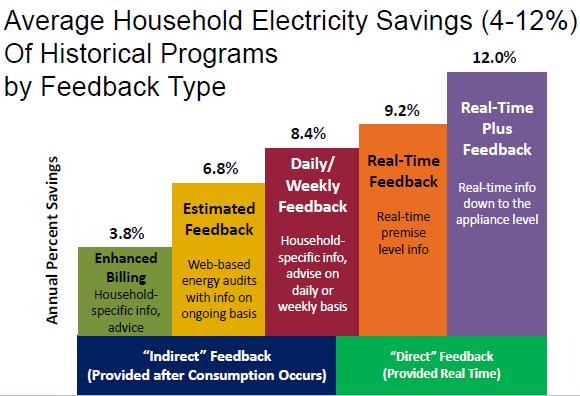
The red column above represents when the energy user receives information about the overall household use once a day or week. The purple column, on the other hand, displays the savings associated with receiving appliance-specific feedback while consumption is occurring. With this level of detail, you could turn off an appliance in your house and immediately see the impact it has on demand.
From this we can gather that consumers could save 12% on their energy bills which represents a 40% increase when you go from daily household data to real-time appliance-level data. While the marked difference is partially a result of timeliness, granularity is even more important. The significant jump in savings between the orange and purple column is solely a result of including the specific details of exactly how much energy your TV or washing machine is using at any given moment.
Why is this significant?
The EPA recently announced the Clean Power Plan, which for the first time ever, proposes limits on carbon pollution from power plants. If adopted, energy efficiency will increasingly serve as an important asset for utilities to cut their carbon emissions to meet these new regulations. They will need to find new means to nudge people into using less energy. One way to do this is to provide customers with energy use data that empowers them to make more efficient choices.
Furthermore, the electricity industry is currently undergoing rapid transformation, which will require a better information flow between electricity provider and user. Utilities should adapt and adopt the system that provides consumers the greatest control and oversight over their energy bill. By being able to compare the results of different types of consumer feedback, utilities can make more informed decisions that will better serve their customers as they transform.
With this kind of real-time feedback on our electricity choices, maybe we can finally shed those undesirable (and unnecessary) energy pounds.