






Climate 411

Overturning the Endangerment Finding would mean more pollution, more harm, higher costs

You may have seen the new study by the National Bureau of Economic Research – or, more likely, the New York Times story about it – that shows American homeowners are facing substantial and rapidly-rising home insurance premiums due to harms from climate-fueled extreme weather events.

The New York Times story, which includes state-by-state analysis, finds that rising premiums are placing severe financial burdens on Americans – doubling home insurance costs in some areas over the last several years, lowering home values by tens of thousands of dollars, and making it impossible for some Americans to purchase insurance at all.

This new reporting adds to a large and growing body of evidence showing that climate change is straining insurance, housing, and banking systems, and in turn posing financial risks to communities across the country.

At the same time Americans are facing these extensive and rising costs, the Trump administration has proposed to rescind EPA’s foundational Endangerment Finding – the bedrock determination that climate pollution harms public health and welfare – along with all of the climate pollution standards for motor vehicles that EPA has ever adopted. These reckless and deeply damaging actions will mean more pollution that is fueling extreme weather events, and thus even higher costs for Americans who are already facing runaway increases in home insurance premiums.

More pollution, more harm, higher costs

EDF’s analysis found that the Trump EPA’s proposed repeal of the Endangerment Finding and motor vehicle standards would result in as much as 18 billion more tons of climate-altering pollution as the cumulative emissions released mount over time. That’s the equivalent of three times the annual U.S. emissions today and would impose up to $3.9 trillion in climate harms on society.

Hundreds of thousands of Americans filed comments with EPA expressing strong opposition to the administration’s proposal to rescind the Endangerment Finding and the motor vehicle standards. Many of those comments underscored how it would only worsen the already high costs they are now suffering — including by raising insurance premiums.

Local, state, and federal elected representatives echoed their constituents’ concerns:

  • The U.S. Conference of Mayors and National League of Cities described how the extreme weather events are pushing up insurance premiums and contributing to falling home values.
  • The Mayor of Tacoma, Washington stated, “[the administration’s proposal] would lead to higher property and health insurance premiums that endanger the financial stability and health of families working day in and day out to achieve better outcomes.”
  • Eight members of Florida’s Congressional delegation similarly stated, “Thousands of Florida homeowners have seen their premiums double or triple in recent years. Climate risk is driving insurance companies to raise rates or withdraw from the state entirely – seven Florida insurers became insolvent between January 2022 and February 2023, disproportionately harming homeowners who are already struggling to make ends meet.”

The administration’s proposal will impose other significant costs on Americans

Rising insurance premiums and other extensive costs from climate-fueled extreme weather events are just one of the ways the administration’s proposal will make life more expensive for Americans.

It will also:

  • Raise gas prices – The Trump administration’s own analysis shows that the proposal will make gas more expensive, increasing gas prices by 25 cents per gallon in 2035 and 76 cents per gallon in 2050. The proposal will force Americans to spend up to $1.7 trillion more on gas.
  • Result in job losses: The administration’s Annual Energy Outlook analysis shows that repealing the Endangerment Finding and vehicle standards will cost 450,000 jobs across the nation by 2035. Those job losses have already begun to materialize as the administration has increased its attacks on clean energy and clean vehicles. EDF released a report last week documenting $25 billion in cancelled clean energy manufacturing investments thus far in 2025, with a loss of more than 34,000 anticipated jobs. In October alone, $3.9 billion in clean energy manufacturing projects were canceled and 6,700 anticipated jobs were lost.
  • Increase air pollution, harming health: The administration’s proposal would increase smog and soot-forming pollution that would lead to as many as 77,000 early deaths and 52 million more asthma attacks — health harms that would cost the nation as much as $260 billion.

If Trump EPA Administrator Lee Zeldin moves forward with this dangerous action, it would put more deadly pollution in our air and hit Americans in their pocketbooks with higher insurance, gas and healthcare costs. Overturning the Endangerment Finding and the motor vehicle standards would put millions of people in harm’s way.

Also posted in Cars and Pollution, Economics, Jobs, News, Policy / Authors: / Comments are closed

The Science Is Clear on the Dangers of Planet-Heating Pollution

This post was co-authored by EDF Climate Scientist Fiona Lo and was updated on Aug. 7, 2025.

The Trump EPA is trying to reverse the Endangerment Finding – the science-based determination that climate pollution harms public health and welfare. That’s in spite of mountains of scientific evidence confirming that climate pollution is driving extreme weather events and putting people at risk.

The scientific evidence was clear that climate pollution endangers public health and welfare when EPA issued the Endangerment Finding in 2009 – but it is even clearer now:

Read More »

Also posted in Basic Science of Global Warming, Extreme Weather, Greenhouse Gas Emissions, News, Policy, Science, Setting the Facts Straight / Authors: / Comments are closed

An Executive Order is attempting to interfere with ironclad state authority to protect people from pollution

States have broad and bedrock authority to protect people from pollution – and President Trump’s Executive Order issued yesterday instructing the Attorney General of the United States to interfere with foundational state prerogatives to protect people from harm cannot change that.

The Executive Order was one of four the President signed yesterday. It is revealing that this order attacking state action came in tandem with another Executive Order that showcased his efforts, certain to fail, to force the American people to use expensive and high-polluting coal. That coal order would make President Trump squarely responsible for imposing a massive tax on the American people in the form of higher energy prices, as it is well established that coal power is costly before even factoring in its roles in contributing to deadly soot and smog and in fueling the deadly fires, heat waves, and storms caused by climate change.

Read More »

Also posted in California, Cities and states, News, Policy, Setting the Facts Straight / Authors: / Comments are closed

Danger ahead: the Trump administration’s attack on EPA’s finding that climate pollution harms public health

On his first day in office, President Trump issued dozens of executive orders attacking the nation’s climate and clean air protections.
Buried in one of these orders is direction to the Environmental Protection Agency to make recommendations by February 19th on the “legality and continued applicability” of EPA’s Endangerment Finding.

The Endangerment Finding is EPA’s science-based determination that greenhouse gases – the pollution that causes climate change – harm public health and welfare.

The directive to reconsider the Endangerment Finding comes straight from Project 2025 and is both cynical and deeply concerning given the mountain of scientific evidence supporting the Finding, the devastating climate harms Americans are experiencing right now, and EPA’s clear obligation to protect Americans’ health and welfare.

Shortly after receiving President Trump’s directive, EPA’s acting Administrator summarily fired the agency’s independent Science Advisory Board – the very scientists who can speak to the extensive scientific basis supporting EPA’s Endangerment Finding.

The real-world consequences of any effort by EPA Administrator Lee Zeldin and the Trump administration to destabilize the Endangerment Finding would be severe and unlawful and would hurt Americans across the country.

What is the Endangerment Finding?

In 2007, the Supreme Court determined that greenhouse gases are air pollutants within the unambiguous meaning of the Clean Air Act and that EPA must make a science-based determination as to whether greenhouse gas pollution endangers public health and welfare.

Following the Supreme Court’s decision, in 2009, EPA issued the Endangerment Finding, which determines that climate pollution threatens the public health and welfare of current and future generations.

Here are a few things you should know about EPA’s finding:

It’s supported by extensive science

The Endangerment Finding is based on a vast amount of scientific evidence that climate pollution harms human health. It was adopted after extensive public process, including multiple opportunities for public input and evaluation of more than 380,000 public comments.

The final Endangerment Finding includes detailed information confirming that greenhouse gas pollution is driving destructive changes in our climate that pose a grave and growing threat to Americans’ health, security, and economic well-being, both now and in the future. These include health harms from increased smog, rising temperatures and extreme weather events, among other things.

Over time, the scientific evidence has only become stronger. The intergovernmental expert body charged by Congress with assessing the impacts of climate change on the United States has issued a series of National Climate Assessments, most recently by the Trump Administration in 2018 and the Biden Administration in 2023. The National Climate Assessments confirm that climate change resulting from greenhouse gas emissions is causing extensive, and increasingly severe harms throughout the country.

EPA has also continued to document the science behind greenhouse gases’ contributions to climate change, including in earlier responses to requests that it reevaluate the Endangerment Finding (here and here) and in multiple actions establishing pollution standards for power plants, cars and freight trucks, and oil and gas facilities – some of which include scientific assessments that were completed within the last year.  And in legal filings supporting these actions, climate scientists have pointed to very recent scientific evidence that even more strongly confirms these climate pollution harms.

In short, the science unequivocally supports what so many Americans are already experiencing – climate pollution is causing harm in communities across the country. There is no question about the Endangerment Finding’s “continued applicability.”

Courts have repeatedly affirmed its Legality

Unsurprisingly, given the extensive evidence supporting it, courts have uniformly rejected legal challenges to the Endangerment Finding.

For instance, the finding was upheld by the D.C. Circuit Court of Appeals in 2012. Industry groups had challenged EPA’s use of scientific assessments, but the court held that EPA’s findings were supported by substantial evidence and that the agency had considered the scientific evidence before it in “a rational manner.”

Then the Supreme Court denied petitions for certiorari (review) that raised challenges to the Endangerment Finding in October 2013.

More recently, the D.C. Circuit again rejected challenges to the finding and the Supreme Court again denied review.

The findings have been the basis of agency decisions across administrations of both parties and have been the basis of numerous judicial decisions. As to the Endangerment Finding’s “legality,” the answer is also a clear and unequivocal “yes.”

Commonsense steps to cut pollution, protect communities

Beyond being grounded in the science, law, and the everyday experience of many Americans, the Endangerment Finding is important because it empowers EPA to do its job – protecting Americans from harmful climate pollution.

EPA has done just that since adopting the Endangerment Finding by taking commonsense steps to reduce climate pollution from large sources like power plants, cars and trucks, and oil and gas operations. These actions have been enormously successful in reducing pollution and delivering immediate benefits to Americans across the country.

It is vital that these commonsense measures remain in place. Recent EDF analysis looks at 11 key actions (including the foundational EPA climate protections mentioned above) that together will reduce more than 28 billion metric tons of climate pollution by 2055. That’s almost five times the total amount of annual emissions from the United States today.

New threats to the Endangerment Finding

President Trump’s efforts to reverse the Endangerment Finding come straight from Project 2025 – the infamous policy playbook crafted in part by Russell Vought, the new head of the White House’s Office of Management and Budget. Targeting the Endangerment Finding is extreme, dangerous, and puts the important benefits mentioned above at risk. It also goes well beyond anything the first Trump administration undertook.

Undermining the Endangerment Finding would be inconsistent with the commitments EPA Administrator Zeldin made during his confirmation hearing. Despite EPA’s recent dismissal of its independent Scientific Advisory Board, Administrator Zeldin affirmed that “I am someone who believes strongly that we should work with the scientists, leaving the science to the scientists … Fortunately, at EPA, we do have many talented scientists who provide that research.” (Senate EPW Committee transcript page 34) He repeatedly committed to “honoring our obligations under the law,” and said that “we will have never done enough to ensure that our water and our air is clean, safe, and healthy. Whatever we do every day to achieve this objective, we need to wake up the next day looking for ways to do more.” (Transcript page 37)

It is simply not possible to square these statements with any effort to destroy a science-based finding, affirmed by the courts, that provides the foundation for EPA’s efforts to protect Americans’ health and well-being from harmful climate pollution today and going forward.

For more information, please see the letter and appendix of relevant documents EDF recently sent to EPA on the Endangerment Finding.

Also posted in Basic Science of Global Warming, EPA litgation, Greenhouse Gas Emissions, News, Policy, Science / Authors: / Comments are closed

Advanced methane technologies can strengthen new landfill pollution limits

(This post was co-authored by EDF’s Peter Zalzal)

When organic waste ends up in landfills, it produces methane — a powerful climate pollutant —as it decomposes.

In the U.S., landfills are our third largest source of methane and a major driver of climate change. They also emit large amounts of health-harming and even cancer-causing pollution, such as toxic benzene, that endangers nearby communities. And to make matters even worse, they cause noise and odor problems.

Recent scientific studies indicate that landfills may be an even greater source of pollution than we thought. A study led by scientists at Carbon Mapper and recently published in the journal Science surveyed 20% of open U.S. landfills and found significant point source emissions at the majority (52%) of sites.

Earlier work based on data from the TROPOMI space satellite looked at 73 landfills and found their pollution was, on median, 77% more than what was reported to EPA’s Greenhouse Gas Reporting Program.

Advanced methane monitoring technology has developed rapidly in recent years, creating new opportunities to substantially reduce harmful pollution from landfills. EPA’s recently finalized oil and gas standards allow operators to deploy these technologies, such as aerial flyovers and drones, to find and fix methane leaks.

Building from this work, EPA now has a vital opportunity to incorporate advanced technologies into new landfill rules.

Read More »

Also posted in Greenhouse Gas Emissions, Innovation, News, Policy / Comments are closed

We need to close a mercury pollution loophole for lignite coal plants

(This post was co-authored by EDF attorney Richard Yates)

The Environmental Protection Agency is soon expected to update our national protections against mercury and other toxic pollution from coal-fired power plants – pollution that is extremely dangerous to human health and has been linked to brain damage in children.

EPA proposed strengthening the Mercury and Air Toxics Standards and closing a loophole for lignite coal and is expected to issue its final update soon. EDF has found that, even as we have made great progress in reducing mercury pollution overall, the lignite coal loophole leaves parts of the U.S. at especially high risk.

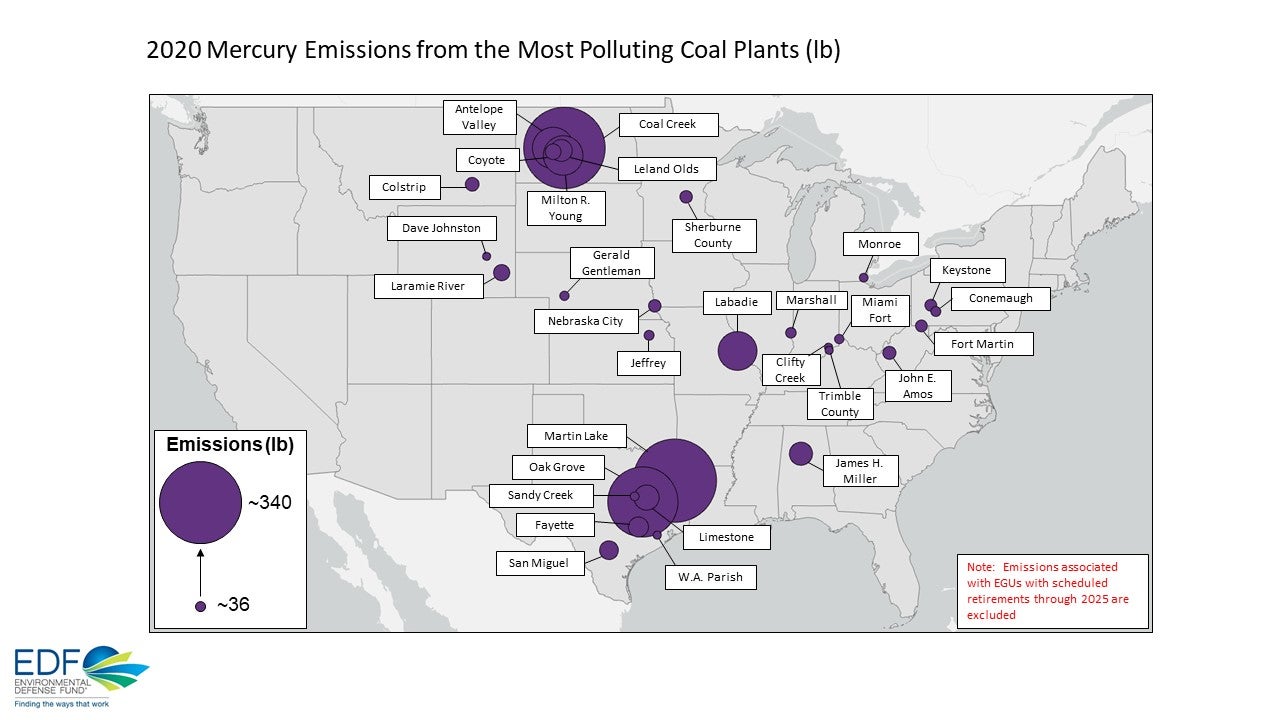
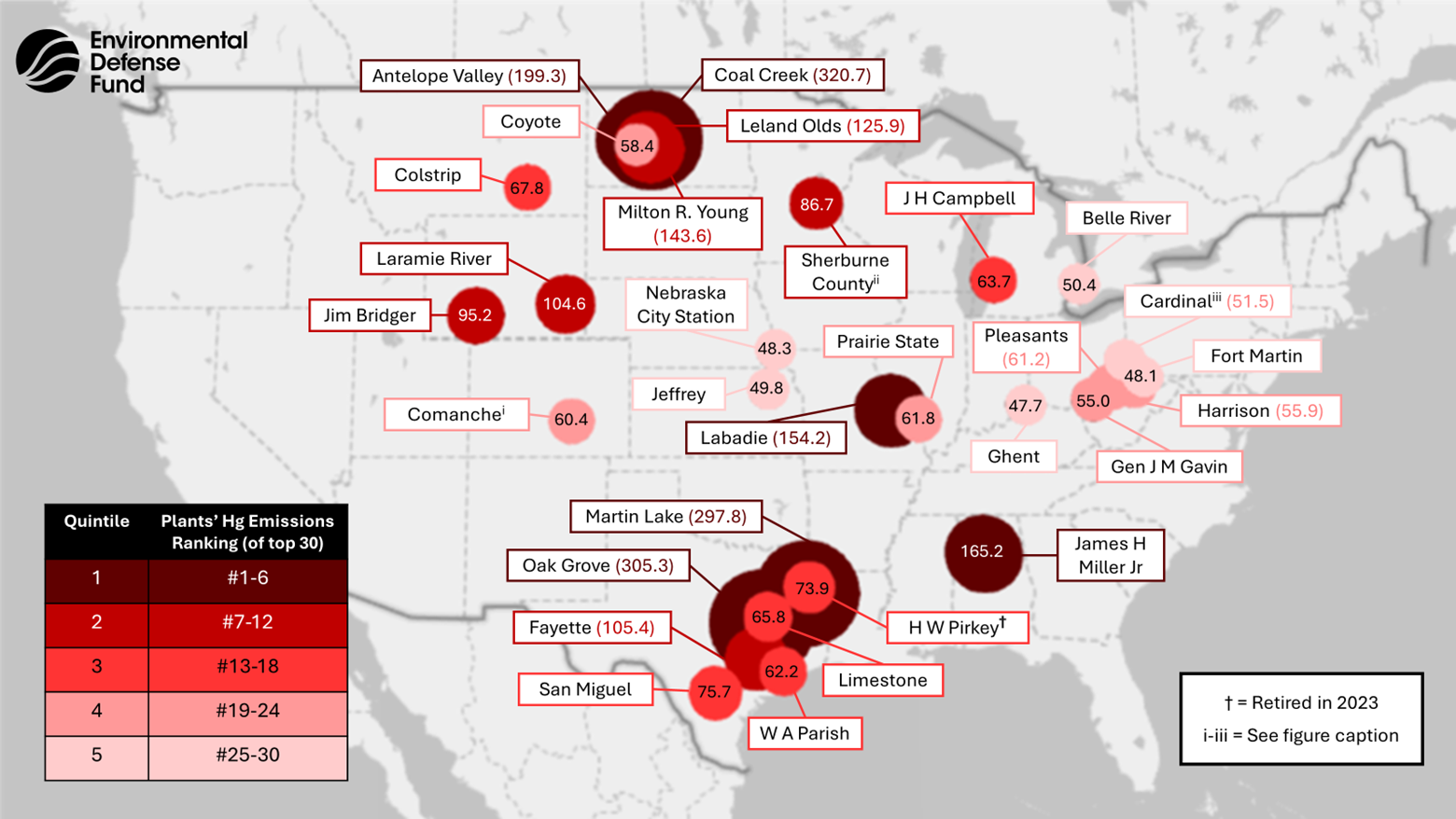
Mapping Big Mercury Polluters

[(i) The owner/operator of the Comanche plant in Colorado has announced its intention to retire unit 2 by 2025 and unit 3 by 2030; unit 1 retired in 2022. (ii) The owner/operator of the Sherburne County plant in Minnesota has announced its intention to retire unit 1 by 2025 and unit 3 by 2034; unit 2 retired in 2023. (iii) The owner/operator of the Cardinal plant in Ohio has announced its intention to retire unit 3 by 2028; units 1 and 2 have no scheduled retirement dates. (Data: EPA’s Clean Air Markets Program Data; EIA’s 2022 Form EIA-860 Data – Schedule 3)] 

Two years ago, EDF published a map of the top 30 mercury-polluting power plants in 2020 across the United States. We have now refreshed this map based on data from 2022, and you can see the results above.

Read More »

Also posted in Health, Indigenous People, News, Policy / Comments are closed