Category Archives: Water

In Texas, Freshwater Use For Oil And Gas Should Be Reduced Strategically

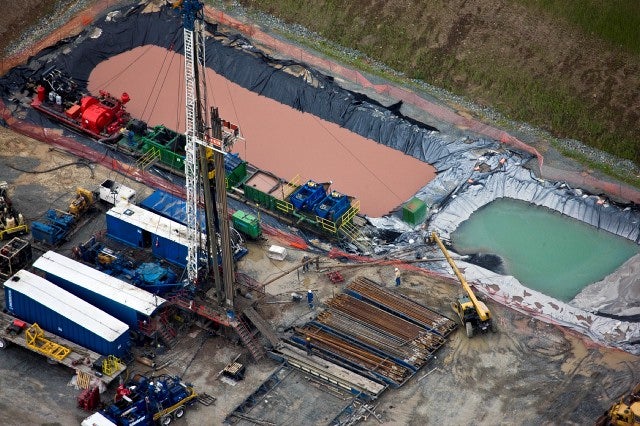
Texas is suffering from a water deficit; one that is spurring lawmakers at the Texas Capitol to discuss unprecedented, and much needed, investments in our water infrastructure.  With roughly 98 percent of the state in drought and water use restrictions in place in 70 percent of Texas counties as of April 3, 2013, it is crucial that our legislators consider every tool available to protect Texas’ water supply.  One approach is reducing freshwater use in the oil and natural gas sector, which can help alleviate competition for scarce water resources; however, this should be deployed at strategic places and times to minimize pollution risks and ensure a sustained future water supply for Texas.

In the Texas Legislature, the House recently passed a bill which will provide $2 billion to fund water supply projects.  It might surprise you to hear that this high price tag represents less than 10 percent of the state funding that will be needed over the next 50 years to sustain water supplies for Texas’ growing population.  In light of this, it is essential that legislators enact bills that encourage responsible water management solutions. Although the oil and gas industry’s water use appears miniscule when considered on a statewide basis, even small amounts can have a big impact in the most water stricken areas. EDF created a map of the counties in Texas currently being impacted by water scarcity and that would benefit greatly if the oil and gas sector reduced its use of freshwater.

Data used to create the map revealed the following:

  • The majority of water used for Texas oil and gas development in 2011 was in 13 counties, ten of which currently have water restrictions in place.
  • For 12 counties, oil and gas water use made up at least 25 percent of overall county-wide demand in 2011.
  • In 15 counties, oil and gas water use is projected to be greater than or equal to 25 percent of the water deficit in those counties in 2020.
  • In five counties, 100 percent of the water deficit projected for 2020 can be met by cutting oil and gas water use by half.

The oil and gas industry is a prime candidate for reducing its reliance on freshwater because – unlike the agriculture and municipal sectors – using non-freshwater is technologically feasible.  Some of the most popular alternative water sources for the oil and gas industry include brackish (or salty) water, treated flowback water from hydraulic fracturing and reclaimed water from public wastewater treatment plants.  Taking advantage of these options could be a win-win-win for industry, people and the environment. Read More »

Also posted in Natural Gas, Texas | Comments closed

New Thinking Is Critical To Better Manage Water And Electricity Resources In Texas

Central Texas Workshop Discusses Opportunities For Resiliency During Extreme Weather Events

This commentary was originally posted on our Texas Clean Air Matters blog.

Last week, I attended a regional workshop that focused on adapting to extreme events, sponsored by the U.S. Environmental Protection Agency (EPA), the National Oceanic and Atmospheric Administration, the Water Environment Research Foundation, the Water Research Foundation, Concurrent Technologies Corporation, and Nobilis. This workshop was the sixth in a series organized around the country to determine what is needed to increase the resilience of water utilities and communities in the face of extreme weather events. While the focus was on water, time and again, electricity was brought into the conversation—the two are closely linked, and in Texas, a state facing shortages of both water and power, this will require some creative thinking on our part.

This workshop focused on Central Texas, in particular our drought. But as the two-day workshop went on, it became clear to the organizers when local water utilities and other stakeholders spoke, that drought was only one extreme event that Texas has had to deal with…and continues to deal with. We are a state of extremes—weather, politics, personalities—and we not only have drought to handle, but also hurricanes, floods, tornadoes, wildfires, and just generally scorching heat. One of the first speakers was John Nielson-Gammon, the State Climatologist based out of Texas A&M University. He confirmed that while these natural phenomena are not new to Texas, we are experiencing more intense weather events. Last year was one of the hottest in Texas since we started recording temperatures, and we are heading into the third year of a pretty gruesome drought. Not being prepared for extreme events to get worse seems pretty foolhardy.

During the workshop, we heard from a variety of speakers from around the Central Texas region, including from the Barton Springs/Edwards Aquifer Conservation District, the Lower Colorado River Authority, rice growers, the University of Texas, the high tech industry, and individuals from Austin, San Antonio, and Bastrop. These people are dealing first hand with the impacts of the extreme events we’ve had in the past few years. They are simultaneously trying to manage the current situation while planning for what the changing climate means in the coming years. It’s a difficult balancing act.

As an outsider to the planning process, I was asked to report on the proceedings of a meeting at the end and to give an overview of my impressions of the workshop. My impressions were as follows:

It is crucial to balance short-term preparedness with long-term resiliency, and neither should be sacrificed at the expense of the other. Planners in Central Texas know how to handle floods, fires, and drought, but the intensity of these natural phenomena will likely increase with the effects of climate change. It’s also essential to ensure that we are protecting our water and electricity needs for the long-term.

There is tension between urban and rural needs. This is not a new concept, and it is particularly tense with regards to water needs. Often the decisions about water and electric needs are made in cities, and city dwellers may think of rural needs only in the abstract. But protecting the quantity of water available for farmers and ranchers is how we feed our urban populations. Some cities in Central Texas are, out of necessity, dealing with this issue. In the wake of the wildfires in Bastrop, planners in that area are taking a closer look at how homes are constructed and how the urban/rural interface affects the ability to provide water for its population and prevent future wildfires. Controlled burns are one way that wildfires are prevented, but you can’t do controlled burns in a subdivision built into a forest. Thinking about developing our communities in more thoughtful ways is critical.

Adapting to our changing climate necessarily includes water, but it also goes beyond water. Emergency preparedness must include ensuring adequate water supplies and electricity. We can envision extreme events in Austin because we’ve had them in the past: fatal flooding, tornadoes, wildfires, drought, and heat waves. These extreme events will likely intensify as climate change advances, and we need to be comprehensive in our planning. We know that we’re facing potential electricity shortages within the next three years, and water supplies are already stressed. We also have to take into consideration whether our current infrastructure can maintain our growing population, especially in the face of future extreme events, and what those events mean in terms of health impacts. Many evacuees from Hurricanes Katrina, Rita and Ike were dehydrated and fell sick, and healthcare workers across the state responded heroically. We should anticipate more vulnerable populations in the wake of extreme events in the future. Read More »

Also posted in Energy Efficiency, Texas | Comments closed

When We Save Energy In Texas, We Also Save Water

Last week, the Texas Coalition for Water, Energy and Economic Security (TCWEES), of which EDF is a member, held a legislative briefing at the Texas Capitol titled Energy & Water, Dollars & Sense: Improving security and maximizing benefits to Texas businesses and residents. The briefing focused on the nexus of water and energy, and furthered the idea that where you save energy, you save water too. The briefing included a panel discussion and a question and answer session. 

State Representative Lyle Larson from San Antonio welcomed attendees, a speaker that is well-suited to talk about water issues. Before becoming a state legislator, he served on San Antonio’s City Council, a city with one of the best water conservation programs in the country. Representative Larson started with an interesting point: In addition to the physical issues of water scarcity, we also need to resolve the psychological issues of water resources.

People simply do not think of water as a scarce resource, despite the multi-year droughts we’ve seen in Texas. Addressing water scarcity has been done in much the same way as system-wide power shortages: in a short term, reactive way, rather than a long term, proactive way. And we will never be able to meet our energy or water needs of our growing populations by being short-sighted.

Representative Larson said that water is the number one impediment to business no matter where you are in the world. Water-rich countries will take American jobs if we can’t address our scarcity, and water-rich states will take Texan jobs. We don’t deploy best management practices in this state when it comes to water. And calling for more water infrastructure is great, but conservation is going to save significantly more water than new infrastructure will. Read More »

Also posted in Energy Efficiency, Texas, Texas Energy Crunch | Tagged , , | Comments closed

A Red Flag On Disclosure Of Hydraulic Fracturing Chemicals

It’s not often that a new regulatory idea becomes so popular that one or more states per month climb on the bandwagon. But that is precisely what has happened with the push to disclose which chemicals are pumped into the ground to stimulate oil and natural gas production during the process known as hydraulic fracturing, or "fracking."

A year ago, only three states (Arkansas, Montana and Wyoming) required oil and gas producers to tell the public what chemicals they were using. Two other states (Colorado and Texas) were actively developing such rules. Today, just twelve months later, statutes or regulations mandating “frack” chemical disclosure are on the books in no fewer than 18 states, and proposals are pending or under consideration in several others.

FracFocus, an online registry that compiles information on hydraulic fracturing chemicals both for states where disclosure is voluntary and required, has been up and running for just 20 months, but already it houses approximately 800,000 records that include ingredients data. As of December 5, 2012, this data represented 33,606 wells. The amount of information on the site continues to grow rapidly.

It is impressive that so much information has been made available in such a short time. Still, people have begun to wonder whether the disclosure rules are accomplishing what was intended. The question is important because rules that aren’t working need to be changed. A good regulatory system is based on a process of continual improvement, not a naive idea that the rulebook can be written in a way that will never need changing.

Unfortunately, judging from early press reports, there are quite a few bugs in the system. To be fair, the reporting requirements are quite new and still being implemented — and analysis of the data has barely begun. But  problems are emerging. The issue receiving the most media attention is the sheer number of trade secret claims. Read More »

Also posted in Chemical disclosure, EPA, General, Natural Gas, Texas | Tagged , | Comments closed

Postcard from Mark Brownstein in Ramallah, Palestinian Territory

Many environmentalist believe that the ideal landscape is one untouched by human hands, and we fight tenaciously to protect unspoiled places from all manner of intrusion.   Yet sometimes landscapes are inspiring precisely because of human action.  Etched upon the Judean Hills is evidence of over a millennium of human activity, and this ancient record enhances their beauty.  The biblical origins of environmentalism are found in Genesis 2:15 where God places man in the Garden of Eden to till and tend it, and driving through hills lined with ancient terraces you can almost hear the voices of a thousand generations whispering “amen.”

I believe that Thoreau was the first to offer the idea that a walk though unspoiled nature restores our souls, but no matter who first said it, I believe it.  But I also believe we were not put on this earth only to contemplate it, and so, how we choose to make use of nature is as important to our spiritual health as the fact that we appreciate it. 

On the outskirts of Ramallah, in the Palestinian Territories, the planned community of Rawabi is rising from the Judean Hills.  When you first arrive there it looks like any other construction site, and you recoil at how significantly the landscape is being scraped and shaped for what looks like just another housing development in the middle of the wilderness.  You recoil, that is, until you meet Amir Dajani, a large, jovial man, who is deputy director of what is this large project.  Dajani talks like a man on a mission, and he is.  The purpose of Rawabi is to establish a town that, in all respects, reflects a new and progressive vision for a Palestinian state.  Rawabi is being developed according to a master plan that takes into consideration all aspects of what makes for a quality life.  The vision statement for the development is “live, work, grow” and this reflects the fact that the developers are thinking about all aspects of what makes for a liveable community, and they are taking steps to ensure that this is a place where Palestinians of different ages, religions, and occupations can build a comfortable and secure life.  The hope is that Rawabi becomes a replicable model for building other similar communities on the West Bank.

Sustainability is at the heart of everything being done at Rawabi, from the site plan that honors the natural contours of site to the buildings which are efficient and make use of the ample solar energy available in the region.  Waste water will be fully recycled to support location-appropriate greenery, and smart grid technology will be deployed to help manage water and energy use.  Rawabi will be a city with free public transportation and a walkable town center where cars will not be required.  For those who believe that smarter land use is a necessary aspect of a sustainable, low carbon future, Rawabi is an exciting experiment in the making.

But perhaps most remarkable is how the Palestinian developers are reaching out to Israeli Jews for advice on the design and development of this project.  Israel itself was inspired by a utopian vision of a better future, and hopefully there is some healing that comes from Jewish expertise and experience helping to lay the foundation of an environmentally and economically sustainable Palestinian state alongside the Jewish one.  There are a thousand reasons why this all ultimately may not work, only some of which pertain to the environmental challenges being tackled here.  But the hope is that in tilling and tending this bit of earth properly, the seeds of a better future will begin to blossom for everybody.

This will be my last post card.  Tomorrow we spend time at the Yad Vashem Holocaust Memorial and tour the Old City of Jerusalem, both of which are infused with much personal meaning, but something I’ll choose to keep private. 

L’hitraot, chaverim.  Looking forward to seeing you all stateside.

Also posted in Smart Grid, Solar | Comments closed

Postcard From Mark Brownstein In Sderot, Israel

(Credit: www.allnumis.com)

“Remember, when you hear the siren, you have 15 seconds to find cover.”  Such is life in the southern Israel town of Sderot only a few kilometers away from the Gaza Strip.  Fortunately, for my tour, today’s rocket attacks fell on the outskirts of town and did not affect our visit.  Israelis often point to such events as the reason why environmental issues are often not very high on the public policy agenda.  How hard is it to spend any time thinking about global warming, when there are more tangible and immediate threats confronting you?

And yet, global warming is having an immediate and tangible impact here as well.  Our visit to Sderot came after a tour of Israel’s largest desalination plant located in the neighboring town of Ashkelon on Israel’s Mediterranean coast.  Israel is chronically short of water, consuming 2 billion cubic meters of water per year where the nation’s natural hydrology is capable of producing, on average, 1.2 billion cubic meters per year, according to Abraham Tenne, head of the Desalination Division of the Israel Water Authority.  Mr. Tenne was blunt in reporting the facts.  The Israel Water Authority expects average rainfall to decline by 15 percent by 2040, while Israel’s population is expected to continue to grow by 1.7 percent each year.  The drought of 2008, where rainfall was only 65 percent of the current average, was a powerful reminder that today’s water situation is bad, and unchecked, it will only get worse. 

Mr. Tenne is understandably proud of the building or upgrades to Israel’s three desalination facilities, which are key to solving the problem, but he is quick to remind us that, as important as this technology is to Israel’s future, it is a last resort.  Israel’s consumption of 2 billion cubic meters of water by a population of roughly 8 million stands in sharp contrast to Arizona’s consumption of 8 billion cubic meters of water by a population of roughly 7 million.  He visited Arizona last year for an international water conference where he was asked to speak on desalination, and was shocked to see flood irrigation – the practice of watering crops by flooding the field – commonly practiced.  He contrasts this with Israel, where drip irrigation is standard practice for 95 percent of all agricultural production, and where the amount of water used is precisely controlled by technology that monitors the moisture at the root of the plant, delivering only what is required to maintain healthy growth.  He then tells us about London, which just inaugurated its first desalination plant, while doing little to fix the local water system where 40 percent of the water flowing through the system is lost to leaks.  And then, for the second time in two days, I hear of smart grid technology being deployed in Israel to pinpoint leaks.

Although recent discoveries of significant natural gas reserves off the Israeli coast suggest that Israel may be able to completely wean itself off coal, over 35 percent of the nation’s installed electric generation capacity comes from coal-fired power plants, including one right next door to the Ashkelon desalination plant we visited today.  But even when the desalination process is driven by natural gas-fired power plants, as this facility is (it generates its own electricity and actually sells some excess production back to the grid) the fact of the matter is that Israel’s total water system – not just desalination, but the pumps necessary to move water around the country – consumers 6 percent of the total electricity produced in Israel.  Thus, the battle to conserve water is also a battle to save energy, which in turn is a battle to avoid carbon emissions that contribute to global warming, and make Israel’s water situation worse.

We are spending tomorrow with some of Israel’s leading experts in solar energy, but already I am wondering why a nation so obviously blessed with ample, strong sunlight, seems to have so little invested in deploying solar power.  Solar hot water heaters have been required here since 1980, and as my friend, and EDF consultant, Roger Duncan, often reminds me, solar hot water heating is often the most overlooked cost-effective solar technology, but given Israel’s pressing challenge of finding both secure and sustainable supplies of electricity, the government’s policy of 10 percent renewable energy by 2020 seems incredibly modest.  A nation with the determination and technological prowess to erect the world’s most sophisticated missile defense system surely should be able to do better and tomorrow will be about finding out why not.

Also posted in Natural Gas, Renewable Energy, Smart Grid, Solar | Comments closed

A Texas Coalition for Water, Energy and Economic Security Briefing: The Drought Threatens Texas’ Power

(Source: www.businessinsider.com)

This commentary was originally posted on the Texas Clean Air Matters Blog.

On Thursday, February 2, the Texas Coalition for Water, Energy and Economic Security (TCWEES), which includes Environmental Defense Fund and other stakeholders in the environmental and business community, held a legislative briefing discussing the impact that the drought could have on power in Texas. This is the first of a series of TCWEES-hosted, educational events focused on energy efficiency that will be held around the state during the legislative interim.

The speakers at the briefing included:

  • Dr. John Nielson-Gammon, Texas State Climatologist and Regents Professor of Atmospheric Science at Texas A&M University
  • Dr. Carey King, Research Associate at the Center for International Energy and Environmental Policy at the Bureau of Economic Geology at University of Texas at Austin
  • Mark Armentrout, President and CEO of Texas Technology Partners; former chair of ERCOT
  • Cris Eugster, EVP and Chief Sustainability Officer for CPS Energy (San Antonio)
  • Kevin Tuerff, Principal and President of EnviroMedia

In 2011, Texas experienced record heat and drought and the electric grid was stressed as a result. Though the Electric Reliability Council of Texas (ERCOT) took a proactive approach to dealing with the crisis, the potential still remains for economic loss caused by electric generation outages related to heat and drought. The drought is predicted to continue and action is needed to protect Texas’ power and economic viability. Given that it can provide the same amount of service while using less electricity, energy efficiency should be a significant part of the solution. Energy efficiency reduces waste, electric bills, emissions and water use needed for electric generation.

During the briefing, Dr. John Nielson-Gammon brought up the recent rain in Texas. He said that while the rain is great for taking people’s mind off the drought, it is not useful for setting us up for the summer of 2012 because it’s too little too late for our current situation. He added that climate change is an important enough factor in the drought that it must be considered in long-term water planning.

(Source: www.droughtmonitor.unl.edu)

Texas State Representative Donna Howard was in attendance and she posed a question about better coordination between state agencies. Though there is some coordination, there is no actual coordinated plan among and between state agencies to be thoughtful about planning for Texas’ future water and energy needs. Dr. Carey King pointed out that both the Texas Water and Development Board and the Texas Commission on Environmental Quality work on water issues, but it isn’t clear how power plants fit into water priorities. He stated that we don’t have an answer and that we need a better understanding of the breadth and depth of water issues.

The key takeaways from this briefing are that water and power are inextricably linked and the stress that the drought has had, and will continue to have, on our ecosystems and electric systems is a serious concern. This is not something that will go away as the climate will continue to change. Cleaner energy sources and greater energy efficiency will cut carbon pollution and help stabilize the climate, protecting our land, water, air and health. We need to find solutions now.

Also posted in Climate, Texas | Comments closed