Climate change solutions
We deliver game-changing environmental solutions that have a real impact for people around the globe.

Building resilient land and water systems that allow people and nature to prosper in a changing climate.
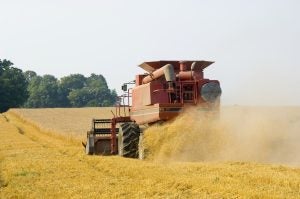 Journalist Michael Pollan deserves credit for elevating the national conversation about food. Over the course of 25 years, his articles and books have thoughtfully contemplated the troubling side effects of the American diet and the way our food is produced.
But his latest piece in the New York Times Magazine reads like a script for a black and white Western, with food companies, agribusiness and commodity producers cast in the role of Bad Guy and local organic farmers and vegans cast as the Men in White Hats.
In Pollan’s script, the bad guys are responsible for everything from America’s weight problem and rising health care costs to widespread environmental degradation and monocultures that threaten national security. If only the law would get on the good guys’ side, he muses.
Food production is actually changing
All industries have issues that continually need to be addressed, and the food industry is no exception.
Agriculture consumes a lot of land and water and emits greenhouse gas emissions that must be curbed. And, yes, our diets have contributed to America’s obesity epidemic.
Except, our food system is changing, more than Pollan acknowledges.
The uptick in consumer demand for local, organic products is promising. So, too, are the contributions that Pollan’s so-called villains – the companies, agribusinesses and commodity farmers who produce what’s on our plate – are making to the environment. They deserve recognition. (more…)
Early adopters of innovative land-based conservation measures are rarely given an adequate reward for participating in agricultural carbon markets. But that’s all about to change, thanks to a nearly $1.2 million USDA Natural Resources Conservation Service Conservation Innovation Grant (CIG) that will leverage private capital investment into agricultural carbon offset practices and ensure that producers are paid for their efforts.
These efforts will guarantee the sale of at least 100,000 tons of credits over the next three years. Here’s how it will work. (more…)

Prudent investors know to keep a few key things in mind. They anticipate the timing of spending priorities, like retirement, and evaluate investment risk accordingly. They might spread resources across funds to meet different objectives. And of course, they look to maximize their return on investment.
Why shouldn’t these same principles apply to investments in our natural resources?
Thanks to a new bill signed into law by Governor Jerry Brown, these principles will now apply to regional conservation investment strategies for wildlife and other resource management activities in California.
AB 2087: A new approach to conservation planning and mitigation
Assembly Bill (AB) 2087 (Levine), will establish voluntary, non-regulatory strategies to help conservationists, local agencies and the state apply core investment principles when planning conservation or mitigation projects.
This legislation comes at a critical time. Expanding development in California has supported a growth in food production, flood protection, transportation and housing, but it has also resulted in various impacts on the environment. The loss and fragmentation of wildlife habitat, in particular, has created a need for the state to restore and maintain at least 600,000 acres for multiple at-risk species in the coming decades. (more…)

We often hear about the deep-rooted water quality challenges in the Chesapeake Bay, and how not enough progress is being made. While agriculture, urban/suburban runoff, vehicle emissions, and other sources share responsibility for the bay’s poor health, all too often farmers shoulder most of the blame.
Earlier this month, USDA released the Chesapeake Bay Progress Report, which revealed that since 2009, federal investments helped area farmers implement nearly $1 billion worth of conservation practices on more than 3.5 million acres and install nearly 3,500 miles of riparian buffers that reduce nutrient runoff into waterways. Between 2006 and 2011, farmer efforts reduced sediment loss by 15.1 million tons per year.
This is encouraging news, and part of the reason the overall health of the bay is improving. Supporting farmers and their livelihoods is key to solving the watershed’s environmental challenges. As the report notes, “a thriving and sustainable agricultural sector is critical to restoring the bay.”
There is still a lot of work to do. Because a significant increase in public funding is unlikely, relying too heavily on federal investment in voluntary conservation programs is not a good pathway to fully heal the bay.
Here are two ways that agriculture can further accelerate improvements in the watershed. (more…)
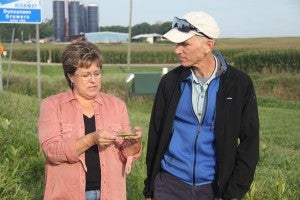
Duncanson Growers is a family farm located in the heart of southern Minnesota. Owners Kristin and Pat Duncanson produce pork and grow corn, soybeans and vegetable peas on the farm, with a commitment to sustainable practices that improve the quality of their land. But it’s not just about environmental sustainability.
“We also need to maintain and increase our productivity to be economically sustainable,” Kristin said.
The Duncanson family has been committed to sustainability not only through their own farming operations, but also through outreach and education efforts. I recently paid a visit to the family’s farm, where just the night before they had hosted 30 college students for dinner, recognizing the importance of communicating their sustainability practices to others.
In addition to their current practices, which include improving data collection to increase fertilizer efficiency, reducing tillage where possible and rotating crops, the Duncansons have also maintained some very high quality habitat for monarch caterpillars and butterflies. (more…)
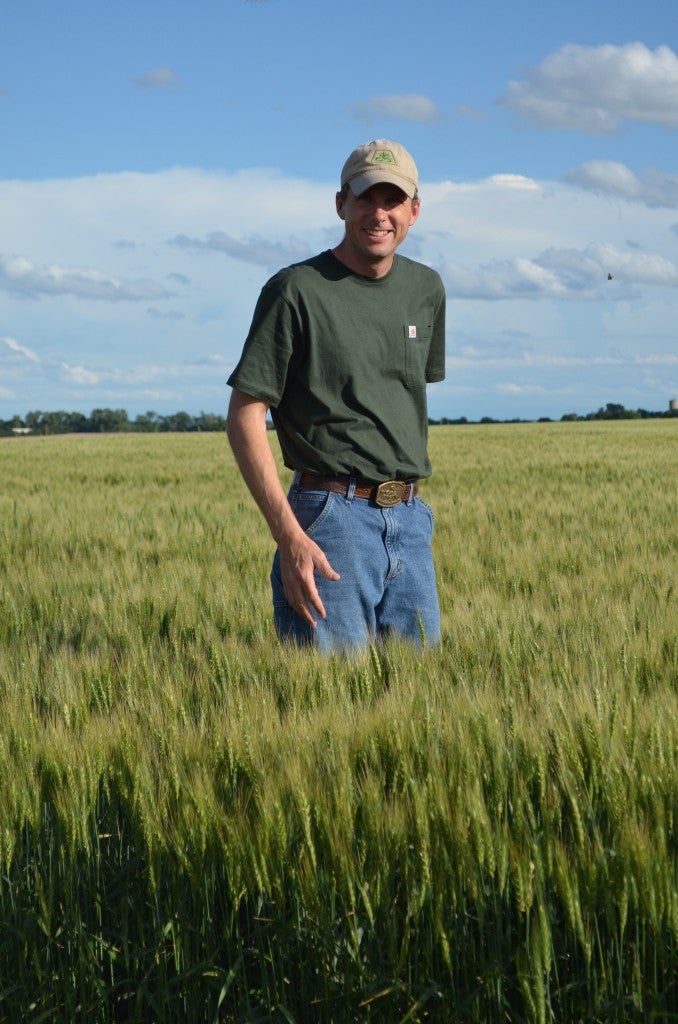 I first met Justin Knopf at a meeting in DC about five years ago. At 6’3”, he definitely stood out, but not just physically. He openly conveyed how important his family and his land are – the reason he cares so much about making sure his Kansas farming operation can live on is for his children. It’s rare to meet someone so articulate, sincere and committed to sustainability.
Over the years, I have become more and more impressed by Justin, who started farming at age 14 when his father gave him the means to rent land and buy seed and fertilizer.
Fast forward to today, and Justin is one of the country’s champions of no-till farming – a practice that has boosted his yields and made his crops more resilient to the effects of extreme weather. His dedication and success caught the attention of Miriam Horn, author of the new book Rancher, Farmer, Fisherman: Conservation Heroes of the American Heartland.
Rancher, Farmer, Fisherman tells the stories of five individuals in the enormous Mississippi River watershed (Justin included) who are embracing sustainability and defying stereotypes. I asked Justin about the book, his beliefs on sustainability and what’s next for no till. (more…)
 Land O’Lakes SUSTAIN® platform – a powerful tool that can make a real impact in improving regional water quality — is coming to the Chesapeake Bay.
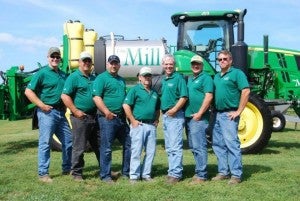
The Mill®, a large agricultural retail company, today became the first business in the area to utilize SUSTAIN in Maryland and Pennsylvania. SUSTAIN provides ag retailers with tools and training in best practices for fertilizer efficiency and soil health – such as cover crops and precision ag technologies – while maintaining the potential for high yields. Retail staff then bring this knowledge to the farmers they serve, meaning that one retail location can reach hundreds of farmers.
That’s why the platform, co-developed by Environmental Defense Fund, is taking off. Thus far, 27 ag retailers across the country have been trained, and food companies such as Smithfield Foods, Campbell’s Soup, Unilever, and Kellogg are connecting to the SUSTAIN platform as a way to meet their corporate sustainability goals.
I asked Ben Hushon, owner of The Mill, to tell me what this means for the Bay, for his company, and for farmers. (more…)
Western ranchers, Midwestern commodity crop growers, fishermen who make their livelihoods along the Mississippi River and the Gulf Coast. In some circles, these folks wouldn’t necessarily be considered models of sustainability. And yet, many are leading a quiet revolution in the way our food is raised, harvested and produced.
In her new book Rancher Farmer Fisherman: Conservation Heroes of the Heartland, my colleague Miriam Horn journeys down the Mighty Mississippi River System to meet five representatives of this unsung stewardship movement: (more…)
 Today represents a huge advancement for sustainable agriculture, and a new era of food company collaboration. At the Farm Progress Show in Boone, Iowa, we are officially launching the Midwest Row Crop Collaborative (MRCC): a diverse coalition working to expand on-the-ground solutions to protect air and water quality, enhance soil health, and maintain high yields throughout the Upper Mississippi River Basin.
Founding members of the MRCC include Cargill, Environmental Defense Fund, General Mills, Kellogg Company, Monsanto, PepsiCo, The Nature Conservancy, Walmart, and World Wildlife Fund. The coalition will work directly with growers to help foster continuous improvement and implement conservation activities across three pilot states responsible for 44 percent of corn, soy, and wheat production in the United States: Illinois, Nebraska, and Iowa. (more…)
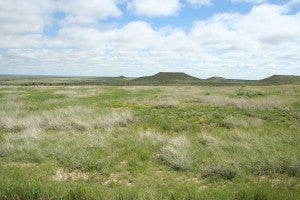
One year ago this month the Climate Action Reserve, the premier carbon offset registry for the North American carbon market, approved the voluntary grasslands protocol: a landmark opportunity for ranchers to get paid for keeping their land as grazing lands, versus converting it to crops.
And now, the protocol is underway. Today, the Reserve officially listed the first two grassland conservation carbon projects– the first step in the process towards generating carbon credits for landowners.
The Southern Plains Land Trust, directed by Nicole Rosmarino, enrolled more than 15,000 acres in Southeastern Colorado in the first two projects. She plans to enroll 7,600 more acres in an additional project in 2017.
Even though ranchers lose the opportunity to convert land for crop production, the protocol provides landowners with a guaranteed revenue source in addition to what they earn ranching on the land. Nicole will work with a project developer to monitor and report on the status of the Southern Plains Land Trust’s grasslands. We expect they’ll start earning credits in early 2017 that can later be sold on the North American carbon market.
Here’s why you can get paid for protecting grasslands, too. (more…)