








Clean power helped Texas beat the heat this summer: Explore the data
Written By


Share
Summary
- Because of Texas’ immense solar, wind and battery resources, the state was able to cruise through record-breaking temperatures and electricity demand this summer.
- For 94% of summer days, the ERCOT grid was powered by majority clean energy for at least one point in the day.
- As Texas prepares for the 2027 legislative session, data shows that keeping the state’s energy market open and free will keep the grid clean and cheap for Texans.
This summer, Texas experienced another year of record-breaking temperatures. Soaring temperatures, coupled with growing electricity demand from new commercial and residential users, pushed electricity use to new highs.
As recently as 2023, a summer like this would have been felt by Texans, like text alerts from the Electric Reliability Council of Texas — which covers 90% of the state — asking residents to conserve energy or even rolling blackouts. But this year, an exceptionally hot summer with a new peak demand record of 91.3 gigawatts in ERCOT, was a non-event for Texans.
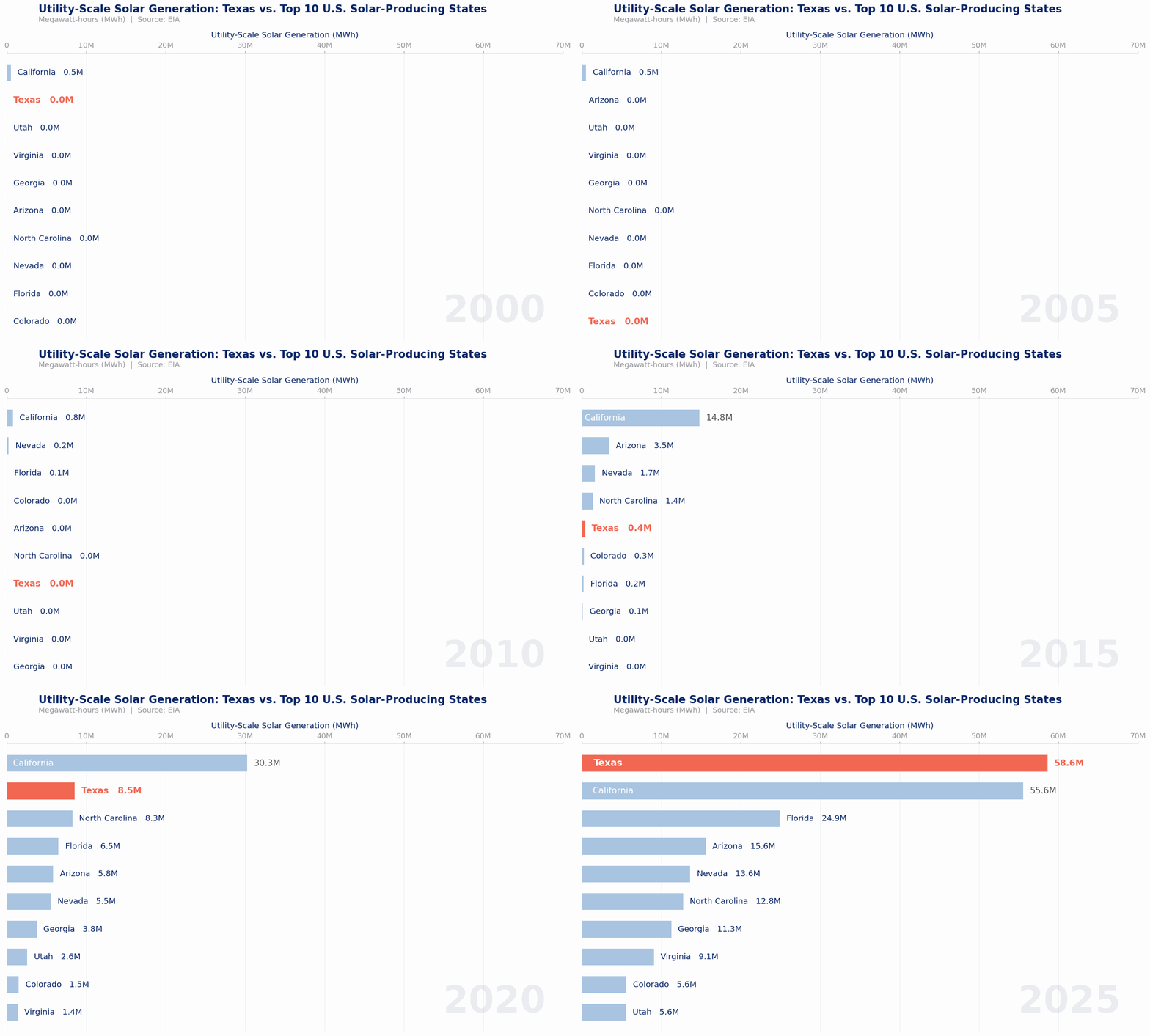
Why? Because Texas has quietly become the clean energy leader of the South, with ERCOT adding 95% of new capacity from solar, wind and battery storage from 2020 to 2025, for a total of 95 gigawatts of solar, wind and battery storage capacity. Texas is first in the nation in wind energy and has led the nation in solar deployment ever since it surpassed California in 2021.
Clean energy powering the grid
Using power data from ERCOT, Environmental Defense Fund compiled a visualization of how clean energy powered Texas this summer.
For 94% of summer days (June, July and August), the ERCOT grid was powered by majority clean power, for at least one point in the day. For 16 of those days — 17% of the summer — the grid was at one point powered by over 75% clean power.
The chart below defines clean power as zero-emissions energy sources: solar, wind and nuclear energy.
ERCOT days with a 50%+ and 75%+ renewables peak in 2026
Source: EIA-930 Hourly Electric Grid Monitor (EIA API, respondent ERCO), Jan 1–.
Hover any day for that day’s generation shares by fuel, an hour-by-hour generation chart marking the peak-share and peak-demand hours, and its peak renewable/clean-power share. Battery storage and
behind-the-meter solar excluded. Orange circles mark days this year that broke ERCOT’s previous official all-time peak demand
record (85,508 MW, Aug 10, 2023); ERCOT’s current all-time record is 91,308 MW, set Jul 22, 2026.
How Texas became a leader in clean energy
Texas has the resources — wide, open plains for capturing wind energy and plenty of sunshine.
On the policy side, Texas began its journey as a clean energy leader in 1999, when the state restructured its power grid market, moving from the standard vertically integrated utility model to a competitive wholesale and retail market. At the same time, Texas started one of the nation’s first Renewable Portfolio Standards which require a modest amount of generation from renewable power. These changes helped the then-nascent wind industry gain a foothold when their product was still on the expensive side. Solar wasn’t even in the conversation yet.
In 2013, Texas completed the transmission needed to bring that wind power from West Texas into the population centers — the Competitive Renewable Energy Zones — a roughly $7 billion dollar transmission infrastructure investment. These lines are now also being utilized for utility scale solar as West Texas has some of the best sun in the state.
Solar has also boomed during this time, with around 37 gigawatts of solar capacity added in ERCOT since 2013, growing total solar generation from less than 0.1% to about 14% of total generation.
Texas’ competitive wholesale market operates as an Energy Only market. This means that the energy resource with the lowest marginal cost is the first power to be utilized.
Renewables like solar and wind have no fuel costs, since sunshine and wind are free — unlike a barrel of oil. With high solar and wind resource potential and land availability, Texas is a profitable location for new renewables. This has also kept prices down, which has been good for consumers.
The technology needed to build new renewables has also gotten cheaper over the years, leading to renewables being the cheapest form of new energy to build, despite rising costs across all energy sources.
Challenges faced by Texas clean energy
The clean energy boom in Texas has not gone unchallenged. Clean energy has faced several challenges in past Legislative sessions.
In both the 2023 and 2025 Texas legislative sessions, a broad coalition of landowners, clean energy operators, environmental nonprofits and local officials were able to stop the worst of the anti-energy legislation. The proposed legislation sought to impose onerous siting and cost requirements on wind and solar developers would have potentially stalled future clean energy development, was ultimately defeated but not without great effort. Interestingly, some of the trade groups representing oil and gas interests joined the effort to defeat the bills due to their concern about negative price impacts. Turns out hardly anyone wants higher electricity bills.
Looking ahead
It is likely that the anti-renewable lobby tries to target clean energy again in the 2027 legislative session, but the data continues to be stacked against them.
Over the past decade, Texans have seen the grid become cheaper and more reliable because of clean energy. Solar, wind and batteries have transformed the power grid and made concerns about summer outages a thing of the past.
This year has shown how an open and free energy market in Texas has resulted in a strong and reliable grid that keeps cost and pollution down. As the next session approaches, Texas should ensure the market stays this way.