









Modest fixes, major risks: North Carolina carbon plan and rate case order puts households at risk
Posted: in News
Written By

Share
Key Takeaways
- Families Face Higher Bills and Risky Fossil Bets: The Carbon Plan order doubles down on costly natural gas and coal instead of maximizing cheaper clean energy and federal tax credits.
- Data Centers Still Leave Ratepayers Exposed: While the new Large Load Tariff is a modest first step for facilities over 50 MW, it leaves roughly half of projected infrastructure costs potentially on everyday customers and lacks clean energy and grid-flexibility requirements.
- Lawmakers Must Act in 2027: With the NCUC falling short, the General Assembly needs to require data centers to pay 100% of incremental costs and bring clean energy, tie tax incentives to clean and flexibility rules, and share volatile gas price risk with Duke.
This week, the North Carolina Utilities Commission issued two sweeping decisions that will shape our state’s energy landscape, climate trajectory, and household budgets for decades to come. Together, the Commission’s rulings on Duke Energy’s multi-year rate case and its updated Carbon Plan and Integrated Resource Plan represent a major missed opportunity to lower power bills, modernize our grid, and hold massive data centers energy users accountable.
The Carbon Plan, by failing to maximize near-term clean energy deployments, leaves billions of dollars in federal clean energy tax credits on the table and exposes North Carolina ratepayers to decades of volatile natural gas fuel costs-which have been the biggest driver of bill increases in recent years.
The rate cases for the first time begin to assign the grid costs incurred by data centers to their operators. But by failing to assign the full costs to data centers, require them to reduce energy use during peak hours or ensure that these massive power users are being used to add clean energy to the grid instead of gas and diesel, the message to everyday North Carolinians is clear: families and small businesses will still be on the hook when the bill comes due for an outdated, fossil-fuel-heavy buildout.
Now, the North Carolina General Assembly must step up to protect ratepayers from the cost burden of over investing in expensive and dirty fossil fuels by implementing important safeguards, closing loopholes, and requiring data centers to bring their own clean energy.
Higher bills today, risky bets for the future
First, let’s look at the rate case order. North Carolina households are already squeezed by rising costs across the board, yet regulators approved a framework that raises residential electricity rates by an average of 3.7% over the next two years and locks in a 9.8% return on equity for Duke Energy’s shareholders. Even worse, the cost-recovery structure shifts a disproportionate share of grid upgrade expenses onto everyday residential customers thanks to legislation passed last year. While the order includes $20 million in shareholder funding for low-income bill assistance and weatherization, that is a drop in the bucket compared to the systemic rate pressure families face.
Then came the Carbon Plan order—and with it, a doubling down on expensive, risky fossil fuels. Despite clear evidence from Duke Energy’s own numbers that utility-scale solar, battery storage, energy efficiency, and grid-enhancing technologies are the fastest and most affordable ways to meet demand, the Commission largely greenlit Duke’s plan to build costly new natural gas plants while delaying the retirement of aging, uneconomic coal units.
Here’s a breakdown of what the Commission approved for Duke Energy’s Near Term Action Plan:
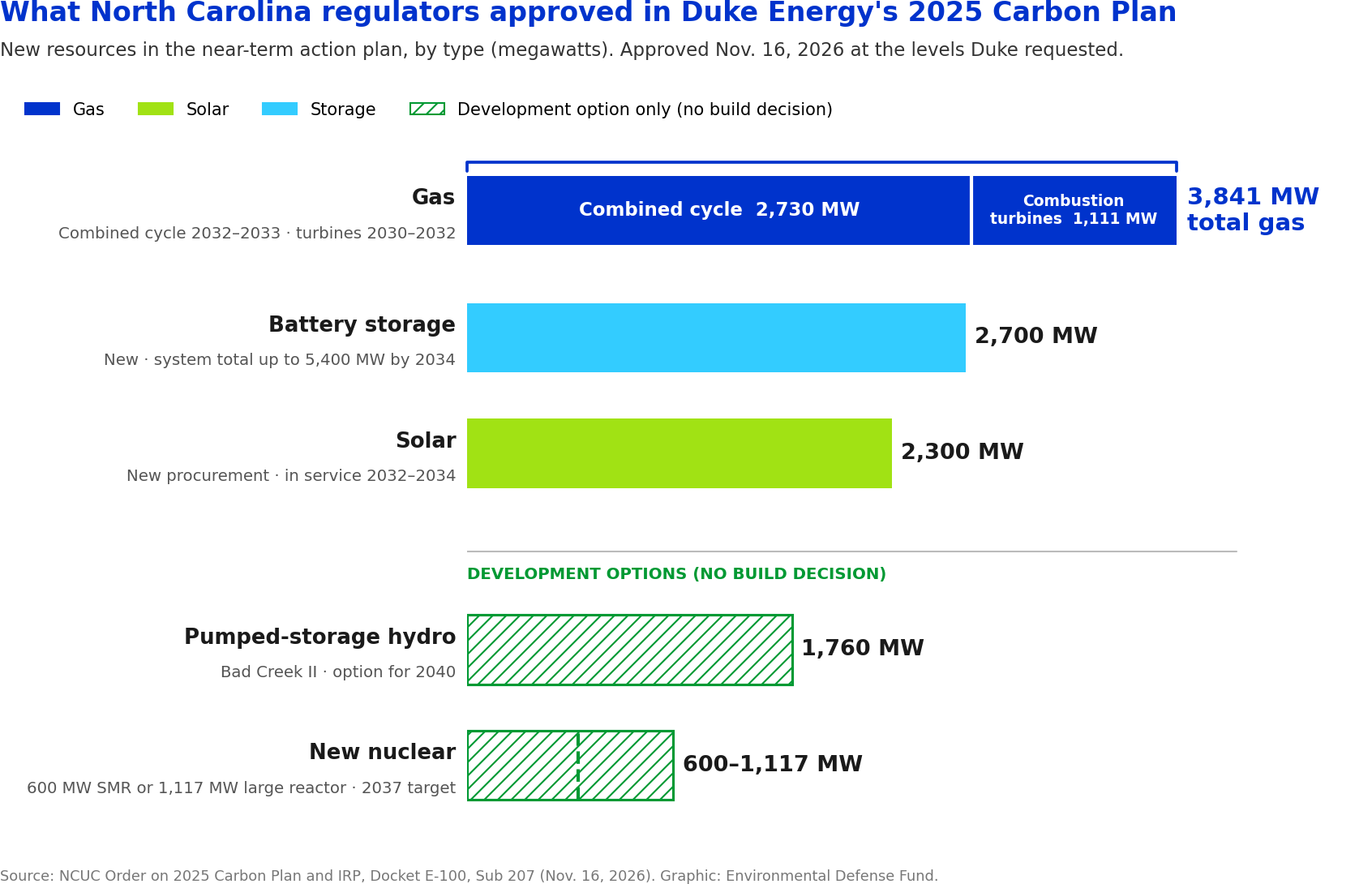
Under the shadow of Senate Bill 266—which stripped away North Carolina’s interim 2030 carbon reduction target and opened the door for utilities to charge customers upfront for power plants still under construction—this Carbon Plan puts our 2050 net-zero mandate in serious jeopardy and opens the door for a huge, risky bet on gas.
Important issues unresolved
Nowhere is the disconnect between utility planning and consumer protection clearer than on the issue of hyperscale data centers.
Data centers account for roughly 80% of the projected surge in new economic development electricity demand across the Carolinas. Modeling from Governor Josh Stein’s bipartisan Energy Policy Task Force recently confirmed what EDF has warned about for years: if we handle this load growth poorly, data centers could add tens of billions of dollars in system costs by 2050, sending residential bills skyrocketing. Conversely, when large loads bring their own new clean energy and operate flexibly, they actually lower costs for everyone else by up to $20 billion-and slash carbon pollution.
In its rate case order, the Commission took a modest first step by establishing a Large Load Tariff for facilities exceeding 50 megawatts, including minimum contract commitments and a “Stranded Generation Charge” intended to prevent ratepayers from getting stuck with the tab if a project folds. That is a welcome baseline that EDF fought hard for throughout these proceedings. Our testimony was cited extensively in the final order explaining the Commission’s decisions to enact a more protective framework than that proposed by Duke Energy and the hyperscalers.
But, as Commissioner Donald Van Der Vaart, who resigned on November 18th, noted in his dissent, the proposed charge would cover only about half of projected transmission and generation costs for new data centers:
“As an example, the commission calculated that a hypothetical 500 megawatt data center could require Duke to build about $674 million worth of new electric infrastructure. But if that data center leaves after 15 years, it would pay only $338 million of those electric costs, the other $335 million would fall to everyday customers. In the end, it falls to this Commission to be the counterweight — to ensure that the utility’s legitimate duty to its shareholders, and the data centers’ legitimate interest in lower costs, do not become an obligation of the families, small businesses and manufacturers who remain on the system.”
More broadly, between the Carbon Plan and Rate Case orders the Commission left critical gaps wide open:
- No Mechanism For Data Centers to Pay for their own Clean Energy: Regulators declined to include an optional clean transition tariff or “bring your own clean energy” requirement. Without a clear mechanism for tech companies to procure new, dedicated solar and storage to match their 24/7 power needs, Duke’s default response to every new data center announcement will remain the same: build more gas plants backed up by hundreds of diesel generators.
- Missing Flexibility Mandates: The orders fail to require or adequately incentivize data centers to curtail or shift load during peak grid stress—one of the most effective tools for avoiding expensive peaker plants and safeguarding reliability during extreme weather.
- Unchecked Speculative Forecasts: Regulators largely accepted utility load projections without rigorous, binding guardrails to ensure we aren’t overbuilding fossil infrastructure for projects that may never fully materialize.
- Lingering Cost-Shift Loopholes: While stranded generation charges help, transmission and distribution network upgrades triggered by data center growth face a year of stakeholder negotiations before we know how much of those costs will actually be assigned to data centers and how much families will continue to subsidize multi-billion-dollar tech conglomerates.
The General Assembly must step up in 2027
The North Carolina Utilities Commission had an opportunity to draw a firm line protecting ratepayers and our climate, and it fell short. That means the spotlight now shifts squarely to the North Carolina General Assembly.
When lawmakers reconvene in 2027, modernizing our energy laws to govern large-load growth must be at the top of the agenda. Legislators should enact clear statutory rules requiring hyperscale data centers to pay 100% of their incremental grid and generation costs, bring new clean energy capacity onto the system, and participate in grid-stabilizing demand response programs.
At the same time, lawmakers should re-examine generous state tax breaks for data centers so taxpayer subsidies are tied directly to clean energy and grid-flexibility commitments. Finally, they should give Duke energy skin in the game on volatile gas prices and force the utility, not just ratepayers, to bear some of the cost when prices come in higher than anticipated.
North Carolina shouldn’t have to choose between economic growth and affordable, clean electricity. But until our laws require big tech and monopoly utilities to play by fair rules, regular North Carolinians will keep paying the price.