






Category Archives: Cap and Trade

Creating Incentives for Agricultural GHG Abatement

One of the goals of EDF’s Ecosystems work is to provide farmers with revenue opportunities in reducing their greenhouse gas (GHG) footprint. Under AB32, California’s landmark legislation aimed at reducing GHG emissions, regulated entities may purchase carbon offsets to meet up to 8% of their obligations. Over the past six years, EDF has worked closely with growers to capitalize on the anticipated demand for these offsets, by developing protocols that will allow landowners to generate and sell agricultural offsets. On March 28, we reach a milestone in these efforts: the California Air Resources Board will host a workshop to begin a rulemaking process to consider the adoption of an offset protocol EDF has developed with the American Carbon Registry, crediting rice producers for GHG abatement practices.

We’ve put a great deal of work into understanding and piloting a myriad of rice farming techniques, while studying their implications for GHG emissions. A major conclusion from our analysis is that there exists a subset of viable alternative practices for rice producers in California with potential agronomic, economic and environmental benefits. The ones we’ve decided to focus on for our offset protocol are: baling, dry seeding, and early drainage of fields before harvest.

Agricultural activities account for an estimated 12% of global GHG emissions – the majority of these arise from sources of nitrous oxide and methane gases, composing ~60% and ~50% of the global total, respectively (as of IPCC AR4). Rice cultivation accounts for 5-20% of worldwide methane emissions; much of it is emitted as a byproduct of organic decomposition under flooded paddies. California’s goal to reduce its emissions to 1990 levels by 2020 through its cap-and-trade program (AB32) provides an opportunity for rice farmers to help the state meet its reduction goal.

There are multiple approaches for rice farmers to reduce GHG emissions. Some of these practices can be carried out before the harvest and others post-harvest. We’ve carried out some in-depth analysis on the various options, to better understand the incentives and revenue possibilities we will be encouraging through our policy work – we have found that there are a handful of ways that farmers can reduce GHG emissions while maintaining yields, earning some revenue for their efforts, and potentially save on costs in some circumstances.

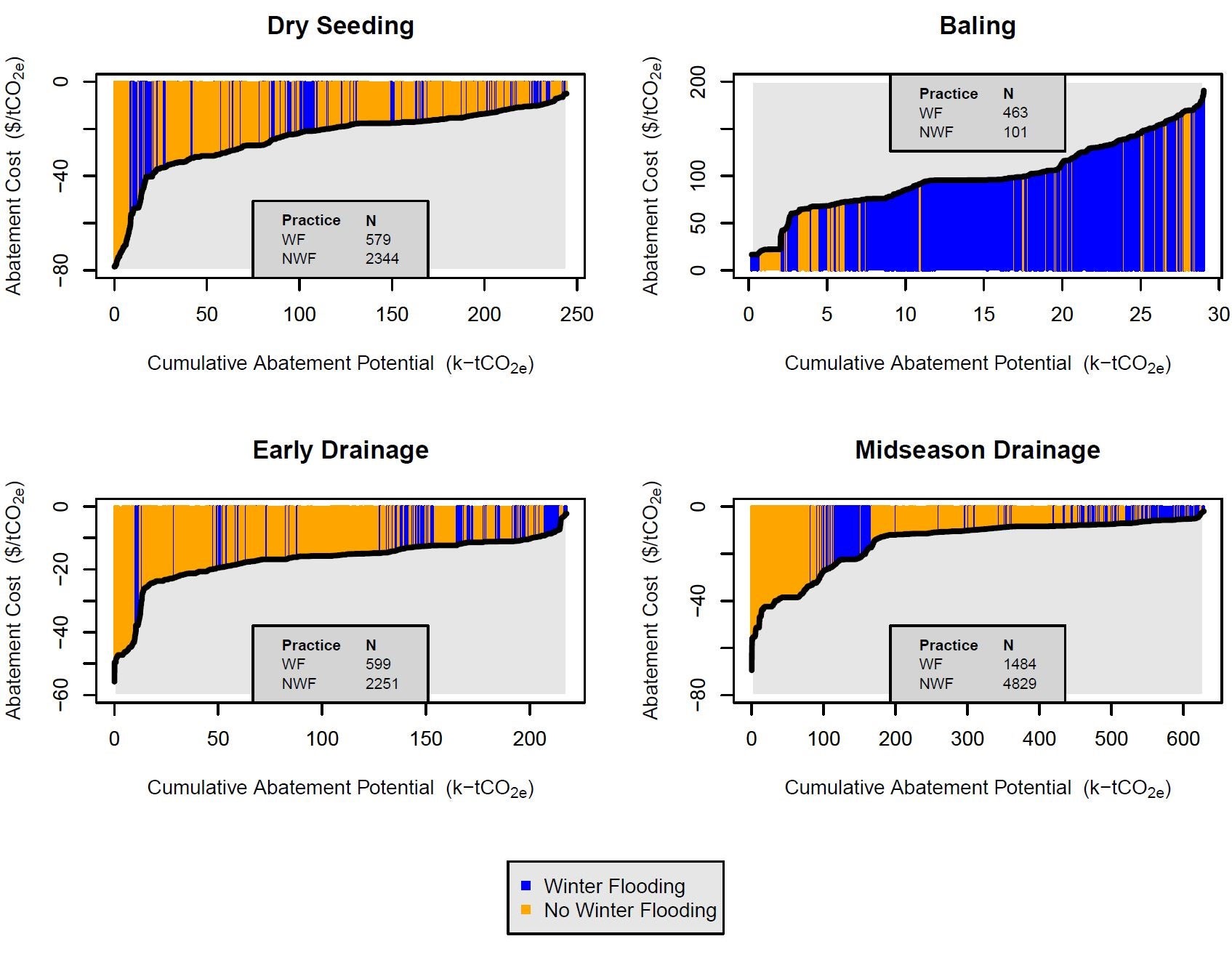
Our analysis builds on a prior study by our partners Applied Geosolutions, UC Davis and the California Rice Commission that estimates GHG emissions and yields for the majority of rice producing acreage in the state. They use the DeNitrification-DeComposition (DNDC) model, simulating 6,316 rice fields for 16 farming practices. In our analysis, we first estimate the potential greenhouse gas abatement of a suite of specific practices: dry seeding the rice fields, baling harvest residue, and hydroperiod adjustments (draining of fields in midseason, before harvest and/or reducing winter flooding).

We then tabulate the cost of each management practice through a combination of literature, farmer and farm advisor consultation and combine these with abatement estimates to generate marginal abatement cost curves for each practice. Our preliminary results indicate a wide variability in abatement costs, depending on farming conditions. Of course, this is before factoring in the role of a carbon credit.

Unfortunately, not all of the practices we’ve studied are tenable in the Californian setting. One practice (midseason drainage of the fields) is accompanied with a significant decrease in yield and therefore does not lend itself well to the Sacramento Valley climate. In the case of stopping winter flooding, there could be negative habitat impacts for waterfowl that use this ecosystem as a feeding ground. Striving to understand such risks has been crucial in determining the extent to which producers will consider the new incentives created through the market.

Because the practices listed above have not been widely adopted, they are key opportunities for the generation of offsets.  To better understand adoption rates, EDF is conducting further research in determining the quantitative and qualitative barriers that are limiting farmers from adopting such farming methods.

California will be one of the first rice producing regions in the U.S. to present abatement opportunities in conjunction with a carbon market. Combining economic principles such as abatement cost curves with biogeochemical models (e.g. DNDC) is useful in studying such opportunities. Further, the ability to simulate practices at the field level is central to understanding the economic potential of offset protocols granting agricultural producers access to carbon markets. In turn, this can create new incentives to abate GHG emissions from agriculture while potentially providing new sources of revenue to landowners – potentially a win-win situation.

We are excited that Thursday’s California Air Resources Board workshop will kick off the rulemaking process and that farmers can soon benefit from these interesting prospects.

Also posted in California, Climate science | Leave a comment

Capping Pollution from Coast to Coast

As the second auction in California’s landmark cap and trade program approaches, a coalition of states on the opposite side of the country – that have been cost-effectively reducing their carbon pollution while saving their consumers money – announced plans to strengthen their emission reduction goals.  Last week, the Regional Greenhouse Gas Initiative (RGGI) – the nation’s first cap and trade program which sets a cap on carbon dioxide pollution from the electric power sector in 9 Northeastern states (Connecticut, Delaware, Maine, Maryland, Massachusetts, New Hampshire, New York, Rhode Island, and Vermont) – released an updated Model Rule containing a number of improvements to the program, primarily a significantly lower (by 45%) overall cap, realigning it with current emissions levels.

Since the program took effect in 2009, emission reductions in the RGGI region have occurred faster and at lower cost than originally expected.  This has primarily been the result of increased electric generation from natural gas and renewables which have displaced more carbon-intensive sources like coal and oil, as well as investments in energy efficiency that lower overall electricity demand.  These reductions have been accompanied by lower electricity prices in the region (down 10% since the program began) and significant economic benefits:  a study from the Analysis Group estimated that electric consumers would save $1.1 billion on their bills over 10 years from the energy efficiency improvements funded by allowance revenue, and further, that these savings would generate over $1.6 billion in economic benefits for the region.

The new lower cap allows RGGI to secure the reductions already achieved, and push forward towards more ambitious pollution reduction goals.  The changes to the program are the result of a transparent and comprehensive program review process set in motion through RGGI’s original Memorandum of Understanding – a mechanism that is successfully fulfilling its original intention by allowing the states to evaluate results and make critical improvements.

While the changes will go a long way to fortify the program, there is room in the future for the RGGI states to look to California’s strong program design for additional enhancements.  For example, RGGI’s updated Model Rule creates a Cost Containment Reserve (CCR) – a fixed quantity of allowances which are made available for sale if allowance prices exceed predefined “trigger prices”.  A CCR is a smart design feature which provides additional flexibility and cost containment – however, RGGI’s CCR allowances are designed to be additional to the cap, rather than carved out from underneath it as in CA’s program (ensuring the overall emission reduction goals will be met).  California’s program has displayed enormous success already, with a strong showing in their first auction.

In the meantime, the RGGI states should be commended for their success thus far, and for their renewed leadership as they take important steps to strengthen the program.  These states have achieved significant reductions in emissions of heat-trapping pollutants at lower costs than originally projected, all while saving their citizens money and stimulating their economies, transitioning their power sector towards cleaner, safer generation sources, and laying a strong foundation for compliance with the Carbon Pollution Standards for power plants being developed under the Clean Air Act.  Such impressive achievements provide a powerful, concrete example of how to tackle harmful carbon pollution and capture the important co-benefits of doing so.

The bottom line is that cap and trade is alive and well on both coasts as the states continue to lead the charge on tackling climate change in the U.S. while delivering clear economic benefits.

Also posted in California, Cap and Trade Watch, Clean Air Act, Markets 101, Politics | Leave a comment

Australia's landmark legislation will put price on carbon pollution, create world’s second-largest carbon-price system

By Jennifer Andreassen, originally posted on our Climate Talks blog.

As expected, Australia’s upper house of Parliament voted yesterday to adopt a carbon price, which will compel Australia’s largest polluters, beginning July 1, 2012, to pay for their carbon pollution.

Australia will have the largest carbon-price system in the world outside Europe's, after its upper house approved the Clean Energy Future package of bills Nov. 8. The package of bills aims to cut emissions from coal-dependent Australia 80% by 2050 from 2000 levels.

The legislation’s passage will give Australia, which has the highest per capita emissions of any developed country in the world and uses even more coal than the United States, the largest carbon-price system in the world outside of the European Union. (That is, the largest outside the EU until California’s program takes effect in January 2013; California last month approved the largest, first-ever economy-wide carbon market in North America, which could eventually link to other sub-national, national and regional markets around the world.)

EDF applauds Australia on its leadership on the vitally important problem of climate change. This vote is another indication that more and more countries around the world – with the U.S. being a notable exception – are taking climate change seriously. The legislation also backs Australia’s international commitment to reduce emissions by between 5 and 25 per cent by 2020 from 2000 levels.

The Clean Energy Future Package

The Clean Energy Future package is made up of 18 bills that will assign a price to carbon starting July 1, 2012 and cut Australia’s emissions 5% below 2000 levels by 2020 (though the target can be strengthened based on science or international action), and 80% below 2000 levels by 2050.

Australia’s 400-500 largest emitters will be covered by the carbon price, which will take the form of a fixed price (starting at A$23 per metric ton) for the first three years, and shift to a carbon market emissions trading system in 2015.

As we mentioned when Australia’s lower house passed the clean energy legislation on October 11, the Clean Energy Future package will shift Australia’s energy towards cleaner and renewable sources by:

  1. Placing a price on carbon.
  2. Creating a market-based system with plans to link it with ‘credible international carbon markets or emissions trading schemes in other countries’ – like New Zealand and Europe – after 2015.
  3. Giving a big boost to renewable energy research and development and deployment through a new $10 billion financing vehicle, the “Clean Energy Finance Corporation.”

(The Southern Cross Climate Coalition has some more details on the legislation in its analysis, as does Natural Resources Defense Council’s Jake Schmidt in his post Congrats Australia! Law passed which will require mandatory carbon pollution reductions for major polluters.)

Climate groups in Australia welcomed the passage of the laws, as did:

Australian Prime Minister Julia Gillard, who told reporters:

Today we have made history. … This is about what's right for the nation's future.

Deutsche Bank Australia carbon analyst Tim Jordan, who said:

This is a very positive step for the global effort on climate change. It shows that the world's most emissions-intensive advanced economy is prepared to use a market mechanism to cut carbon emissions in a low-cost way.

CEO of The Climate Institute John Connor, who said:

This is a vital cog in Australia's pollution reduction machinery with the potential to help cut around 1 billion tonnes of carbon pollution from the atmosphere between next year and 2020.

This vote means Australia now brings greater credibility going into international climate negotiations starting later this month in South Africa. It also puts wind in the sails of other jurisdictions about to introduce, or considering, emissions trading schemes which similarly price and limit carbon pollution.

The G20 Cannes Action Plan for Growth and Jobs even highlights the Australian legislation as an example of how members will “enhance competition and reduce distortions” in its plan to create “sustained, broad-based reforms to boost confidence, raise global output and create jobs.”

What’s next for Australia

Now, the Government moves into implementation mode, which means it will take to:

  • Establishing new institutions, including the Climate Change Authority (to recommend on future emissions targets); the Clean Energy Finance Corporation; and the Clean Energy Regulatory to oversee the market;
  • Finalizing contracts next year to close 2000 MW of brown coal power generation;
  • Working with New Zealand and EU officials on linking schemes after 2015.

Linkages to international carbon markets that are built into the system will also see Australia become a key player in the international offset market.

And Australian officials will be able to hold their heads high at the UN climate conference in Durban at the end of this year, as they promote their joint proposal with Norway for a roadmap to a 2015 global climate treaty.

Also posted in Cap and Trade Watch, International, Politics | Leave a comment

Newsflash: Clean Air Act saves lives, boosts GDP

We have sometimes been the bearers of bad news on jobs in the past. Not bad news, really. Realistic news. So excuse me for being a bit giddy at the sight of the latest piece of very realistic—and very good—news.

The EPA just released a new White Paper that turns out to be as green as it is red, white, and blue.

Lives and health at a bargain price

First, it starts with what really matters when considering the impact of the Clean Air Act—health and the corresponding social and economic benefits:

  • 18 million child respiratory illnesses prevented in 1990 alone,
  • 200,000 lives saved that year (160,000 in 2010),
  • total benefits outpacing costs 30:1 since 1990.

These are the key figures we need to keep in mind. Always.

Healthy kids means a healthy workforce

For anyone who isn't yet satisfied but worries about the economic impact of the Clean Air Act, there's more good news:

Protecting children from neurotoxins leads to workers with higher IQs.

That should be an obvious statement. It also turns out to come with real economic benefits. The latest study by Harvard's Dale Jorgenson et al shows that the Clean Air Act has boosted productivity and growth:

GDP in 2010 is 1.5 percent higher than it would have been without the Clean Air Act.

Again, that's GDP. Hard economic growth. The number that measures everything except that which makes life worthwhile.

Clean and competitive

Lastly, the paper concludes with a look at competitiveness concerns. The verdict: the Clean Air Act does not harm competitiveness.

That's not as strong as saying that the Clean Air Act improves U.S. competitiveness. Improving productivity also improves competitiveness, and combining the standard competitiveness arguments with Jorgenson's productivity results may well show that to be the case.

But no one to my knowledge has done that yet credibly. (Of course, I'd love to be proven wrong on that point.) To the full credit of EPA and the credibility of its analysis, the paper does not go that far either.

The White Paper stays well within the mainstream of economic analysis of the Clean Air Act and bears plenty of good news for health, wealth, and the planet.

Read it at your own peril. It may well be the first piece of economic analysis that makes you giddy yourself.

Also posted in Markets 101, Politics, Technology | Leave a comment

Carbon trading grows up

Cross-posted from Reuters AlertNet.

When someone robs a bank, nobody challenges the legitimacy of banks. They suggest instead that the bank find better security. Why should carbon markets be any different?

Wednesday last week the European Commission (EC) discovered cyber thefts of carbon allowances valued at around €30 million from accounts in a handful of member states. It promptly halted all trading in its nearly €130 billion/year market until the holes could be plugged, accounts could be cleared, the stolen allowances could be traced by their unique identifying numbers, and culprits could be identified.

The fact that some trading registries are apparently less secure than your Facebook account is a clear problem and points to serious underinvestment in market infrastructure and security.

It certainly does not call into question, however, the idea of carbon trading, although some opponents of carbon markets have taken that step. These people range from outright climate deniers—those who can't even admit we have a global warming problem—to those who believe that markets aren't the most efficient way of addressing climate change, to those who can't capitalize on the carbon market's opportunities.

Let's be clear: Putting a firm limit on carbon pollution, and providing polluters with flexibility in determining how to reduce pollution—including through transparent trading of pollution allowances—is fundamentally the best way to combat global warming pollution.

This basic fact is not changed by a €30 million theft of carbon credits that might have been prevented through a €10 thousand investment in security software and better computer hardware. Although not perfect, markets are the most rational and efficient way of allocating resources toward filling a specific need. Every stock exchange on the planet faces attempted cyber attacks, and most are well equipped to deal with them.

A day after the theft was discovered, the EC released a wholly separate, long-awaited decision to stop accepting pollution credits generated by destroying trifluoromethane, HFC-23, and nitrous oxide. Opponents of carbon markets seized on this announcement as further evidence that carbon trading markets aren’t working.

But actually, the EC's decision to stop accepting these credits is the right move. HFC-23 was originally developed as an alternative to ozone-depleting chlorofluorocarbons. HFC-23 is a potent global warming gas, and destroying it helps the climate.

However, trading in HFC-23 credits creates perverse incentives. With a high enough price for carbon credits, it could make economic sense to build factories that produce HFC-23 for the sole purpose of destroying the gas and collecting credit for doing so. A better way for dealing with HFC-23 would be to subsume it under the successful Montreal Protocol, which is working to repair the hole in the ozone layer.

The coincidence of the EC’s decision to stop trading HFC-23 credits and the temporary suspension of trading on the heels of the carbon allowance theft, gave opponents of trading the opportunity to launch a two-pronged critique of carbon markets. But barring HFC-23 credits from entering the EU system can only be applauded—it's entirely in the spirit of putting a firm upper limit on carbon pollution.

These two events highlight the carbon opportunity for the EC going forward. The emissions trading system has already proven its worth as the centerpiece of European efforts to cut global warming pollution. By improving the technical security of its trading program, the EC can assure investors that no more emissions allowances will be purloined.

And by closing its carbon market to credits from one-off HFC-23-type projects of dubious environmental value, and instead linking the EU market with jurisdictions that establish high-quality cap-and-trade systems, the EC can strengthen its own market and challenge others who are developing similar policies—from New Zealand to Tokyo to California, and beyond—to follow suit.

In the end, that’s all that counts—and the only thing the planet truly notices.

Also posted in Cap and Trade Watch, International, Politics | 2 Responses

Not the U.S. or China, but the U.S., China and the Planet

One of the pleasures of my job is having a slew of superbly qualified prospective interns knock on our doors. Yesterday, I interviewed someone who graduated at the top of his class at Renmin University in Beijing.

There have been plenty of column inches written on "China versus the US," including when it comes to green jobs and clean tech. So,

Who's going to come out ahead, China or the United States?

It took him nary a second to nail this one:

China, relatively. Both China and the U.S. in an absolute sense.

That's the textbook answer.

The atmosphere wins

China has a lot of catching up to do. Comparatively, it will clearly gain on the U.S. But trade also has advantages for both parties involved. That's why we trade in the first place.

The planet emerges as a winner as well. It doesn't care where a ton of carbon gets emitted or where it gets reduced—just that reductions happen.

If China produces cheaper solar panels, we get fewer emissions overall. The planet wins. China wins. What about the U.S.?

What about jobs?

If you are among the 800 workers in Devens, MA, who last week found out that Evergreen Solar was moving its plant to China, you will feel very differently about free trade right about now. The textbook economic answer would say that the move can still make everyone better off: compensate the losers through portions of the gains from the winners, and everybody wins once again.

This situation, of course, is the moment when you throw out your textbook and think about the full consequences.

As a result of the move, solar panels will likely become even cheaper for everyone, enabling many more to buy them. Still, the Devens 800 will not be among the people lining up to buy cheaper solar panels.

What can they do? What should the U.S. do as a matter of policy?

First, we need to realize that the rules of trade still apply. China has lots of cheap labor. It does and will continue to manufacture many products sold in the U.S. Solar panels are no different.

But that's still not a satisfying answer, nor is it the whole story—not for manufacturing itself, and not for the clean tech industry overall.

How to keep clean tech jobs in the U.S.

To get to the bottom of this, we need to look at the full supply chain for solar panels. This, of course, oversimplifies things, but we can split the entire process into three distinct buckets: inventing, producing, and installing.

Right now, the U.S. is inventing, China is producing, and it is the one installing the resulting solar panels domestically at massive scale.

The U.S. ought to do everything to make sure it keeps inventing clean tech products. That means a concerted push to fund basic research and development. But R&D subsidies alone won't do.

Many mentions of "R&D" add a second "D" for deployment. Government support can get things going, but large-scale deployment of clean technologies won't happen through subsidies alone (at least not without bankrupting the government).

So how do you get deployment up to scale?

Deployment clearly needs to be driven by demand. That's where a cap on carbon pollution, with its resulting price on carbon, comes in. A cap helps create a more level playing field for solar and other renewable energy sources relative to fossil energy and, therefore, creates the necessary demand. (There are alternatives, like simply requiring a certain percentage of power to come from solar, but none is quite as cheap and flexible as a cap.)

Made in USA?

Moreover, cheap labor and cheaper production facilities may be a decisive factor, but they are not the only reason companies consider when choosing where to locate. There are many more, but let's focus on two: intellectual property (IP) protection and being close to where the demand is.

The U.S. has a leg up on China in terms of IP protection. That's, in part, why the U.S. (still) leads on R&D. It's also a clear draw for some companies to locate their production facilities in the U.S.

Another oft-cited reason is to be close to consumers. That's once again where the importance of the second "D"—deployment—comes in. The more demand there is for solar panels in the U.S., the more companies will locate their production plants in the U.S. as well. The case of First Solar supplying panels for Wal-Mart is a prime example. (Note that this is distinct from cheaper production leading to more demand in the first place.)

In the end, though, we must also be clear that jobs will be different in the new, cleaner economy. We will need fewer gas station attendants. Many other jobs will thrive. Underlying trade forces will mean that China may well be producing many of the solar panels sold globally. Assembling, installing, and maintaining solar panels in the U.S. will require plenty of skilled labor. And none of these jobs can be exported.

California leading

With the right policies in place, the U.S. will keep inventing. It will also create thousands of jobs dedicated to deployment. China will play a major role in producing, but even there, smart environmental policy can only help.

California is taking the lead with its Million Solar Roofs initiative, creating many a job assembling, installing, and maintaining solar panels. That initiative, though, still has to be paid for by tax dollars, and it won't go on forever.

That's where the cap on carbon kicks in. California is bound to stay ahead of the rest of the U.S. with its ambitious cap-and-trade system that starts on January 1, 2012 and the resulting market signal that says that clean tech pays in the U.S. as well.

Consider the just-released Next 10 report, Many Shades of Green, that found that in the most recent observable 12-month period (January 2008 – January 2009) jobs in the green sector grew more than three times faster than total employment in California. (Of course, all of this always comes with the warning that green sector jobs are still a small fraction of total jobs—much like IT jobs were a minuscule part of overall employment in the early 1980s.)

One of our internship spot may well end up going to a Chinese student, but that, too, can only be good for the planet—making a small contribution to help train the next generation of Chinese environmental leaders. And rest assured, there are plenty more open job positions (including one for a post-doc working with our economic team, open to anyone with a Princeton affiliation).

Also posted in California, International, Markets 101, Politics | 4 Responses

The long and the short of energy efficiency

David Owen asks a provocative question in the current New YorkerIf our machines use less energy, will we just use them more? He more or less says yes. The real answer comes in two parts.

For now—over days, weeks, months, and even years—energy efficiency will decrease energy use and emissions. Screw a compact fluorescent light (CFL) bulb into a socket that used to hold an incandescent and your energy use will go down. Chances are you won't leave the lights on four times as long just because light now costs a quarter.

Over time—years, decades, centuries, and millennia—more energy efficient lights and appliances will indeed mean that more people use more of them. CFLs make light more affordable. That doesn't matter to the typical U.S. household, where few light sockets remain unused because of energy costs. But globally—and over time—it does make a difference.

The Jevons Paradox

William Stanley JevonsOwen goes back to 1865 and William Stanley Jevons who at 28 came up with what has later been called the "Jevons Paradox":

It is wholly a confusion of ideas to suppose that the economical use of fuel is equivalent to a diminished consumption. The very contrary is the truth.

Jevons is right, of course. We have seen dramatic increases in energy efficiency over centuries while energy use has gone up by orders of magnitude.

Does that mean we shouldn't increase energy efficiency? Of course not. We just need to be clear about what we are getting in exchange.

Energy over the millennia

Sperm WhaleBy the mid-1800s, the latest and greatest in lighting technology was spermaceti, a fat from the head of sperm whales. It cost around $1,500 a barrel in today's dollars and its price was only going to go up as whales became ever scarcer. Since then, we have seen gas lights come and go and by now electric lights cost less than a thousandth as much as the equivalent in lighting power back then.

That's not a recent phenomenon. Bill Nordhaus went back to 500,000 BC. Lighting cost a million times [PDF] as much then as it does today. Needless to say, we are using much more of it now.

Another word for this phenomenon is “technological progress.” That’s really what’s behind the whale oil story, and we want more of it. There is still plenty of energy poverty [PDF] in the world. We clearly want affordable, clean energy for as many people as possible.

Of course, misguided “progress” has also led us to a planet on the brink of breakage. We need to limit greenhouse gas emissions—and do so sooner rather than later.

Will energy efficiency save the climate?

Should we look to energy efficiency as a way to do some of that? Absolutely. Energy efficiency is cheap, quick, clean, and often underutilized.

McKinsey has looked for zero-cost energy efficiency opportunities in the United States and has found possible savings of above 20 percent of total demand in 2020.  Those savings, could go a long way toward meeting commonly discussed climate policy goals.

But won’t those energy savings just mean that we are using more energy eventually? History has shown it to be true after all.

In the short run—over days, weeks, months, and even years—the Jevons Paradox manifests itself in a well-documented “rebound effect” of around 10 percent. On average, you would indeed leave your CFL on for a bit longer than you would an incandescent. We lose a tenth of energy savings to increased use. (Owen cites the 10 percent figure but then goes on to overstate some of the implications dramatically.)

That leaves 90 percent in true savings and points to the clear win-win potential of energy efficiency measures.

Not by energy efficiency alone

In the long run—over years, decades, centuries, and millennia—cleaner and cheaper energy also means more people will be using more of it.

Does that mean energy efficiency is bad? Of course not. Energy inefficiency is another term for waste. And we clearly want less of that. But the problems our planet faces are too large to address through waste reduction (“reduce, reuse, recycle”) alone.

To get emissions down in the long run, there’s no escaping the (gasp) inconvenient truth that we must limit pollution directly—ideally though a declining cap on total emissions.

A cap on emissions—and the ensuing price on carbon pollution and race to invent cleaner energy sources—is the only mechanism we know that can break the link between emissions and energy use.  It limits the former and makes clean energy cheaper relative to fossil fuels.

Also posted in Markets 101, Technology | 3 Responses

First steps for the California carbon trading market

Whoever said cap and trade is dead hasn’t been paying attention to the news in California.

Recently, the first trade of a greenhouse gas emissions permit in the Golden State took place, signaling the beginning of what experts project to be a robust carbon market—and the largest in the U.S. given the absence of a nation-wide policy (note that the Regional Greenhouse Gas Initiative (RGGI), the first mandatory market-based effort in the U.S. with 10 participating Northeastern states, applies to utilities, while California’s program will also apply to industry and in later years, transportation).  The trade takes place hot on the heels of the defeat of Proposition 23 in the November elections.

Although the compliance market won’t launch until 2012, Barclays Bank and NRG Energy completed the first allowance trade:  a forward contract which guarantees the delivery of allowances valid for use in the California market at the start of the program at a locked-in price (around $11-$11.50 according to Point Carbon).  By helping provide certainty about the future, these types of trades allow firms to make smart business planning decisions, such as which energy technologies to invest in.  Experts at Barclays as well as at San Francisco-based CantorCO2 expect that other early trades are soon to follow, as firms look for ways to reduce risk and start transitioning to a clean energy economy.

Ensuring the integrity of the carbon market…

State regulators have been able to provide sufficient certainty about how the market will be structured and the timeline for regulatory action to allow for this early launch of the California market.  However, it will be important to nail down sooner rather than later the nitty-gritty specifics of how the market will be regulated in order to ensure that trading occurs in an efficient and transparent way (note that the California Air Resources Board (CARB) is currently accepting comments on a detailed rule proposal).

The financial crisis we just lived through should provide ample incentive for us to make sure to get the rules right and for ensuring tough enforcement and strong oversight — for example, by requiring all carbon trading to be done on registered exchanges, rather than over the counter.  On that point, it’s worth noting that the recently passed Dodd-Frank Financial Reform legislation requires the Commodities Futures Trading Commission (CFTC) to lead an interagency study on how best to regulate the carbon market.  (Carl Royal’s 2009 testimony from the House Energy & Commerce Committee hearing on the American Clean Energy and Security Act and our own fact sheet provide some more arguments).

The path forward for CA

California's cap-and-trade program will cover the power and industrial sectors starting in 2012 and the transportation sector (including cars and fuels) beginning in 2015.  Time and time again, California and other regional initiatives, like RGGI, continue to lead the nation on sensible energy and climate policy (and stay tuned for developments in the Western Climate Initiative (WCI) as well as New Mexico).  Time for Washington to catch up.

Also posted in California, Cap and Trade Watch, Markets 101 | Leave a comment

How environmental economics saved Christmas

Art Carden has a great piece on the Grinch saving Christmas,

using Pigouvian taxes and the bargaining business.

But it reminds us again that even Coase missed the mark,

when it comes to things outside of Whoville's small arc.

So to Art's welcome take on a Yuletide tradition,

We humbly append a climate-change addition:

Since Whoville Whos’ chanting affects only the Grinch,

Bargaining is the solution that works in a pinch.

Climate's a problem that affects the whole planet,

Coasian bargaining is much too small to span it.

A price on carbon is the better path,

all we need now is the political math.

Failing that, to be sure, we have the EPA,

not a first-best choice, still it may win the day.

To save the world's Whovilles, we need a solution

that in the end puts a firm limit on carbon pollution.

Cap and trade is the most certain way

to give every Who joy on this and future Christmas Days.

Also posted in Politics | Leave a comment

No jobs in economic modeling

Co-authored with Nat Keohane.

Last week Nat Keohane and I tried to shed some light on the inner workings of economic models when it comes to jobs. Among other more specific statements around climate policy, we also said that,

many macroeconomic models don’t actually attempt to model jobs. In fact, they generally assume full employment no matter what happens, which doesn’t leave any room for estimating increases or decreases in jobs as a result of specific policies.

We should have been clearer here. If you think of employment as "total units of labor employed, given equilibrium wages and household labor-supply decisions," then yes macroeconomic models do model employment—just as they model the equilibrium values of other inputs and outputs in the economy.

That's just not how you or I think about jobs, and that has some major implications.

Economic modeling versus the real world

Computable general equilibrium models of the economy literally assume full employment in the sense that everyone who wants to work works.

When we think about unemployment in the real world, it is due to the fact that people actually lose their jobs. More technically, there are market frictions that keep wages high in recessions. As a result, demand for workers goes down.

Not so in the world of general equilibrium economic models. There, wages rise and fall with the fate of the economy. In a recession, wages fall and people simply choose to work less. The technical term is the household "labor-leisure tradeoff." People work less because they supply less labor to the economy.

Most people, of course, would argue that when wages fall you have to work more to make up the gap.  That intuition can't be true in an economic equilibrium, which is what the models are trying to capture; hence the discrepancy between models and the real world.

Not all models are created equal

So how then do economic modelers estimate employment impacts?

First, not all models are of the "general equilibrium" type that have the full-employment assumption built into them.  For example, the Department of Energy’s Energy Information Administration relies on a macroeconomic model called National Energy Modeling System (NEMS), which has a different structure.  Partly as a result, the NEMS model does produce employment estimates.

Second, you sometimes see even general equilibrium models being used to derive numbers on jobs.  In those cases, however, the jobs impacts are computed after the fact: the modelers take the estimated effects on output and then back out employment impacts using rather arbitrary rules of thumb that assume a high degree of friction in labor markets even over long periods of time, often decades.  This is problematic, to say the least, because it goes directly against the grain of the underlying models used to produce those results.

The Peterson Institute study mentioned in our last post, which uses the NEMS model, is in the first camp.  It is also among the first to take a more realistic look at the jobs impacts of climate policy given the current recession.  Not surprisingly, it comes up with a very different answer on the jobs question.

Also posted in Politics | 1 Response