







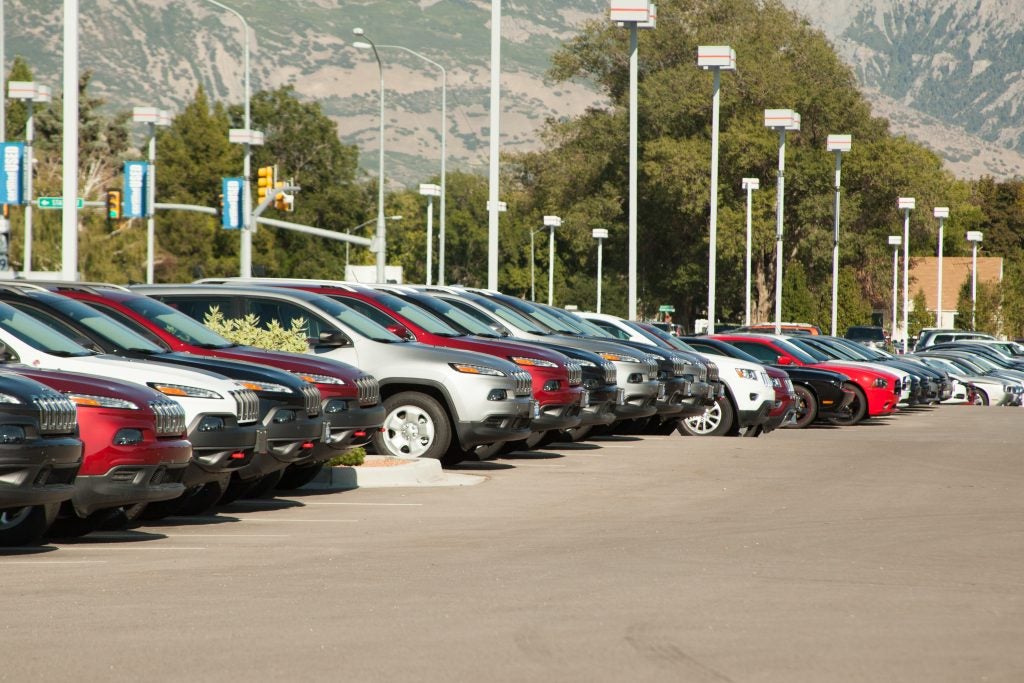
Cars on a dealer lot, waiting to be sold. Photo: Every Car Listed
(EDF Legal Fellow Erin Murphy co-authored this post)
EPA Administrator Scott Pruitt just announced his intention to rollback one of our country’s biggest climate success stories – clean car standards that reduce pollution and save Americans money at the pump.
In a closed-door ceremony, Pruitt kicked off a process to weaken these standards — placing at risk as much as two billion tons of climate pollution reductions and $460 billion in consumer savings.
His determination cited the auto industry dozens of times yet made no mention of people’s health or climate change, and cited zero EPA analyses justifying the rollback.
Even some auto industry leaders have raised concerns about this attack:
- Honda: “We didn’t ask for that,” said Robert Bienenfeld, assistant vice president in charge of environment and energy strategy. “The position we outlined was sensible.”
- Ford: “We support increasing clean car standards through 2025 and are not asking for a rollback.”
- Adam Lee, chairman of Lee Auto Malls: “Trump has been saying these standards are crushing the auto industry. But we’ve had record years for the past four or five years, in terms of sales and profit. It almost makes you think he doesn’t have the facts.”
- Automotive Technology Leadership Group: “It is in the nation’s best interest for the U.S. to continue leading in the development and manufacture of the cleanest and most efficient vehicles in the world. The innovation brought on by competition and our national performance standards has created hundreds of thousands of jobs in this country and significant market opportunities for U.S. companies abroad.”
Pruitt’s announcement has even generated a backlash in the most auto-industry-friendly place in America – Detroit.
In a strongly-worded editorial, the Detroit Free Press accused auto companies of reneging on their deal with the American taxpayer:
- “[T]he auto bailout was more than a federally guaranteed loan; it was a multi-lateral agreement that your companies would henceforth go about the business of manufacturing cars and trucks more thoughtfully than they had in the past … [M]anufacturing more fuel-efficient vehicles that would cost less to operate and spew a dramatically smaller amount of greenhouse gases into the atmosphere was part of the bargain that saved your lives.” – Detroit Free Press editorial
The clean car standards have strong public support across the country. A recent American Lung Association poll showed that nearly seven in 10 voters want EPA to leave current fuel efficiency standards in place.
That support is reflected in the broad outpouring of support for clean cars expressed in the run up to, and aftermath of, Pruitt’s rollback announcement. A diverse group of leaders recognizes that weakening these protections will cost Americans money, hurt our health, and harm our national security:
- “Thanks to emissions and efficiency standards, consumers have saved billions of dollars on fuel over the last 5 years. And if the standards were protected instead of undermined, consumers could expect to save a lot more over the next decade. It would be wasteful to discard those consumer savings, but EPA now appears poised to do just that.” – Shannon Baker-Branstetter, Consumers Union
- “The American Lung Association strongly opposes EPA Administrator Scott Pruitt’s decision to revise the clean car standards … Transportation is the nation’s single largest contributor of carbon pollution, which drives climate change. Starting a process to weaken clean car standards marks yet another step backward from the fight to curb climate change. Climate change poses serious threats to millions of people, especially to some of the most vulnerable Americans, including children, older adults and those living with chronic diseases such as asthma.” – American Lung Association CEO Harold Wimmer
- “Weakening CAFE and reducing future U.S. net oil exports will further diminish the future global energy leverage of the United States and leave the country and its allies on a more precarious footing.” – Council on Foreign Relations blog, 3/13/18
Political leaders across the country have voiced strong bipartisan support for the existing clean car standards:
- “Today’s EPA decision on vehicle emissions won’t prevent us from fulfilling what we believe is an obligation to protect Colorado’s air and the health of our citizens. Many of our auto manufacturers are making cars cleaner and more efficient. Indeed, many support the existing stricter standards. It doesn’t make sense that the EPA would take us backwards. Who is the EPA trying to protect?” – Colorado Governor John Hickenlooper:
- “As U.S. attorneys general, mayors and county executives, we – not federal officials in Washington, D.C. – are primarily responsible for the transportation systems upon which our residents and our local and regional economies depend. A clean, efficient and high-performance vehicle fleet is an essential component of these systems. We strongly support the current federal standards for such a modern vehicle fleet agreed to in 2012 by the automotive industry, the federal government and the State of California.” – A Coalition of 12 State Attorneys General and Over Fifty Mayors
- “Today’s announcement by EPA Administrator Pruitt to weaken vehicle emissions standards is in direct conflict with the agency’s mandate to reduce air pollution. This decision will increase air pollution and limit innovative technology advancements that bring cleaner, more efficient cars to market. We support the current federal standards agreed to in 2012 by the automotive industry, the federal government, and the State of California. These standards are helping to drive the global transition to more efficient transportation technologies. They also protect the health of our communities and reduce the pollution that is changing our climate.” – 17 Governors of states across the country and Puerto Rico
Labor and investment experts have also recognized that the clean car standards are essential for long-term American auto sector innovation, vitality, and jobs:
- “The current standards have helped bring back, secure, and create jobs nationwide; they have reduced pollution; saved consumers billions at the pump; and have been integral to growing and sustaining America’s manufacturing sector over the past decade. Weakening the rules — which is indicated to be the intent of today’s decision — could put American jobs at risk today and in coming years, and would threaten America’s competitiveness in manufacturing critical technology.” – BlueGreen Alliance Director of Advanced Vehicles and Transportation, Zoe Lipman
- “Strong national fuel economy and emissions standards spur innovation and open the door to tremendous economic opportunities. They represent an investment in technological and economic leadership. Weakening them would be a bad deal for investors, workers, car owners, and businesses—and for the American economy itself.” - David Richardson, Impax Asset Management