







Land Repurposing Workshop connects the dots across a changing landscape
Written By


Share
This blog was co-authored by Lauren Parker, Managing Director, Secure Water Future, Valley Institute for Sustainability, Technology, & Agriculture (VISTA), UC Merced.
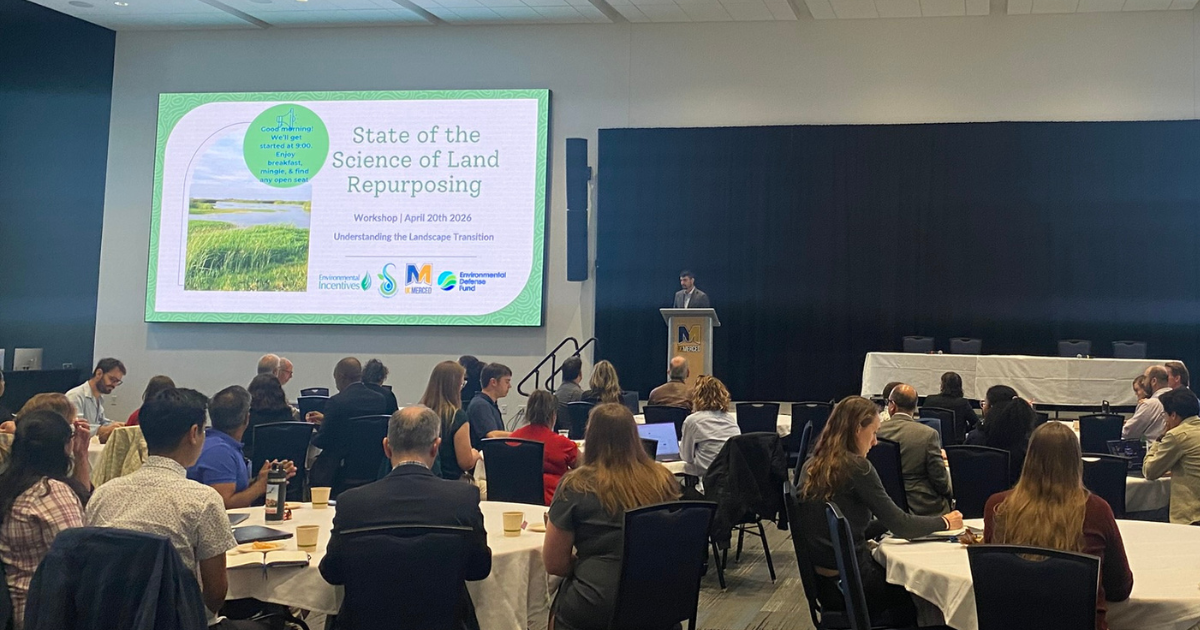
This spring, researchers, policymakers, water managers and community leaders gathered at UC Merced and attempted to answer the question, “Is land management adapting to water scarcity fast enough?” This question has become urgent as reduced groundwater access threatens farm operations and increases the acreage of idled farmland in the San Joaquin Valley.
The event, the 2026 State of the Science of Land Repurposing workshop, explored how repurposing farmland can be used as a tool to conserve groundwater while supporting people and ecosystems in the face of a changing agricultural landscape.
Co-hosted by Environmental Defense Fund and UC Merced VISTA, the gathering was the second State of the Science of Land Repurposing workshop since California created its Multibenefit Land Repurposing Program (MLRP) to support communities implementing the state’s historic Sustainable Groundwater Management Act. As Ann Hayden, VP of EDF’s Water Program, noted during the workshop, MLRP is picking up momentum in California, with nearly 5,000 acres of projects approved since its inception in 2022, and the program is starting to draw interest from other states such as Oregon and Arizona that are also experiencing major declines in water supplies.
A central takeaway emerged from the workshop: Analytical tools and empirical insights are increasingly capable of informing land repurposing decisions, but their effectiveness requires taking a multidisciplinary approach that also considers local geography, experience, and the practical demands of implementation.
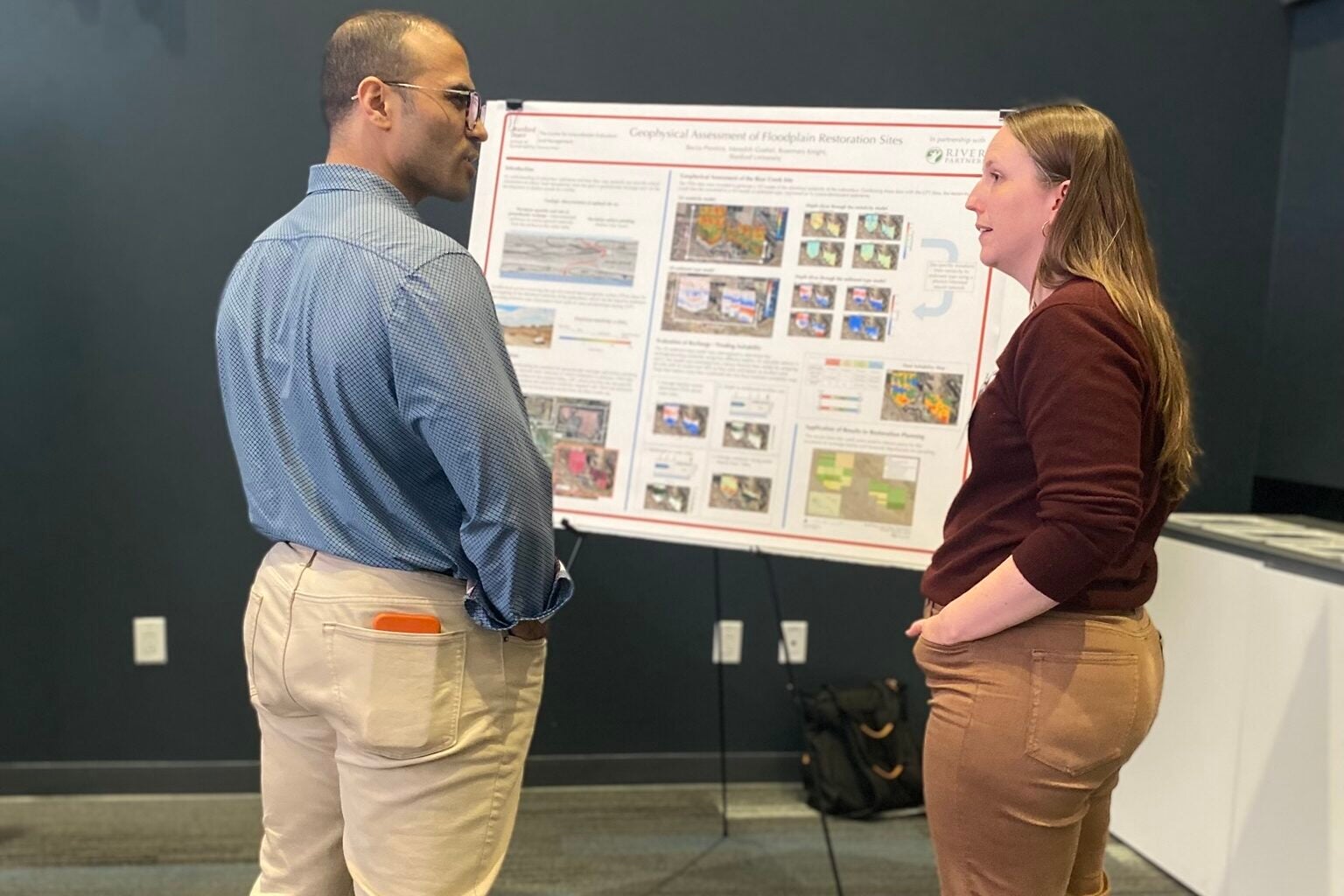
Emerging challenges and opportunities for land repurposing
Adapting to changing conditions is complicated: Land and water decisions are shaped by tightly interconnected hydrologic, economic, ecological and social factors. Shifts in water availability affect agricultural viability, which in turn affects land use, environmental conditions, local economies and livelihoods.
A growing body of research is beginning to take an integrated approach to land repurposing that better accounts for these connections. Multiple speakers highlighted interactions among such issues as water scarcity, groundwater overdraft, land subsidence, lack of safe drinking water for disadvantaged communities and decreased biodiversity.
John Cain, conservation director at River Partners, talked about the San Joaquin Valley Regional Conservation Investment Strategy, a coordinated public-private strategy to restore habitat, recharge groundwater and reduce flooding.
Similarly, Scott Butterfield, lead scientist for The Nature Conservancy California Chapter’s Land Program, discussed upland habitat restoration at Capinero Creek in Tulare County, a project funded in part by the California MLRP. Endangered species such as the blunt-nosed leopard lizard and Crotch’s bumblebee have recently been observed on the site, which also reduces water use and protects against negative air quality impacts from fallow lands.
On the flip side, Adeyemi Adebiyi, an assistant professor at UC Merced, shared his research showing how cropland fallowing can increase dust generation and heat exposure. And Ashley Larsen, a professor at UC Santa Barbara, noted other negative impacts from land retirement such as more weeds, pests and molds. But she also noted that these risks decrease with higher levels of vegetation recovery on retired lands.
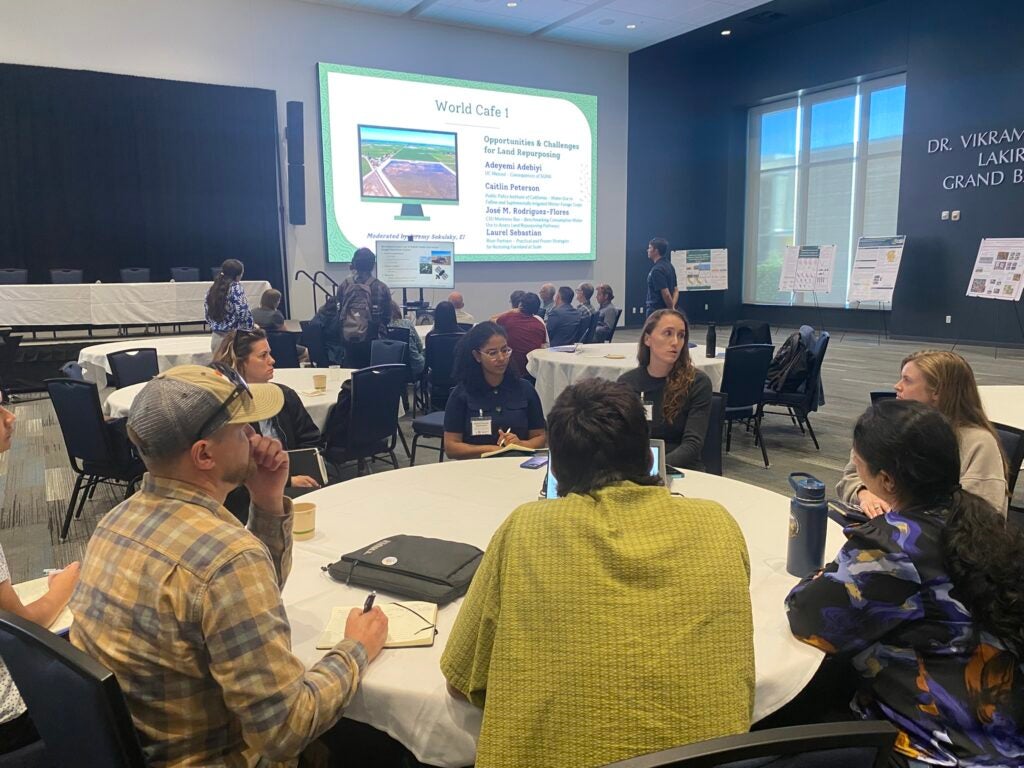
Evaluating tradeoffs
Others presented approaches to quantify tradeoffs, evaluate management options and guide decisions under groundwater constraints. By creating more sophisticated tools for evaluating these tradeoffs, researchers hope to ensure land repurposing benefits as many actors as possible.
Alvar Escriva-Bou, an assistant professor at UC Davis, discussed how economic tools can help prioritize groundwater supply and demand management strategies to achieve groundwater sustainability and how these strategies can support the design and implementation of multibenefit land repurposing projects in the most viable areas.
Tom Harmon, a professor at UC Merced, shared a geospatial toolkit that can be used to identify suitable areas for MLRP projects in the Kaweah and Tule subbasins and could be transferable to other regions.
Analyses of water use under alternative cropping systems by Caitlin Peterson, a research fellow at the Public Policy Institute of California, and José M. Rodriguez-Flores, geospatial data scientist at CSU Monterey Bay, clarified how different land uses and crop choice may contribute to water savings and groundwater sustainability goals.
Engaging with people and place
Analytical insight alone is insufficient to address the many issues facing the San Joaquin Valley. For scientific research to be actionable, it must accurately reflect the lived realities, values, and constraints of the communities and landscapes where land repurposing occurs.
Tribal leaders and community representatives highlighted the place-based nature of land and water decisions. Land use changes are not only technical or economic issues, but also shape livelihoods, cultural relationships to land and community well-being.
For example, Wukchumni Tribal Chairperson Darlene Franco described how water has its own spirit, and how land repurposing is helping restore traditional land use practice in Tulare County. Tekoah Kadara, co-associate executive director of Allensworth Progressive Foundation, noted that “going from extraction to extraction is not helping anybody. We need to make changes, and it can’t be one thing at a time.”
Planning must also include the realities of landowners, whose participation is crucial to the success of California’s Multibenefit Land Repurposing Program.
Duncan McEwan, principal economist at ERA Economics, discussed economic and grower incentives that can encourage voluntary participation in land repurposing. Mike Tietze, general manager of the East Turlock Groundwater Sustainability Agency (GSA), discussed the agency’s focus on supporting landowner choices. The GSA created a “menu of options” for growers to connect land repurposing efforts to their business goals in a way that can restore habitat, enhance infiltration and hydrologic function, and maintain yields.
Aaron Fukuda, CEO of Tulare Irrigation District, noted how the bottom line matters to corporate farmers, whereas a family farmer is more likely to focus on what’s right for their family and their community — and their decisions might not necessarily match their bottom line.
From insight to action
Shanna Atherton-Bauer, director of the Division of Land Resource Protection at the California Department of Conservation, noted that small family farmers will be hit the hardest by water scarcity and air quality issues driven by climate change. “Time is not on our side to transition all of the acres we need to, but there is an opportunity to involve communities in this work, utilize evidence-driven approaches, collaborate across boundaries and share success stories of land transition that is already happening,” she said.
Progress will depend not only on advancing the knowledge and science of land repurposing, but on embedding that knowledge within the systems supporting land use change on the ground. Strengthening the connection between analysis and action will be essential to successfully navigating the challenges — and opportunities — of landscape change.
Ashley Swearengin, president and CEO of Central Valley Community Foundation, closed the day by highlighting the importance of land purposing as part of the “big change” that is needed to address water scarcity. While there is no silver bullet, she said, land repurposing projects are “no regrets investments.” “We have to work together,” she said. “This place matters. … We can’t give up.”
Agenda and funding
This workshop was supported by Agriculture and Food Research Initiative Competitive Grant no. 2021-69012-35916 from the USDA National Institute of Food and Agriculture. The agenda for the day can be found here.