Climate change solutions
We deliver game-changing environmental solutions that have a real impact for people around the globe.

Building resilient land and water systems that allow people and nature to prosper in a changing climate.
A report released yesterday in the journal Scientific Reports found “substantial probability” that the eastern population of monarch butterfly could be wiped out in a “quasi-extinction” event in the next two decades.
The study attributed the increased likelihood of an extinction event to extreme weather, which has historically posed a threat to monarch populations. But the study also noted that the most recent declines have been primarily caused by the eradication of milkweed from farms in the United States.
Despite the results of this report, I am convinced that we can save the monarch.
That’s because all of the pieces will soon be in place to reverse habitat loss and make recovery a reality. (more…)
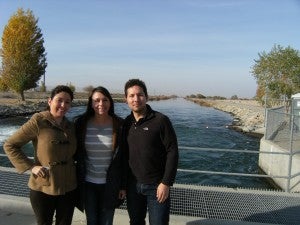
On World Water Day, I am reminded of what brought me to the Environmental Defense Fund: a passion for working on market-based incentive programs to improve groundwater management in California, ultimately benefiting multiple, diverse communities.
Born and raised in Mexico City, I moved to San Francisco to work on drought-related problems in California. It has been a surreal experience, allowing me to help disproportionately impacted communities, many of which are poor Latino communities in the rural Central Valley, where most of the nation’s fruits and vegetables are grown. In this way, I feel a little bit closer to home.
Water security for all
Many people may not realize it, but only about 5 percent of usable water in California is visible; the rest is underground. With access to surface water curtailed because of a five-year drought, many of the state’s biggest water users – farms and cities – have relied on groundwater pumping as a last resort. This has drawn down aquifers to dangerously low levels, and has left some rural communities without any water at all. (more…)
When I think about what motivates me as a conservationist, I often reflect on the bird species we’ve lost – the Carolina parakeet, the ivory-billed woodpecker, the passenger pigeon.
I remember these species when I work to create pathways to prevent extinction for today’s at-risk wildlife – the lesser prairie-chicken, the golden-cheeked warbler and the greater sage-grouse.
But it’s not just the birds that inspire me. It’s also the people.
My role as director of conservation strategy and habitat markets often requires me to cultivate partnerships with ranchers, farmers, oilmen and large multinational corporations. It’s incredibly satisfying to work with this diverse set of stakeholders to find common ground. Sure, we all have different interests driving us, but I am steadfast in my belief that we can protect natural resources, while at the same time enabling the responsible production of food, fuel and fiber. (more…)
 Organic. Conventional. Locally grown. And the list goes on. The seemingly age-old debate of what system can best feed and sustain the planet is again at the front of my mind on National Ag Day.
When I spoke at a recent Food Entrepreneurship Symposium event at Princeton University, an audience member asked me if organic is the best path forward to feed the planet sustainably. At Commodity Classic in New Orleans earlier this month, I spoke with growers about whether conventional ag is the way to feed a growing population.
My answer: there is no silver bullet when it comes to sustainable agriculture. There is no single system, no one-size-fits-all prescription that can solve our food security and environmental sustainability challenges.
That’s why we cannot afford to shut the door on any idea, or on any system of food production. Here’s how organic and conventional compare on yields and environmental impacts, and why we need both systems, local and global production, and big and small farms in order to protect food security and the planet. (more…)
Earlier this week, The Washington Post reported that the monarch butterfly, along with the manatee, is on a “big rebound.” It’s true that the iconic North American butterfly is in better shape today than this time last year. But it’s too soon to celebrate.
A sensitive species
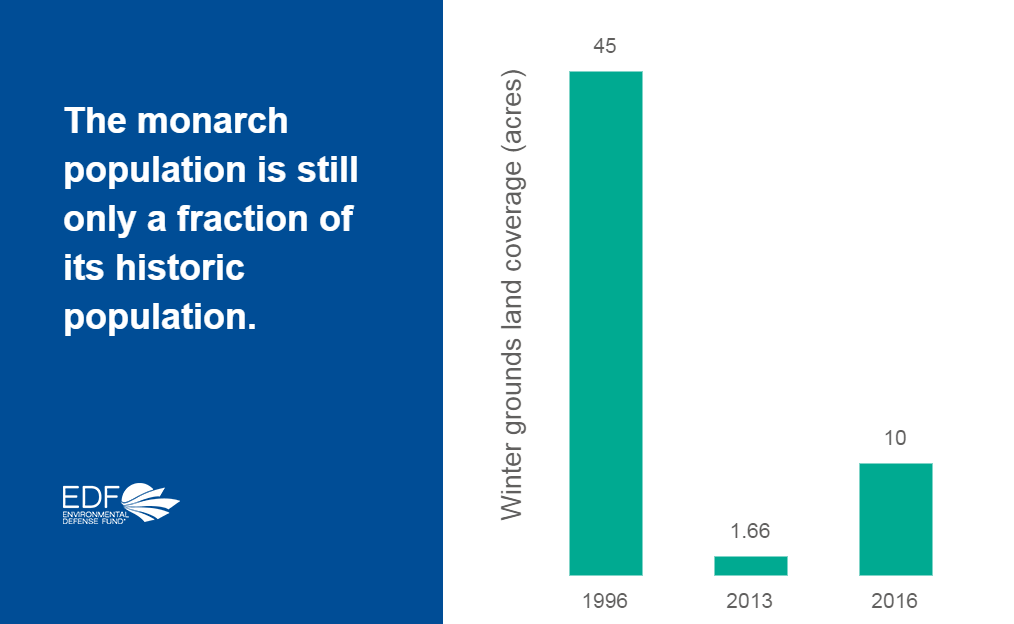 The population of monarch butterflies has historically had drastic dips and spikes. That’s because the monarch is a sensitive species greatly impacted by extreme weather events.
In January 2002, the species experienced unprecedented and catastrophic mortality due to a rare freeze at its overwintering site in Mexico, killing an estimated 500 million butterflies. That’s more than two times the size of today’s population, even with this year’s boost.
Fortunately, the monarch is as resilient as it is delicate. This year’s bump in number proves that. It also shows that recovery is possible, that conservation efforts can make a difference. (more…)
 Big name food companies are starting to source sustainably grown grains to increase transparency and reduce climate and water risks in their supply chains. Precision agriculture tools can help farmers meet this new demand, but it’s difficult to tell which ones perform as advertised because little data exists – or is publicly available – to prove a tool’s effectiveness on the ground.
That’s why EDF developed NutrientStar, an independent, science-based program that verifies the fertilizer efficiency claims of products on the market.
NutrientStar identifies fertilizer management tools that effectively keep nutrients on the farm, reduce fertilizer losses, and improve air and water quality. Scientific assessments conducted by an independent review panel provide valuable information on a tool’s performance, and on-the-ground research trials show performance in working fields. As tools and products are reviewed, the analysis will be posted on the NutrientStar website. Tools and products assessed to date include:
Here’s what this new program means for the entire commodity crop supply chain – from farmers to food companies. (more…)
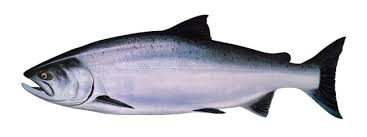
Already an endangered species, California salmon populations have reached record lows.
Fisheries officials with the National Oceanic and Atmospheric Administration found that just 3 percent of this generation of winter-run Chinook salmon survived in the Sacramento River. This is a record low survival rate – more than 10 times worse than the survival rate before the California drought.
How does drought affect salmon?
Salmon at any stage need cold water to survive, and severe drought conditions have put a chokehold on the state’s water supply, which relies on snow melt from the Sierra Nevada Mountains. Without this snow melt, there is less cold water flowing into California’s waterways, creating higher than normal water temperatures in the Sacramento River.
But it’s not just the lack of cold water that’s affecting salmon populations. They also lack sufficient habitat to grow and thrive. Even if the drought ended today, they would still be in peril without adequate habitat. (more…)
 Approximately 56 percent of all corn, soy, wheat, and cotton farms use strip-tillage or no-till on at least a portion of their land. No-till, as defined by experts at the U.S. Department of Agriculture, means “limiting soil disturbance to manage the amount and distribution of crop and plant residue on the soil surface year round.” Strip tillage, meaning soil disturbance occurs on 30 percent or less of the field, also qualifies as no-till.
No-till is a widely recognized conservation practice that can help growers maximize soil health. The practice works best when implemented year after year and combined with other conservation measures like fertilizer efficiency and cover crops (wherever geography permits). There are myriad benefits for farmers and the planet, but barriers still exist.
That’s why I’m so amazed by a no-till adoption rate of 90 percent in north central Montana.
I talked with Carl Mattson, Montana grain grower and an agricultural policy and conservation consultant, about why he made the switch to no-till, why he was an early adopter of the practice, why so many farmers in his region use no-till, and what he sees as other obstacles to the future of sustainable farming. (more…)
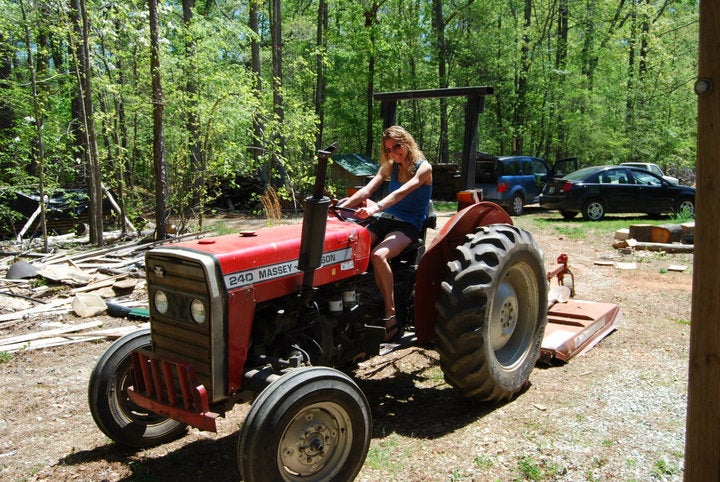
My passion for improving the food system for the health of my family, my fellow citizens and our planet is in my genes.
My grandmother ran a natural foods business out of her kitchen in the 1950s, a time when the country was moving towards more processed food. My parents, who took me on annual Earth Day trash walks to pick up garbage alongside the road by our house, instilled in me a deep respect for the environment. My mother, a teacher, also started a composting and gardening program at her school that incorporates what the students grow into the school menus.
I draw on my family’s heritage in my life and work. That’s why I’m proud to be part of the team that helped Smithfield Foods establish and deploy a program to improve the sustainability of the grains they feed their hogs.
EDF and Smithfield don’t agree on everything, but we do agree that farmers growing animal feed have an important role to play in reducing the climate and water impacts of agriculture.
Here’s why a career focused on feed grain sustainability is a perfect fit for me – and why I believe that momentum in animal feed sustainability is a great way for protein companies across the supply chain to make tangible improvements to air and water quality. (more…)
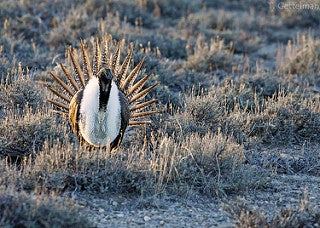 The state of Nevada recently made $1 million available to landowners for enhancing and restoring habitat for the greater sage-grouse, with another $1 million becoming available in the fall of 2016.
Nearly two dozen landowners submitted letters of interest to generate conservation credits for the bird – a clear signal that the market for conservation is viable and competitive.
The U.S. Fish and Wildlife Service may have determined that listing the greater sage-grouse on the Endangered Species List was “not warranted,” but that isn’t stopping landowners in key states from stepping up to help the bird, ensuring that it stays off the list. That’s because new conservation programs are coming online that are attractive to landowners, conservationists, and state and federal agencies. (more…)