









Portland General Electric joins the Extended Day-Ahead Market as total savings surpass $32 million
Written By


Share
Summary
- Since its launch in May, the Extended Day-Ahead Market has saved customers nearly $33 million.
- Portland General Electric joined the Extended Day-Ahead Market on October 1, adding to the growing list of participants in the electricity market.
- By 2028, the Extended Day-Ahead Market is projected to cover 55% of electricity demand in the West.
Last month, Portland General Electric officially joined the Extended Day-Ahead Market, marking another significant step in the growth of the Western electricity market in the region. Portland General Electric joins the California Independent System Operator and PacifiCorp, which have both participated in the Extended Day-Ahead Market since its launch in May.
Expanding the Extended Day-Ahead Market gives participants more opportunities to buy and sell electricity a day in advance across a larger region, allowing them to plan ahead and make better use of lower-cost clean power across the West.
More utilities are on the way, with BHE Montana and NV Energy recently becoming the eighth and ninth utilities to commit to the Extended Day-Ahead Market — bringing the market’s projected footprint to 55% of electricity demand in the West by 2028.
Customers are already seeing benefits. The Extended Day-Ahead Market saved customers nearly $33 million from its launch in May through September — even before Portland General Electric joined in October — with the potential for significantly greater savings as more utilities join, which will increase demand and resources in the market and in turn lead to greater total trade volumes.
This progress is happening alongside another major milestone for Western electricity markets. On September 30, the Regional Organization for Western Energy officially appointed its inaugural board of directors, who will immediately begin putting in place key changes to enable independent governance for the Extended Day-Ahead Market starting in 2028.
Regional transfers demonstrate the Extended Day-Ahead Market’s value
One of the clearest early benefits of the Extended Day-Ahead Market is the increased ability of participating balancing authority areas — the entities, often utilities, responsible for balancing supply and demand on the grid — to share resources across the region as system conditions change seasonally.
Participants are already experiencing the benefits of a large, unified market. Excess energy is not going to waste, as it can be shared across borders, and states can depend on their neighbors in times of high demand.
Energy transfers between the California ISO, PacifiCorp East — the balancing authority covering Rocky Mountain Power’s service territory in parts of Utah, Wyoming, and Idaho — and PacifiCorp West — the balancing authority covering Pacific Power’s service territory in parts of Oregon, Washington, and California — have grown and shifted with changing electricity needs since the Extended Day-Ahead Market launched, with net energy transfers across the market increasing 70% in August compared with July.
Overview of regional transfers
- California ISO’s energy exports declined from May through August, shifting from a net exporter in June to a net importer in July and August as summer demand increased.
- In June, abundant solar generation during the day allowed California to export excess electricity to PacifiCorp.
- However, as hotter temperatures and air conditioning drove up electricity demand in July and August, California drew more power from the rest of the region.
- At the same time, PacifiCorp East increasingly became an exporter, while PacifiCorp West remained a net importer.
- Direct transfers between PacifiCorp East and PacifiCorp West also grew from almost nothing in May to steady flows over the summer.
These changing flows demonstrate an important feature: electricity markets are a two-way street, with a balancing authority area’s role shifting with system conditions. The Extended Day-Ahead Market allows market participants to optimize the dispatch of existing generation resources and make more efficient use of existing transmission infrastructure to move electricity across the West where and when it is needed, ultimately lowering total costs.
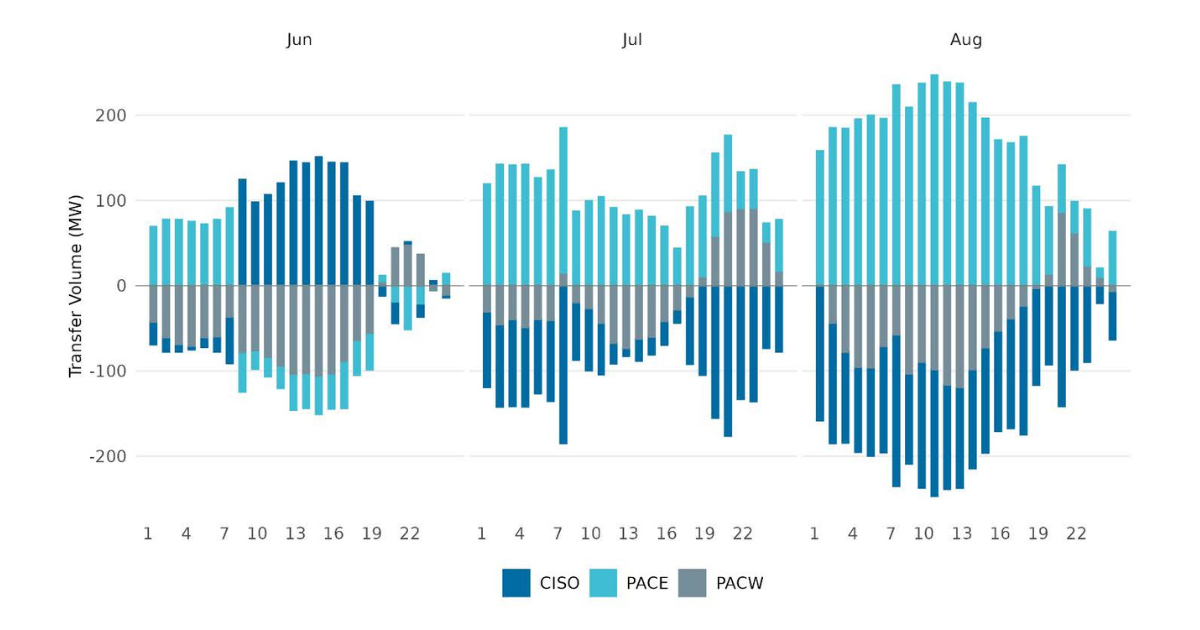
Average hourly trends, seen in Figure 1 below, also show how the direction and amount of electricity transferred can change significantly throughout the day.
- In June, California exported electricity during the sunny midday hours, but imported power in the evening as solar generation declined while electricity demand remained high.
- By July, California was importing electricity throughout the day, with the greatest imports during the evening hours and relatively little during midday.
- In August, as summer demand peaked, California imported substantial amounts of electricity consistently throughout the day.
PacifiCorp West also showed changing hourly patterns, importing during the day but exporting during the evening and nighttime hours when solar generation across the region declined.
Source: EDAM Performance August Report
The Extended Day-Ahead Market also enables participants to share flexibility, not just energy
Imbalance Reserves, a new product introduced with the Extended Day-Ahead Market, secure flexible capacity on a day-ahead basis to manage differences between forecasts and real-time conditions. These reserves can be transferred across the market, allowing available flexibility in one area to support another in the real-time market.
For example, if unexpected cloud cover reduces solar generation in California below the day-ahead forecast, flexible resources in neighboring areas can help make up the shortfall in the real-time market. Similarly, if electricity demand rises above expectations during a summer heat wave, utilities can draw on additional flexibility.
This ability to tap into flexibility across the region can help participating utilities manage changes in demand and renewable generation together rather than relying only on resources within their own balancing authority areas.
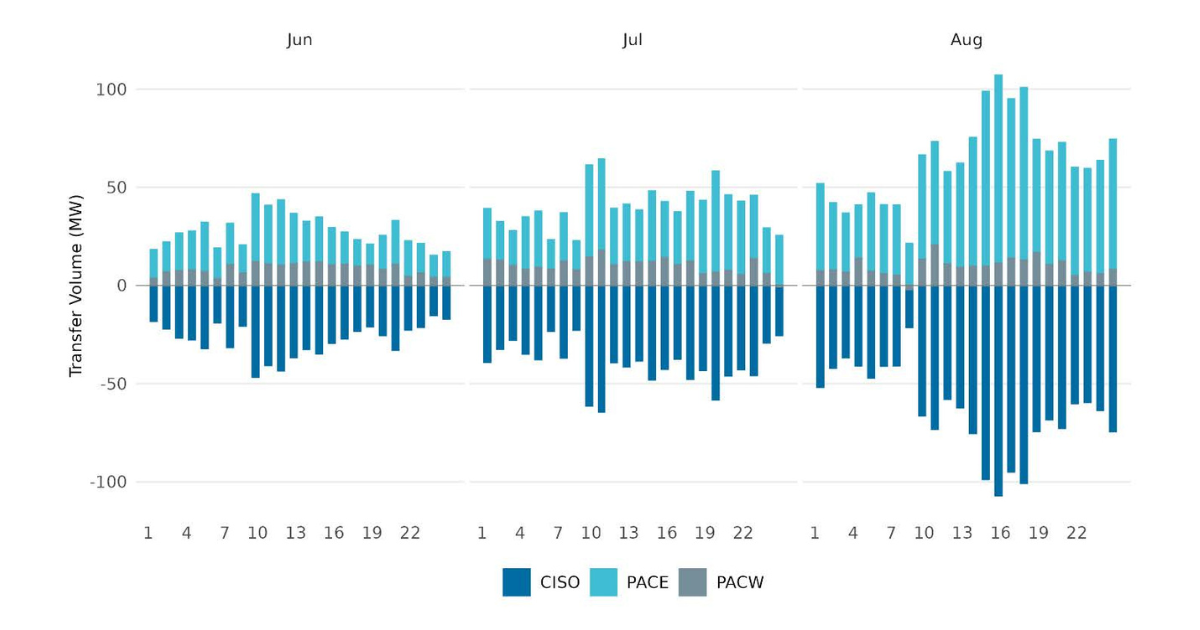
The same regional coordination is taking place with Reliability Capacity, another new Extended Day-Ahead Market product. The day-ahead market clears electricity based on supply and demand bids, while California ISO also develops its own forecast of electricity demand. This product helps ensure additional capacity is available when the amount of electricity cleared in the day-ahead market falls short of this forecast.
Reliability Capacity Up transfers between balancing authority areas increased 58% from July to August, reaching their highest levels since the Extended Day-Ahead Market launched.
Source: EDAM Performance August Report
Looking ahead
Portland General Electric saw a smooth operational switch over to the Extended Day-Ahead Market, giving confidence to other utilities considering joining the market. The market’s performance confirms what advocates have been saying for years: the bigger the market, the bigger the savings. And this is only the start.
Together, growing transfers of energy and other reliability products show that the Extended Day-Ahead Market is beginning to deliver on a central promise of a regional market: allowing utilities to share not only cheap clean electricity that lowers costs, but also the flexibility and capacity needed to support grid reliability across the West.