







Regional Greenhouse Gas Initiative’s September auction raises over $1 billion for investments in clean, affordable energy
Written By


Share
Summary
- The Regional Greenhouse Gas Initiative’s 73rd auction settled at $37.65 for the first time in the program’s history, generating over $1 billion for investments that will expand clean, affordable energy and energy efficiency — lowering bills, improving air quality, and cutting climate pollution across participating northeast and mid-Atlantic states.
- This auction was the first after Virginia’s re-entry into the Regional Greenhouse Gas Initiative. It comes ahead of the sixth control period compliance deadlines and ahead of anticipated implementation of program updates including a strengthened pollution cap in early 2027.
- The Regional Greenhouse Gas Initiative is a longstanding and proven power sector pollution reduction program. Investments to date are projected to save ratepayers in the region $23 billion, while climate pollution from power plants in the region has been cut in half since 2005. Increased investment and Virginia’s re-entry will ensure more communities across the region experience these benefits.
Results were released last week for the Regional Greenhouse Gas Initiative’s third auction of the year, and 73rd overall. The auction, held on September 9, 2026, is the first since Virginia officially re-entered the program on July 1 of this year.
This auction also comes ahead of RGGI’s next compliance deadline on March 1, 2027 for the sixth control period ending on December 31, 2026, and ahead of anticipated program updates in early 2027, including a strengthened pollution cap.
Cap-and-invest 101
RGGI’s Cap-and-Invest auctions are administered quarterly by RGGI, Inc. on behalf of the participating states. During the auction, compliance entities submit their bids for allowances.
RGGI is a cooperative policy approach across 11 participating states in the Northeast and Mid-Atlantic that sets a binding, declining limit on pollution. Large power plants in participating states are required to hold one allowance for every ton of climate pollution they emit, with the total number of allowances decreasing each year.
September auction results
- All 27,389,847 current vintage allowances offered for sale by participating states and all 1,148,000 cost containment reserve allowances were purchased, resulting in a sold out auction with 28,537,847 total allowances sold. No emissions containment reserve allowances were withheld.
- The auction settled at $37.65, $34.96 above the price floor of $2.69 and $2.65 above RGGI’s last quarterly auction price of $35.00.
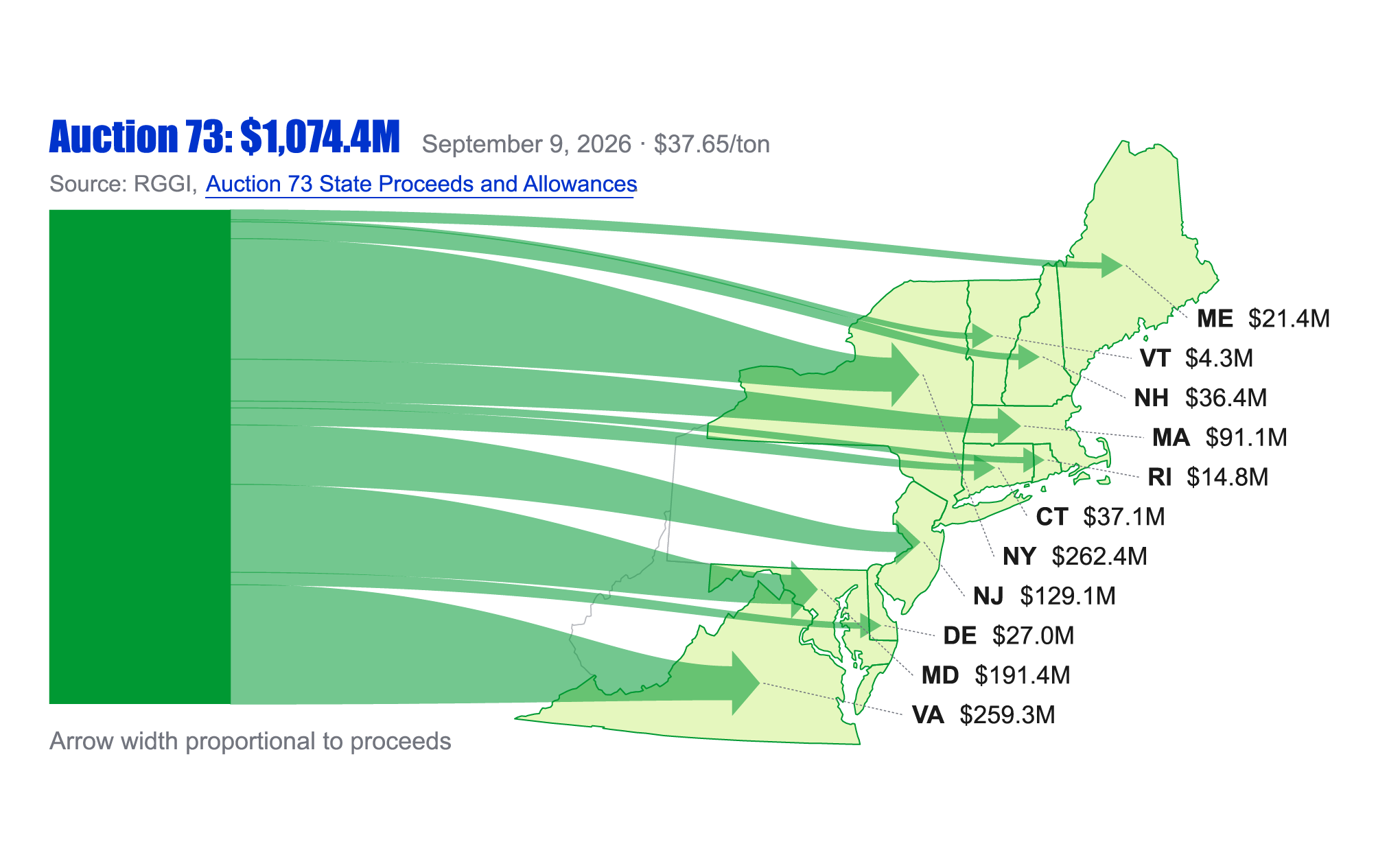
- This auction generated $1.07 billion in revenue, which will be invested into a range of programs to expand clean, affordable energy, energy efficiency, community resiliency programs and provide electric bill credits. These programs lower bills, improve air quality, cut climate pollution, create jobs, and make communities safer during extreme weather events.
What these results mean
Wednesday’s 73rd RGGI auction marked two major milestones for the nation’s longest-running carbon market: Viriginia participated in its first auction since rejoining RGGI, and the auction generated more than $1 billion for participating states for the first time in the program’s history.
Why prices rose
Allowances settled at $37.65, the highest clearing price in RGGI’s history and $2.65 above the record set in June. Bids came in at 2.6 times the initial offering. The immediate driver is supply: the cost containment reserve, the mechanism that releases extra allowances when prices climb, was fully drawn down for the ten long-standing states back in March, and the 1,148,000 reserve allowances Virginia brought to this auction were all sold. Compliance entities are also securing allowances ahead of the sixth control period ending on December 31, 2026. Virginia’s return adds supply, but it adds obligation too, and the state’s emissions have grown since it left the program in 2023.
How investment of proceeds can deliver for affordability
A higher allowance price means more money flowing back to states. With a strategic investment portfolio, states can actively lower electricity costs for residential ratepayers — especially low- and middle-income households — over the near- and longer-term, while at the same time supporting decarbonization goals.
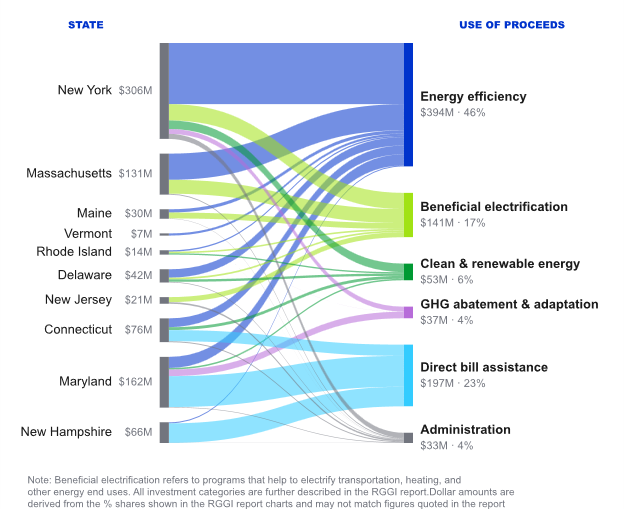
Energy efficiency investments lower electricity consumption and ultimately lower bills for households on a durable, long-term basis. Investments to help residents and communities electrify transportation and heating and install distributed energy resources like rooftop solar and batteries also support lower and more stable monthly bills as households are less exposed to volatile fossil fuel costs.
At the same time, states can return proceeds directly to customers to immediately put downward pressure on bills. Several RGGI states return revenue directly to customers at fixed percentages (e.g. NH, MD) or when proceeds reach a certain threshold (e.g. CT, NY). Across the region, direct bill assistance accounted for $197 million, or 23%, of 2024 investments. Since that time, states have directed an increased amount of revenue to bill credits.
States can size a credit to fully or more than fully offset the bill impact for low- and moderate-income households, or for all residential ratepayers, and still fund efficiency, resilience, and electrification priorities. In other words, states have flexibility to make residential ratepayers better off relative to a scenario without RGGI, with savings growing as allowance prices increase.
Importantly, as total RGGI proceeds increase, additional use of revenues for bill credits can be consistent with growing investment in priorities like efficiency and electrification that are essential for medium to long-term savings, depending on the specific revenue allocation strategy of the state. And, using revenues to reduce electricity bills itself is consistent with decarbonization, as electrification of transportation, buildings, and other sectors is critical to achieving economywide emissions targets.
Background on RGGI
Launched in 2009, RGGI caps power sector emissions across 11 states in the Northeast and Mid-Atlantic and requires power plants to purchase allowances for every ton of pollution they emit. Proceeds from the sale of allowances are re-invested by states in programs to scale clean, affordable energy, help residents and businesses make energy efficiency upgrades, and provide direct credits on electricity bills. These investments have lowered electricity bills, improved public health and supported local economies since the program’s inception.
Since its launch, this longstanding, proven example of collaborative climate policy has helped cut climate pollution from power plants across the region in half compared with 2005 levels and generated $8.6 billion in cumulative auction proceeds as of 2024. Participating states have already invested $5.73 billion as of 2024. Over their lifetimes, these investments are projected to save ratepayers more than $23 billion on their energy bills, or roughly $4 in bill savings for every $1 invested. In its first six years alone, RGGI supported 48,000 job-years and yielded over $5.7 billion in public health benefits, including fewer heart attacks, mitigated respiratory illnesses, and fewer premature deaths.
This proven program — the very first market-based system designed to reduce climate pollution in the U.S. — underscores the effectiveness of cap-and-invest policies that require polluters to pay for their pollution and reinvest revenue in programs that lower energy bills and benefit communities.
Looking ahead
States across the Northeast and Mid-Atlantic are working to update their RGGI regulations, implementing agreed-upon changes that will strengthen the pollution reduction and investment benefits of the program while introducing new cost containment mechanisms. New York became the first state to finalize its revised rules in early August, and others are working through the regulatory revision process and expected to follow New York this fall.
The remaining RGGI states should move expeditiously to finalize their rulemaking so the strengthened program can begin delivering even greater pollution reductions, energy savings, public health benefits and investments in local communities in 2027. With a proven track record already behind it, strengthening RGGI will allow participating states to build on their progress and ensure residents across the region continue to share the program’s benefits.