







States are moving forward to strengthen the Regional Greenhouse Gas Initiative, accelerating pollution cuts and investments in clean, cheap energy
Posted: in News
Written By


Share
Summary
- RGGI states are making progress to update program rules that will enable this proven program to deliver more cuts in climate pollution and scale up investments in clean, affordable energy in the years to come.
- New York just took a leading step to finalize its updated rules, joining Maryland, Rhode Island and Vermont. Other states are underway and expected to do the same this fall.
- RGGI investments to date are projected to save ratepayers in the region $23 billion, while climate pollution from power plants in the region has been cut in half since 2005. Updates will ensure more communities across the region experience these benefits.
States across the Northeast and Mid-Atlantic are working to update their rules for the Regional Greenhouse Gas Initiative, implementing agreed-upon changes that will strengthen the pollution reduction and investment benefits of the program while ensuring it remains durable for years to come. New York just became the latest state to finalize its revised rule, joining Maryland, Rhode Island and Vermont. Other participating states are working through the regulatory revision process and expected to follow suit this fall. RGGI has been delivering cuts in climate pollution for nearly 20 years, investing billions in clean, affordable energy, and delivering major public health benefits at the same time.
Remind me, what is RGGI again?
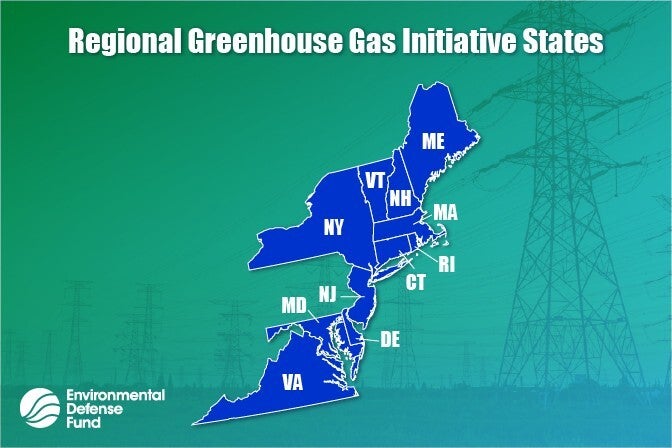
Launched in 2009, RGGI caps power sector emissions across 11 states in the Northeast and Mid-Atlantic and requires power plants to purchase allowances for every ton of pollution they emit. Proceeds from the sale of allowances are re-invested by states in programs to scale clean, affordable energy, help residents and businesses make energy efficiency upgrades, and provide direct credits on electricity bills. These investments have lowered electricity bills, improved public health and supported local economies since the program’s inception.
Since its launch in 2009, this longstanding, proven example of collaborative climate policy has helped cut climate pollution from power plants across the region in half compared with 2005 levels and generated $8.6 billion in auction proceeds as of 2024. Participating states have already invested $5.73 billion as of 2024, with another $2.54 billion committed for future investment. Over their lifetimes, these investments are projected to save ratepayers more than $23 billion on their energy bills, about $4 in bill savings for every $1 invested. In its first six years alone, RGGI supported 48,000 job-years and yielded over $5.7 billion in public health benefits, including fewer heart attacks, mitigated respiratory illnesses, and fewer premature deaths.
This proven program – the very first market-based system designed to reduce climate pollution in the U.S. – underscores the effectiveness of cap-and-invest policies that require polluters to pay for their pollution and reinvest revenue in programs that lower energy bills.
What’s happening now? States are putting Program Review updates into regulation
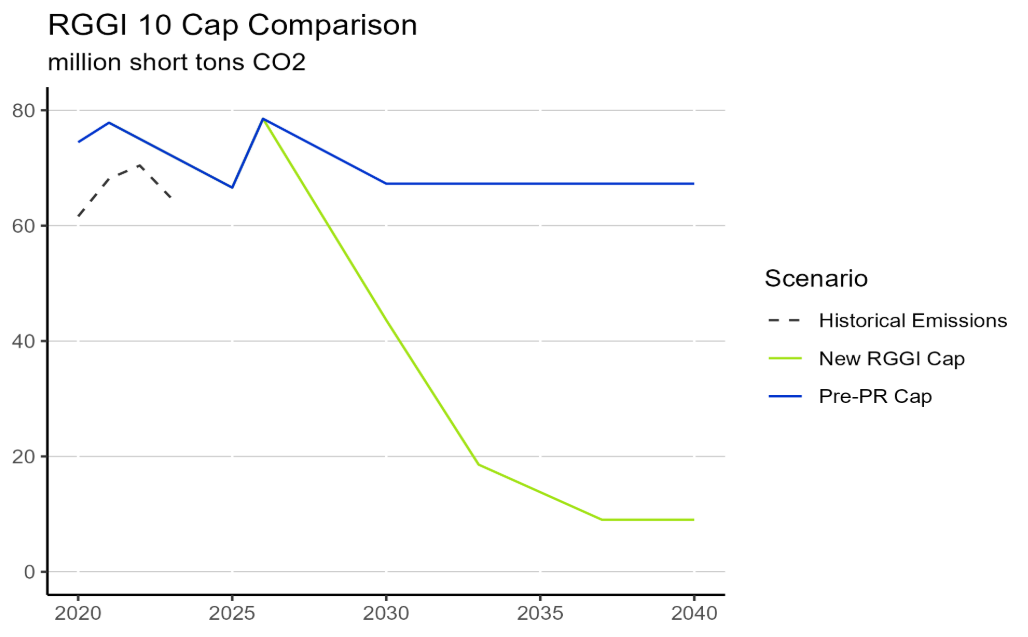
Every so often, RGGI states work together to review and revise the rules for the program to ensure it is effectively and efficiently delivering on its goals. Last summer, participating states concluded their Third Program Review and announced updates that strengthen the regional cap on climate pollution, beginning in 2027. Changes also introduce new measures to protect energy affordability and reaffirm the program’s commitment to cutting pollution, promoting clean energy and supporting local communities. The conclusion of the program review means that participating states agreed on a new “model rule” that incorporates these changes.
Importantly, under the new model rule, the emissions cap declines by about 8.5 million tons per year from 2027 through 2033 — or about 10.5% of the 2025 cap. After 2033, the cap declines by about 2.4 million tons per year, or 3% of the 2025 budget. The updated cap reflects a 76% reduction in power sector carbon emissions from 2005 levels by 2030, bringing RGGI more closely into line with the emissions pathway in the power sector needed to meet the climate goals that many climate leadership states have committed to.
With the new model rule in hand, each participating state must go through its own administrative process to update its RGGI regulation. This process looks a bit different in each state, but it commonly involves an opportunity for the public and interested stakeholders to review and comment on the revised regulations.
All participating states are working towards finalizing their updated rules by the end of this year, enabling the program changes including the updated pollution cap to go into effect January 1, 2027.
New York leadership adds to growing momentum for a stronger RGGI
New York has long been a leader in the RGGI program and is taking up the mantle once again. The state became the latest – and the largest – in the region to finalize its updated regulation earlier this month. These changes, alongside updates in other states once final, will ensure the health and bill-lowering benefits of RGGI reach even more New Yorkers in the years to come. The announcement from state agencies emphasized proven benefits of RGGI including pollution cuts and net savings of $12 billion for New York ratepayers, a six-to-one return on $2 billion in investments to date.
DEC Commissioner Amanda Lefton said, “RGGI is a longstanding and successful example of multi-state collaboration that delivers real benefits to New Yorkers, including affordability, decreased emissions and improved public health. Implementing these regulations as part of the program review with the rest of the RGGI participating states, will further enhance New York’s ability to deliver clean and affordable energy solutions and healthy communities.”
NYSERDA President and CEO Doreen M. Harris said, “Strengthening RGGI reinforces New York’s leadership in lowering emissions while generating resources that help make clean energy more affordable and accessible for New Yorkers. Through these investments, NYSERDA is expanding access to clean transportation options, more efficient and comfortable homes and buildings, and job opportunities across the state – delivering benefits to communities from Long Island to Buffalo.”
A stronger and more durable RGGI program in New York will provide critical investments to programs that lower energy costs for residents. Examples of programs funded by RGGI to date that will be scaled as a result of these updates include:
- EmPower+, which provides low and moderate-income households up to $10,000 to upgrade their homes with energy efficiency measures that cut utility bills by $600 a year.
- NY-Sun, which makes cheap, local solar energy more accessible to homes and businesses. During the first week of a heatwave in New York this July, rooftop and community solar helped New Yorkers save an estimated $200 million in electric costs by reducing peak demand on the grid.
- The Drive Clean Rebate program, which has helped more than 225,000 New Yorkers switch to an EV and save on the order of $370 to $1,000 per year on fuel costs alone.
Other states have a lot to gain by finalizing their rules
The remaining RGGI states are all on the path to updating their rules by the end of this year – working at the agency level to update their rules and review public comments. And, they all stand to gain by following through with updates to their rules on time. Here are just a few examples of the ways RGGI is benefiting communities, the environment, and the economy in other participating states:
- New Jersey
- RGGI has enabled $205 million in investments across 384 projects in New Jersey as of December 2024, with 88% of those funds invested in Environmental Justice communities.
- Over their lifetimes, these projects are expected to avoid roughly 587,000 metric tons of greenhouse gas pollution and generate more than $75 million in public health benefits.
- RGGI investments are bringing cleaner vehicles to New Jersey communities: A $70 million investment has helped put 114 electric school buses and 26 electric transit shuttles on the road, while other RGGI funds are electrifying municipal vehicles like fire trucks – cutting diesel and tailpipe pollution where kids learn and families live.
- Virginia
- Virginia rejoined RGGI in July under Gov. Spanberger, after the Youngkin administration had previously withdrawn the state from the program.
- During Virginia’s previous participation from 2021-2023, power plant carbon emissions fell 22% and the program generated $827.7 million in auction proceeds for the Commonwealth.
- 45% of those proceeds – more than $372 million – went to the Community Flood Preparedness Fund, supporting flood planning, resilience and mitigation projects across Virginia, while 50% supported low-income energy-efficiency and affordable housing projects.
- Connecticut
- RGGI has generated more than $627 million for Connecticut since the program began, supporting direct rate relief, energy-efficiency programs, clean-energy investments, and clean-vehicle rebates.
- Of these proceeds, the state has used $117 million for direct electric-rate relief and $338 million for energy-efficiency investments; those efficiency programs are estimated to return $2.38–$3.30 in economic benefits for every $1 invested.
- RGGI has also delivered major health benefits in Connecticut: reductions in fossil-fuel air pollution produced an estimated $152 million to $364 million in health benefits in the program’s first six years alone, including fewer asthma attacks, cardiovascular and respiratory illnesses, premature deaths, and lost workdays.
New York and other leading states have demonstrated what timely implementation can look like. The remaining RGGI states should move expeditiously to finalize their rulemaking so the strengthened program can begin delivering even greater pollution reductions, energy savings, public health benefits and investments in local communities in 2027. With a proven track record already behind it, strengthening RGGI will allow participating states to build on their progress and ensure residents across the region continue to share the program’s benefits.