






Energy Exchange

New Thinking Is Critical To Better Manage Water And Electricity Resources In Texas

Central Texas Workshop Discusses Opportunities For Resiliency During Extreme Weather Events

This commentary was originally posted on our Texas Clean Air Matters blog.

Last week, I attended a regional workshop that focused on adapting to extreme events, sponsored by the U.S. Environmental Protection Agency (EPA), the National Oceanic and Atmospheric Administration, the Water Environment Research Foundation, the Water Research Foundation, Concurrent Technologies Corporation, and Nobilis. This workshop was the sixth in a series organized around the country to determine what is needed to increase the resilience of water utilities and communities in the face of extreme weather events. While the focus was on water, time and again, electricity was brought into the conversation—the two are closely linked, and in Texas, a state facing shortages of both water and power, this will require some creative thinking on our part.

This workshop focused on Central Texas, in particular our drought. But as the two-day workshop went on, it became clear to the organizers when local water utilities and other stakeholders spoke, that drought was only one extreme event that Texas has had to deal with…and continues to deal with. We are a state of extremes—weather, politics, personalities—and we not only have drought to handle, but also hurricanes, floods, tornadoes, wildfires, and just generally scorching heat. One of the first speakers was John Nielson-Gammon, the State Climatologist based out of Texas A&M University. He confirmed that while these natural phenomena are not new to Texas, we are experiencing more intense weather events. Last year was one of the hottest in Texas since we started recording temperatures, and we are heading into the third year of a pretty gruesome drought. Not being prepared for extreme events to get worse seems pretty foolhardy.

During the workshop, we heard from a variety of speakers from around the Central Texas region, including from the Barton Springs/Edwards Aquifer Conservation District, the Lower Colorado River Authority, rice growers, the University of Texas, the high tech industry, and individuals from Austin, San Antonio, and Bastrop. These people are dealing first hand with the impacts of the extreme events we’ve had in the past few years. They are simultaneously trying to manage the current situation while planning for what the changing climate means in the coming years. It’s a difficult balancing act.

As an outsider to the planning process, I was asked to report on the proceedings of a meeting at the end and to give an overview of my impressions of the workshop. My impressions were as follows:

It is crucial to balance short-term preparedness with long-term resiliency, and neither should be sacrificed at the expense of the other. Planners in Central Texas know how to handle floods, fires, and drought, but the intensity of these natural phenomena will likely increase with the effects of climate change. It’s also essential to ensure that we are protecting our water and electricity needs for the long-term.

There is tension between urban and rural needs. This is not a new concept, and it is particularly tense with regards to water needs. Often the decisions about water and electric needs are made in cities, and city dwellers may think of rural needs only in the abstract. But protecting the quantity of water available for farmers and ranchers is how we feed our urban populations. Some cities in Central Texas are, out of necessity, dealing with this issue. In the wake of the wildfires in Bastrop, planners in that area are taking a closer look at how homes are constructed and how the urban/rural interface affects the ability to provide water for its population and prevent future wildfires. Controlled burns are one way that wildfires are prevented, but you can’t do controlled burns in a subdivision built into a forest. Thinking about developing our communities in more thoughtful ways is critical.

Adapting to our changing climate necessarily includes water, but it also goes beyond water. Emergency preparedness must include ensuring adequate water supplies and electricity. We can envision extreme events in Austin because we’ve had them in the past: fatal flooding, tornadoes, wildfires, drought, and heat waves. These extreme events will likely intensify as climate change advances, and we need to be comprehensive in our planning. We know that we’re facing potential electricity shortages within the next three years, and water supplies are already stressed. We also have to take into consideration whether our current infrastructure can maintain our growing population, especially in the face of future extreme events, and what those events mean in terms of health impacts. Many evacuees from Hurricanes Katrina, Rita and Ike were dehydrated and fell sick, and healthcare workers across the state responded heroically. We should anticipate more vulnerable populations in the wake of extreme events in the future. Read More »

Posted in Energy Efficiency, Texas, Water | Comments closed

Should America Get Behind The Fuels Of The Future Or The Past?

One of Yogi Berra’s famed quotes is about to apply to America’s energy policy:  “When you come to a fork in the road, take it.”

The truth is, America’s been staring at a fork in the road for a few decades.  Every president since Nixon has talked about freeing the country from its dependence on foreign oil.  And each recent administration has understood that our energy policy affects more than the price of a gallon of gas or a kilowatt of electricity.  It affects job growth, technological innovation and environmental progress (or decline).

The last few months of the budget and debt debate gives us a good picture of the paths America could take.

One path, embraced for years by both parties, entails government investments in new, clean, efficient and affordable energy.  It harnesses the creative talents of our top scientists, engineers, businesspeople and research centers.

The other, most recently articulated in Representative Paul Ryan’s budget, is driven only by a doctrinaire obsession with cutting government – no matter what we sacrifice in doing so.  According to that view,  the government need not invest, because the private sector has it all figured out.  That’s a stunning philosophy given that some of the most important breakthroughs – the Internet, our space program, wind and solar energy development – have happened because government and industry worked hand-in-hand.

The President recently called for a $2 billion Clean Energy Trust that would fund energy research and development.  That’s exactly the kind of thing we need in order to continue the clean energy technology revolution that will make it possible to reduce imports of foreign oil and weaken the threat of rising greenhouse gas emissions. The budget is tight, so how do we find the money for it?  By using money collected from oil companies when they drill for oil and gas on federal lands.  Put another way, we can use some of the proceeds from the fossil fuel industry to help accelerate the transition to a clean, low-carbon energy economy.  Read More »

Posted in Innovation, Oil, Renewable Energy, Washington, DC | Tagged , | Comments closed

Chasing Green: Going Solar By Paying Your Utility Bill

This commentary was originally posted on our EDF Voices blog.

Source: SolarPowerForYou/Flickr

So far, my experience is that environmentalists and business executives often speak different languages. Take the basic idea of sustainability. To an environmentalist, sustainability, as applied to a business, refers to the amount of environmental damage it will cause over time. To a business person, the term refers to the ability of the business to generate profits and so sustain itself.

In other words, there is a profound difference between the "green" that environmentalists are focused on and the "green" that businesses must generate to survive.

At EDF, I am trying to bring those two camps together. Broadly defined, my work involves creating opportunities for companies to make profits by selling products that benefit the environment, usually by reducing carbon emissions. My belief is that, with the right incentives and market structures, the profit motive can be a powerful force for change. Green companies that hire workers also create new advocates for environmental policy.

A study by McKinsey, the big consulting outfit, has shown that there are potentially hundreds of billions of dollars in energy efficiency investments that could yield annual returns of 7% to 20%. At a time of historically low yields on fixed income investments, like bonds, those are pretty good numbers.

Mostly, I focus on increasing investment in energy efficiency and renewable generation projects for homes, offices and other commercial properties. In many cases we can lower a building’s utility bills, including financing costs, while also reducing carbon emissions.

Take investments in solar technologies. I am lucky enough to have pretty good credit and was able to get a solar installer to finance a rooftop installation that provided my wife and I with immediate savings. Unfortunately, many homeowners do not currently qualify for financing. So EDF is working to decrease financing costs and increase availability of capital for such projects through a program called On-Bill Repayment (“OBR”).

OBR can help a building owner finance, say, a rooftop solar array, with money put up by an third part investor, and then repay that loan through his or her monthly utility bill. The costs of the loan are reduced because the loan is part of the legally binding rate tariff for the property, and will remain in place even after a foreclosure.

Once we have OBR in place, far more homeowners should be able to finance the upfront cost of installing energy efficiency or solar projects that lower their bills. This creates jobs, saves money and is good for the planet. What’s not to like?

Take California. The state is expected to initiate an OBR program for commercial properties in about 4-6 months. EDF’s economists estimate that this program over the next 12 years will lead to about $7 billion in third-party clean energy investment, create 50,000 job-years that cannot be exported. Over the same period, OBR will the cut carbon emissions by 10.3 million tons, the equivalent to replacing 180,000 gasoline cars for 12 years with solar-powered electric vehicles. And the environmental benefit will continue to grow as we add residential customers and expand to other states.

OBR is just one way in which business and the environment can coexist. In future blog posts, I will look at other ways to achieve the same end.

Posted in Energy Efficiency, On-bill repayment, Solar | Tagged , | Comments closed

ALEC Updates & Action Alert: State-By-State Renewable Energy Attacks Are Underway

Back in November, I wrote about how the American Legislative Exchange Council (ALEC) was partnering up with the Heartland Institute to attack renewable energy standards across 29 states. As an organization propped up by the fossil fuel industry, this behavior comes as no surprise. But the sneaky way they are trying to undue laws that encourage solar, wind and other renewable energy sources needs to be exposed and citizens of these states must stand up to the corporate interests desperately holding onto their power to pollute.  Across the country, we are watching ALEC and industry allies try to unravel decades of progressive energy legislation.

In the sunny southwest, the Arizona Corporation Commission (ACC) has eliminated the performance-based incentives (PBIs) provided to commercial solar energy customers by the state’s two investor-owned utilities (IOUs). It also drastically reduced the upfront incentives (UFIs) provided by the IOUs to residential solar energy customers. SolarCity Governmental Affairs Director Meghan Nutting explained that “as the Arizona incentives have been slowly reduced, the industry has kept up. Ratepayers have invested in the industry to a point where we are almost without a need for incentives. But a sudden and complete elimination of all incentives that cuts the commercial solar industry off at the knees means we will have to start over.” The ACC decision, she added, means “people are going to lose their jobs in the sunniest state in the country in an industry that Arizona has depended on through the recession and should dominate.” The ACC commissioners’ rationale for the cuts was that they will reduce the Renewable Energy Standard and Tariff (REST) premium added to Arizona ratepayers’ utility bills to fund solar. The REST premium was established by the ACC in 2007 and is capped at $4.00 per month. Calculations by Arizona solar advocates concluded that the PBI cuts will save APS ratepayers no more than $0.02 to $0.06 per month.

Read More »

Posted in Renewable Energy, Texas | Tagged , , , | Comments closed

Colorado: A Case Study In Clean Tech Planning And Execution

In a recent posts, we revisited the recent trio of reports of the clean energy clusters in Ohio, Iowa and Colorado and shared some insights on lessons learned from Iowa and Ohio.  In this post, we'll take a look at Colorado.

Colorado is the 12th windiest state in the U.S. and is currently 9th in installed wind capacity. It's one of only six states that have exceeded 10% of state generated electricity coming from wind.  For more than a decade, Colorado has been atop most lists for states vying for leadership in the clean energy economy.  It has research labs, a proactive state government, universities and active economic development efforts.  All of these have combined to help Colorado excel in the new energy landscape.

Consider that Golden, CO is home to the National Renewable Energy Laboratory (NREL), the only federal lab dedicated to research, development, commercialization and deployment of renewable energy and energy efficiency technology.  For more than 30 years, NREL has been working on advancements in solar, wind, geothermal and other renewable energy sources.  NREL, Colorado universities and private companies have leveraged the hometown lab to establish specialized research centers in several of these areas and contribute more than $700 million in the economic activity of Colorado each year.

The Denver-metro area, where our report focuses, has become a particularly popular place for cleantech startups and more mature companies.  In 2011, the region had about 1,500 companies and 18,000 employees in the cleantech industry, a 35% increase in direct employment growth from 2006. In terms of the entire Colorado workforce, cleantech employees account for 1%.  But that's twice the national average and generates more than a billion dollars in annual wages. Read More »

Posted in Renewable Energy, Wind | Tagged , , , | Comments closed

30 Years Of Forward-Thinking Leaders Has Spurred Iowa's Clean Tech Growth

People who haven’t been following the renewable energy industry will be forgiven for their reaction when they’re told that Iowa is among the most advanced, opportunistic state in the cleantech economy.  “Iowa?  Isn’t that corn country?”

Well, yes.  But it’s also wind country.  And like few other states, Iowans have turned their constant breeze into a powerful economic force.

This is the last in a trio of posts highlighting the findings from EDF’s reports on the cleantech economies of Ohio, Colorado and Iowa (here is my last post on Ohio).  Today, I’ll focus on Iowa.

Despite its size, Iowa produces the second most wind power in the U.S. (Texas is #1 and California is #3) and is one of only two states that receives over 20% of its electricity from wind power.  More impressive has been the state’s ability to capture the economic — not just the environmental — benefit of that ranking.  According to the American Wind Energy Association, Iowa has attracted more major wind industry manufacturers than any other state.  It’s a great example of supply meeting demand.

Politically, wind power has been supported by both parties for three decades.  It was the first state to pass a Renewable Portfolio Standard, under republican Governor Terry Branstad in 1983.  In 2005, democratic Governor Tom Vilsack signed a tax credit for renewable energy production.  And in 2007 democratic Governor Chet Culver created the Iowa Power Fund to invest in local renewable energy research and development projects.  This level of across-the-aisle cooperation is unique among states and has given Iowa a considerable advantage in competing against larger and richer states. Read More »

Posted in clean energy, Renewable Energy, Wind | Tagged , , , | Comments closed

EDF And Others Honored For New York City's Carbon Emissions Video

Source: Carbon Visuals

Last week, Environmental Defense Fund (EDF) and Carbon Visuals, a UK-based firm (brought to EDF’s attention by Power Angels) dedicated to “communicating carbon data more effectively,” were honored by American Clean Air Skies Foundation at their awards gala to commemorate videographers and web-based innovators for works that bring climate change and energy resources to mainstream media.  Carbon Visuals produced a video, funded by EDF, which encapsulates, literally, New York City’s (NYC) carbon emissions in a year’s time.  The video shows blue bubbles as they multiply and expand to cover NYC’s skyline over the course of an hour, day and year.  It was designed to engage everyday people who use energy (which is everyone!), helping them to visualize the magnitude of carbon emissions emitted in order to better understand why we must act NOW to accelerate the transition to the clean, low-carbon energy economy we need to avoid climate catastrophe.

This visually impactful video was made possible with the support of NYC and its exemplary effort to track and reduce greenhouse gas emissions.  The City of New York provided a report from September 2011, Inventory of New York City Greenhouse Gas Emissions, documenting the 54 million metric tons of carbon dioxide (CO2) – the principal contributor to man-made climate change – NYC added to the atmosphere that year.  The building sector alone contributed approximately 75 percent of the emissions, with the bulk of the remainder attributed to the transportation sector.  While these figures may seem irreversible, NYC and Mayor Bloomberg have made considerable strides to reduce emissions in one of the most energy-intensive cities in the world. For instance, emissions in 2010 were 12 percent less than 2005 emissions, and NYC continues to stay on track to reduce emissions by 30 percent by 2017 – a commendable target.

Read More »

Posted in Climate, Energy Efficiency, Investor Confidence Project, New York, On-bill repayment | Tagged | Comments closed

We Cannot Afford To Undo Economic And Environmental Progress In Ohio

EDF is working with Ohio elected officials, the small business community and other stakeholders on adopting an on-bill repayment (OBR) program in Ohio.  As a private capital solution to financing energy efficiency (EE) and renewable energy (RE) projects, OBR enables building owners to access low-cost capital, with repayment on their utility bills.  Small businesses in particular have trouble accessing affordable financing for energy projects, as it is hard for lenders to assess small to medium-sized business (SMB) credit risk and SMB properties are likely rentals that experience high turnover rates.  OBR provides lenders with significant credit enhancement, since the repayment obligation is tied to the utility meter and survives changes in rental and ownership.  At the same time, utilities and customers can benefit from a well-designed OBR program – one that compensates utilities for their services and allows utilities to receive credit toward state mandates for the OBR-enabled EE and RE investments.

As we at EDF endeavor to increase demand for clean energy projects in Ohio, other parties, including the American Legislative Exchange Council (ALEC), have proposed rollbacks to Ohio’s energy efficiency and renewable portfolio standards.  The standards were established by SB 221 in 2008, with bi-partisan support,– and there is a strong effort underway to defend them.  EDF is working with other Ohio clean energy stakeholders to keep the existing standards in place.  As we actively participate in this dialogue, EDF vigorously supports the State’s commitment to investing in clean energy – a commitment that has resulted in environmental and economic progress from which we cannot afford to undo.

EDF’s clean energy economic development series documented progress made in Ohio to date, which is extremely promising:

Stimulating Demand

The 1992 Energy Policy Act seeded demand for renewable energy and energy efficiency through tax credits and other programs.  In Ohio, two important state efforts in 1999 expanded on this federal support.

The Advanced Energy Fund, created by the Ohio Electric Restructuring Act, provided funding for energy efficiency and renewable energy projects.  The same bill introduced net metering, which allows homes and businesses that install alternative energy technology — solar, wind, biomass, hydro, etc. — to receive credit for the excess energy their systems generate.  Combined, these two efforts provided ways for individuals to reduce the cost of deploying "clean tech" or even turn it into a revenue generator.   Read More »

Posted in clean energy, Energy Efficiency, On-bill repayment, Renewable Energy | Tagged , , | Comments closed

New BLM Proposals For Large Oil And Gas Fields Ignite Wyoming Air Quality Concerns

Wyoming is already one of the country’s top natural gas producers. And large new developments under review by the

Source: Anne Nowell

U.S. Bureau of Land Management totaling more than 25,000 new wells in the coming years could further solidify Wyoming's status as a national energy leader.

But what will this leadership look like? Will this series of development projects lead to worsening air quality or set an example for safe, responsible development?

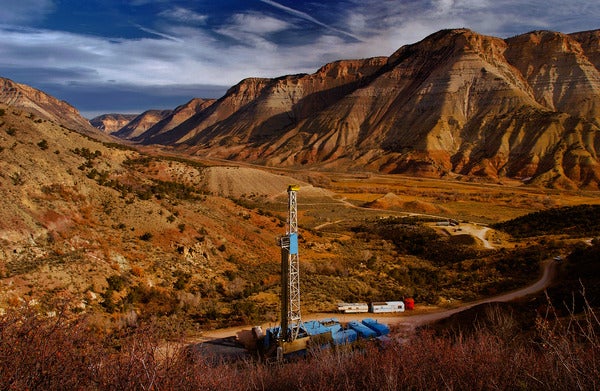
The first of these, the Continental Divide – Creston Project, is alone one of the largest onshore natural gas developments ever proposed on federal lands in the United States. This enormous development slated for the Wamsutter area of south-central Wyoming, includes drilling nearly 9,000 new natural gas wells across 1,672 square miles (or 1.1 million acres) of public and private lands — an area a bit larger than the state of Rhode Island. The well-known Jonah Field in western Wyoming, by comparison, covers about 21,000 acres and includes about 3,500 wells.

The scale, concentration and vicinity of new wells proposed by the CD-C project are fueling concern for regional air quality issues. If managed improperly, this project could lead to more unhealthy air for local residents and workers.

Unhealthy air, as a result of oil and gas development, has been a particular issue in Pinedale, a community just northwest of the CD-C proposal in Wyoming’s Upper Green River Basin. The past few winters have earned the area unwanted national attention for its U.S. Environmental Protection Agency nonattainment designation for ground-level ozone pollution – one of the first non-urban areas to report such high levels of smog. Read More »

Posted in Climate, Methane leakage, Natural Gas | Tagged , , | Comments closed

Solar, Wind Prompting Electricity Grid Innovation In California

In a February Wall Street Journal article (“California Girds for Electricity Woes”), reporter Rebecca Smith gives an alarmist and misleading account of California energy regulators’ efforts to secure a cleaner, less expensive, more reliable electricity grid.  Right now, California has plenty of power:  44 percent more generating capacity than it typically uses, including a considerable fossil fuel energy portfolio.  Renewables – large scale, rooftop solar, wind, and, increasingly, energy storage – make up almost 15 percent of the grid, a percentage that will more than double in the next decade.  These clean, innovative energy technologies are working to improve the system by reducing the need for fossil fuels.

The reality is that the grid is changing, driven by California’s quest to secure an environmentally safe and affordable electricity system. Increasing the amount of renewable energy on the grid will mean that more generation is variable; electricity output from solar and wind depends on sunshine or windiness, respectively.    Up to this point, California has met this challenge by backing up clean resources with fossil fuels.  But California’s ratepayers can’t afford to keep doing this, so instead of “girding for woe,” the CAISO and the CPUC met to proactively address our changing future – to move California towards cleaner, less expensive electric grid planning.

This new approach can increase California’s ability to rely on clean energy generation by building greater flexibility into the system – while giving more options to consumers.  Not only can customer-based (“demand-side”) clean energy technologies reduce reliance on polluting power plants, they are quite likely to be more reliable and are potentially more cost-effective.   Demand response, or the ability of customers to choose to save money by responding to a price or electronic signal from the grid operator in times of excess system demand, will be key to integrating large amounts of intermittent solar and wind without back-up fossil or storage.   In fact, during afternoon peak demand, where supply is extremely limited in its ability to serve load, the addition of virtual generation resulting from the participation of DR into the market will actually lower energy prices.

California has already installed a robust digital metering infrastructure – and it’s time to put these meters to work by enabling customers to participate in demand response and other demand-side programs.  Coupled with technologies that now allow for fast, reliable, automated ‘set-it-and-forget-it’ adjustments to electricity use, we can seamlessly integrate variable electricity resources, such as wind and solar, without disrupting energy users.  Customers can choose to become an energy resource instead of fossil fuel plants.  Read More »

Posted in California, clean energy, Renewable Energy, Smart Grid, Solar, Wind | Tagged , , , | Comments closed