






From water bankruptcy to hope: How a grassroots movement in Arizona made history (Part 2)
Written By

Share
Lessons from the front lines after making history
Read Part 1 of this special feature here.
“I woke up feeling hopeful in this valley for the first time in a long while,” Steve Kisiel told me early in the morning on Dec. 19, 2024. We were talking on the phone within minutes after the Willcox Active Management Area (AMA) became the first new AMA ever established by the state water agency, the Arizona Department of Water Resources (ADWR). The local community had made history again, only two years after creating the first new AMA through a vote of the people in the groundwater basin just south of Steve’s home in Cochise County.
Over two billion people depend entirely on groundwater to meet basic needs. Many live in areas that are slipping into water bankruptcy, like where Steve and his neighbors call home in Willcox, Arizona. The community was deeply divided after the contentious 2022 Willcox AMA vote failed by nearly a 2-1 margin. But that’s not where this story ends.
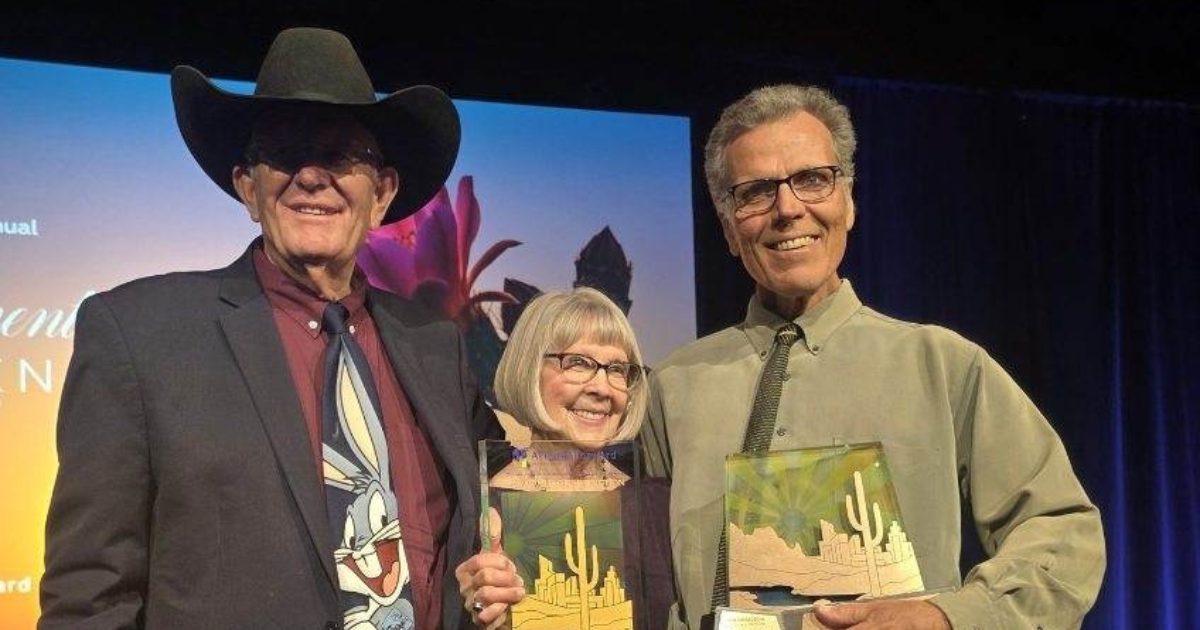
Steve, his neighbors and other local community leaders were honored in the spring of 2026 with a Crescordia Award from Arizona Forward and the Governor’s’ Award for Arizona’s Future. When I asked Steve about the awards, he said, “None of us are doing this for recognition, but it felt special to be recognized for what ordinary neighbors can accomplish when they decide to show up.”
Steve told me during this interview, “This story now becomes bigger than us. The next chapter is showing what we did here can be a model.”
So I asked him, what exactly did he hope would be a model for other communities on the front lines of groundwater depletion? “I hope we showed that even small communities like ours have the power to change our future,” he said. That’s why Steve and his community’s journey offers a powerful story of hope for a world with more places struggling to respond to water bankruptcy.
In the interview below, I ask Steve about lessons and advice for other communities on the front lines of groundwater depletion. For more on formative moments and challenges, see Part 1 of our conversation.
What was it like to wake up that morning in late December 2024 to see the Willcox AMA designation posted?
Wow. I was so happy for all the folks who had been suffering under the fallout of extreme groundwater depletion. This was for them and for future generations. At some point it looked like all of us would lose access to water and maybe our homes. But we now had a cause to hope that wouldn’t be our future. How can I describe that feeling? “Joy” is the best word I can think of.
That summer the governor came to our community, she came to my home, she sat at my dining room table to listen to a group of neighbors share our experiences with groundwater depletion. I never thought I’d have that experience. She spent the whole day down here. When the governor came to our house and genuinely listened, I knew something was shifting.
Finally, we were being heard. That’s what this felt like.
What does a new AMA do?
Before the AMA, I’d see new land being cleared all around. After the 2022 vote, it was happening faster. Every new well was digging us into a deeper hole. Two hundred acres right next to my home were being cleared for pistachio trees on grassland that had never before been irrigated. The AMA immediately stopped all that unsustainable expansion.
We had no protections or rules here whatsoever with groundwater. I used to tell folks, it’s like there was a giant billboard at our exit on I-10 that said, “Welcome, come and take all the water you want for free.”
The AMA completely changed that here, and set in motion a whole new system of groundwater management. But it will take a few years to get all the pieces set up and working. We now have a local council to work with ADWR and the community to set up our first groundwater management plan. They just had their first public meeting.
ADWR takes input from the community on the management plan, listens, incorporates feedback, and comes back to us. The process has been really collaborative and community-minded.
The farming community is positively engaging at the table. There is a growing understanding of what it’s going to take to make this area sustainable for our homes and our farms. Cuts to pumping are coming once we finish the management plan. It’s going to be challenging. But the community is ready, and I’m genuinely hopeful.
What advice would you share with other communities on the front lines?
Get started with the work to make positive change and stay encouraged. The work will bring you new friends for life. You will get through it together. Learn as much as you can. Hydrologists will actually call you back. Understanding groundwater, laws and policies was foundational for us. Find experts, but don’t forget you are an expert, too. Your unique experience matters and you are going to learn so much. You need people who will stay beside you for the long haul. It’s ok to not know what’s possible, like us, but still take that step forward.
Host community education forums. Let the community come to you with their stories. Bring in respected experts, let them lay out the facts, and use that as a platform for community conversations. That was one of our most effective tools.
Be cautious with social media. It can be a tool for getting the word out, but it’s also a vehicle for misinformation that’s hard to counter. It’s frustrating, but don’t give up on it entirely. The most powerful tool we had was face-to-face conversations. Ask people what concerns they have and listen. Know your facts, but don’t be afraid to say, “I don’t know.”
A lot of people take for granted that when they turn on their tap, the water’s going to come. But that isn’t true for everyone. Water isn’t going to keep coming for any of us if we keep draining our groundwater. That’s powerful when it gets people thinking. Keep people engaged with that thinking.
We went from no groundwater stories in the media to suddenly it was impossible to miss them. Your community had a major part in that. What role did storytelling play?
Everybody has a relationship with the water. We wouldn’t be alive if we didn’t. It touches something in all of us. I remember sitting in a friend’s house when he told me the story of when he turned on the tap and nothing came out, telling their kids and grandkids that they would need to ration showers outside and carrying five gallon buckets from a neighbor’s house to wash dishes. These are real experiences. Data alone can’t capture what that’s like.
I never thought I’d testify at the Capitol before, but my neighbors and I have several times now. We didn’t change votes, but we learned our stories were inspiring people from all over to fight for us. I was not expecting that.
When regular people, who drove three and a half hours just to be heard, walk into a committee hearing and tell their story, it lands differently.
It took time to build confidence to speak to the media and legislators. We’d stay up late practicing with each other. We supported each other writing for newspapers. I lost track of how many times someone reached out to interview me and my neighbors. My neighbor and I were even interviewed by European media! It made a real difference, but it took practice and patience.
Bitter community divisions started healing in the process of getting new groundwater management. Tell me more about that.
Healing has been one of the most unexpected outcomes. After the divisive 2022 Willcox AMA vote, I wasn’t sure if the community could ever come together again.
We set up a new community group with the help of one of our state universities and other partners where residents, farmers and municipal officials could talk to each other. It was so hard to get past the slogans during the 2022 campaign and the winning or losing mindset, but this was different. There was a shared understanding that we’d have respectful, fact-based conversations, no personal animosity. We didn’t agree on everything, but we respected each other. And community leaders stepped up, like our friend Ed Curry, a gifted peacemaker. He had voted against the AMA in 2022, but ultimately became a major supporter.
One moment stands out to me. When the Willcox AMA designation process began, this new group held a facilitated meeting to develop a statement, not “for or against the AMA,” instead describing the groundwater situation and what actions we could agree on. One attendee spoke up and said they thought the exercise was “a waste of time” and everyone should just vote on whether they were for or against the AMA. No one responded. Everyone knew that would tear the group apart. So people kept going with the facilitated conversation. We stayed focused on what we could agree on. That group never took a position on the AMA, but it still provided an opportunity for honest dialogue.
There is still some animosity in some quarters stuck in the past, but the vast majority of us are moving forward together now on implementing groundwater management. It’s not easy, but we’re doing it and the community is healing.
What other lessons did you learn over the last five years?
I learned that reaching out for help can make all the difference. That phone call with you in 2021 started something special. Friendship, access to like-minded people, and expertise in law, policy, science and communications. I never imagined that I’d have the experiences that we’ve had together on this journey, I’ll never forget it.
I learned even a small group of motivated and persistent people can make a big difference. When we got started, no one knew if any of this was possible. But we had no choice but to try.
I learned to not underestimate the power of the voices in our community. Sticking to the facts and speaking from the heart is a powerful combination. I remember working with a neighbor before her first time testifying late the night before. I am no pro on that, I still get nervous myself, but she asked me for help. She almost backed out at the last minute. But she followed through. She was the first person the committee called to testify, I could see in her face how nervous she was. But she walked up to the podium, spoke, and she was incredible. One legislator called her back to the podium after she had gone back to her seat. He grilled her with hard questions, but she held her own. She was learning how strong she really was in that moment. All of us had experiences that challenged us and helped us grow along this journey.
What comes next?
I see the AMA as the beginning, not the finish line. As a state, and a nation, we need to come together to work on bigger solutions to groundwater depletion. It’s not about choosing water or growing food, we need to innovate with both.
We don’t have it all figured out here, but we’re coming together as a community so that families can grow up here. And so farmers can make a living growing our food and fiber. We’re working on doing that in a way that is sustainable, and that’s what these new AMAs are about. We still have a big water deficit; our challenges didn’t go away overnight. But we finally found hope, and because of that our community is on a different path.
There was another new AMA set up in western Arizona just several months ago. Communities in other areas want a say in their future, just like we did. This now becomes bigger than us.
What we choose to do today matters for the future we’ll end up getting. I hope the story of what happened here shows that we can solve our groundwater challenges together. We can preserve farming livelihoods and protect communities’ access to water.
I hope our story challenges what people think is possible. Because if we can do it here, it can be done anywhere. So to me, the work is just getting started.
And that call from Steve in 2021 is why to this day I still answer calls from unfamiliar numbers.