Market Forces

FEMA’s Risk Rating 2.0 Is Reshaping Flood Insurance, Leaving many Households Financially Vulnerable to Growing Flood Risk

Across the United States, climate change is driving more intense and frequent flooding, putting millions of homes and neighborhoods at growing risk. Flood insurance is one of the most important tools families have to recover and rebuild after disasters, but affordability challenges are increasingly leaving too many households without this essential protection. 

In our new study, Effects of Risk-Based Pricing Reform on Flood Insurance Uptake,” published in the Journal of Catastrophe Risk and Resilience, my coauthors Max Snyder, Carolyn Kousky, and I examine how the National Flood Insurance Program’s (NFIP) new pricing system (Risk Rating 2.0) is reshaping flood insurance coverage across the United States. 

Risk Rating 2.0: modernizing pricing, but at a cost 

Implemented by the Federal Emergency Management Agency (FEMA) in 2021 and 2022, Risk Rating 2.0 represents a significant update to the NFIP’s pricing methodology. It is designed to ensure that premiums reflect each property’s unique flood risk and cost to rebuild. The new system uses modern data and models to evaluate factors such as proximity to water, flood frequency, and property characteristics, rather than relying on outdated flood maps. 

This reform has the potential to create important efficiency gains. By aligning premiums more closely with actual risk, Risk Rating 2.0 helps ensure premiums align with the costs of servicing the NFIP’s debt to the U.S. Treasury and may encourage households and communities to invest in adaptation to flood risk. 

However, our research also reveals an unintended consequence. As premiums rise to reflect today’s risks, more households, especially those with lower incomes, are dropping their coverage. We find that since implementation of Risk Rating 2.0, there has been roughly an 11–39% decline in new NFIP policies and a 5–13% drop in renewals of existing policies, depending on how much premiums have increased. These reductions in coverage are largest in lower-income areas, suggesting that affordability barriers are pricing out the households most in need of protection.  

The Rising Protection Gap and its Impact 

Flood insurance is critical for financial recovery after disasters. When coverage declines, the number of households left unprotected grows, widening what experts call the “protection gap,” the divide between households exposed to flooding and those insured against it. Larger protection gaps can make recovery slower and more costly, increase reliance on federal disaster aid, strain local economies, and even raise the likelihood of mortgage delinquencies or defaults following floods.  

The takeaway is clear: while risk-based pricing may promote adaptation to flood risk and can help manage the federal fiscal burden of the NFIP, it also creates a range of negative outcomes when households are unable to afford coverage. 

Balancing risk-based pricing with affordable coverage 

Risk Rating 2.0 is essential for aligning insurance rates with property-specific risks and communicating risk to property owners and as such should remain in place. At the same time, policymakers could consider the role of a means-tested affordability program to help low- and moderate-income households maintain their flood insurance coverage as premiums rise. The goal should be to implement a program that would preserve the benefits of risk-based pricing while keeping coverage within reach for those who need it most.  

The study’s findings reinforce recommendations from EDF’s NFIP Policy Platform. It calls for coupling Risk Rating 2.0 with income-based affordability assistance to make coverage accessible to those least able to afford rising rates. It also highlights several complementary policies to strengthen and modernize the NFIP, including:  

  • Improving flood risk disclosure and transparency so homeowners and renters can better understand their risk and their options 
  • Modernizing FEMA’s flood mapping to better reflect a growing understanding of risk, including rainfall-driven flooding and increasing risk due to climate change. 
  • Expanding resources to support flood mitigation, including nature-based projects that can reduce losses and lower insurance costs over time. 

Looking ahead: building equity into resilience  

As climate change continues to intensify flood risk, we must ensure that flood insurance continues to reflect property-specific risks and affordable for low-income households. Risk Rating 2.0 represents a major step toward modernizing how we price flood risk and incentivize adaptation. But for the NFIP to succeed, affordability protections must evolve alongside pricing reforms. 

By pairing accurate risk pricing with targeted financial support, we can close the flood protection gap, strengthen community recovery, and help ensure that every household, regardless of income, has the tools to repair, rebuild, and thrive after floods. 

For more details, view our full press release here. 


Posted in Climate Change, Economics / Tagged , , , , , , | Authors: / Comments are closed

Canada’s 34,000-Job Opportunity: Finalizing Canada’s Methane Regulations

This post by Environmental Defense Fund economist Luis Fernández Intriago; Senior Campaign Manager, Canada, Ari Pottens; Senior Manager of Economics and Policy Analysis, Maureen Lackner; and former EDF intern, Chi Chia (Gina) Chen. 

  • Canada has a methane problem, but solving it with smart national regulations could create around 34,000 jobs and recover billions in revenue. 
  • The job growth would support lower-emissions energy production in the west and manufacturing in the east, helping to conserve a valuable economic commodity – natural gas – while offering economic growth throughout the nation. 

Canada’s oil and gas sector has a methane problem. The best available data suggests that the industry emitted 1.9 million metric tons of methane gas in 2023. While it only lasts in the atmosphere for a short period, this powerful greenhouse gas contributes 84 times more to near-term warming than CO2. Scientists estimate that nearly 30% of the warming experienced today can be attributed to methane from human activity. 

It’s not just a climate problem either: because methane is the primary component of natural gas, methane emissions also result in the loss of a valuable energy resource. An analysis by Environmental Defense Fund found that Alberta’s 2022 methane emissions translated to a waste of over $670 million in natural gas revenue and a loss of over $120 million in uncollected royalties and corporate taxes.

Preventing methane waste is good for Canada’s economy and good for Canada’s climate. Finalizing regulations to reduce these emissions should be included as a cornerstone in the government’s anticipated climate competitiveness strategy which will seek to capitalize on the economic benefits associated with climate change mitigation.

Canada’s proposed methane regulations could tackle methane emissions and create about 34,000 jobs.  

The methane problem can be a methane opportunity, if the Canadian government continues taking steps to seize it. In 2021, Canada announced a goal to reduce oil and gas methane emissions 75% below 2012 levels by 2030. In 2023, Environment and Climate Change Canada (ECCC) proposed amendments to the existing federal methane regulation that would impose strict limits on venting and flaring, mandate the installation of low- or zero-emissions equipment, and require regular monitoring for unintended emissions leaks at new and existing facilities.  

If implemented, ECCC projects that between 2027 and 2040 these rules would prevent the release of over 5 million metric tons of methane, conserving a valuable commodity that can generate revenue for producers. The rules would also prevent the release of 1.5 million metric tons of volatile organic compounds and smog-forming local air pollutants. The benefits don’t even stop with recovered gas, cleaner air and less climate pollution: we estimate that these regulations would also create approximately 34,000 total jobs, or 95,000 person-years of employment, across Canada.  

Growing Canada’s economy, sustainably  

Canada’s oil and gas industry is well-positioned to tackle Canada’s ambitious climate goal. The sector enjoyed record revenues in 2022 and 2023 and has potential to play a major role in meeting growing international demand for gas produced with minimal methane emissions.  According to the Canadian Association of Petroleum Producers (CAPP), the industry contributed $71.4 billion CAD (3%) to Canada’s GDP in 2022, employs 450,000 workers directly and indirectly, and supports an additional 450,000 induced jobs. 

The oil and gas industry’s efforts to limit harmful methane emissions could drive significant growth from Canada’s methane-mitigation sector. As identified in a recent report commissioned by EDF and the Pembina Institute, 81 manufacturing firms and 55 service firms provide oil and gas operators with the equipment and services needed to cut methane emissions. These firms have locations across Canada and offer high-quality, well-paying jobs. 

Jobs from coast to coast to coast: A national economic opportunity 

Our upcoming economic analysis reveals that finalizing Canada’s methane regulations would generate substantial employment nationwide.  

ECCC’s proposed regulations mandate quarterly leak detection and repair (LDAR) inspections at high-risk sites and annual checks at lower-risk ones. Large emission sources would need repair within 24 hours and smaller ones within 90 days. The rules would also restrict intentional methane releases, generally prohibiting venting and requiring flaring only when capturing the gas is not feasible. Achieving compliance with these new standards will take a lot of labor and create a lot of employment across Canada.  

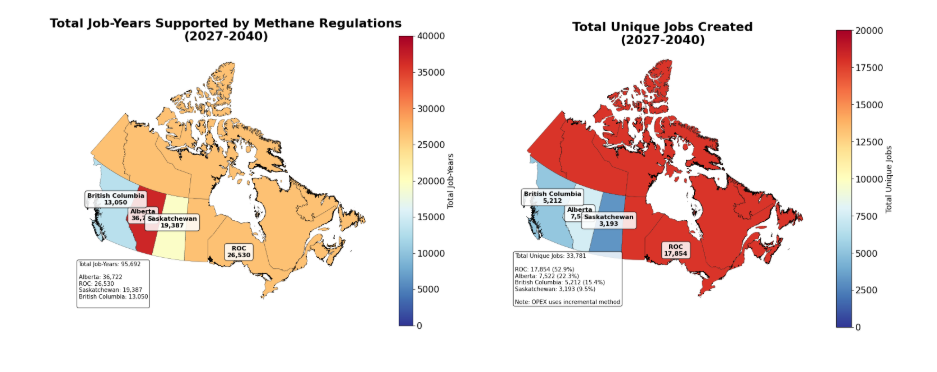
These requirements create two main types of work. First, regulatory compliance demands on-site work, including installation, monitoring, and field services, which must take place at the oil and gas facilities themselves, concentrated in Canada’s energy-producing provinces, Alberta, Saskatchewan, and British Columbia. Second, it requires the purchase of new manufactured hardware (such as compressor vents and control devices), which are concentrated in Canada’s industrial heartland, primarily, in Ontario and Quebec (which make up the majority of our “Rest of Canada” or ROC economic region jobs).
Canada methane jobs

Between 2027 and 2040, our analysis of the approximately 34,000 total jobs or 95,000 person-years of employment shows this national split: 

  • Installation and field operations (~16,300 unique jobs or ~70,700 person-years): Equipment installation, leak detection and repair services, ongoing monitoring, and operations at oil and gas facilities in Alberta, Saskatchewan, and British Columbia. 
  • Manufacturing and specialized services (~17,500 unique jobs or~25,000, person-years): Most of the equipment manufacturing would be in ROC producing compressors, vapor recovery units, pneumatic devices, and monitoring systems required for compliance. Engineering firms and technology companies provide specialized services both remotely and on-site. 

This distribution reflects existing industrial supply chains: equipment is manufactured where manufacturing capacity exists, while installation and operations occur at the facility.  


How $15.4 Billion in Compliance Spending Creates Jobs 

Our analysis is a detailed, bottom-up approach. We followed ECCC’s Regulatory Impact Analysis Statement (RIAS) and modeled how the estimated cost for industry to comply with the regulations would be spent year by year from 2027 to 2040.  

Our total jobs estimate represents the number of unique positions that would be created across Canada between 2027-2040 to fulfill the requirements under the regulations. In contrast, person-years refers to the amount of work a person will contribute in one year to support compliance with the regulations. This means that 14 person-years of employment could translate to a single person in the same job working over the 2027-2040 period. Estimates for both total jobs and person-years of employment include direct, indirect, and induced jobs.  

Employment estimates are based on economic input-output analysis using Statistics Canada multipliers and compliance cost data from the RIAS. The analysis accounts for capital and operating expenditures associated with mitigation efforts across nine emission source categories and across four regions (Alberta, British Columbia, Saskatchewan, and the Rest of Canada (ROC)). Then we allocate capital and operational costs to the appropriate Statistics Canada Business Sector (BS) Industries. Finally, we apply the input-output multipliers to the industries and location-specific costs.  

Manufacturing employment is allocated based on Statistics Canada BS 333200 (Industrial Machinery Manufacturing) employment distribution, which shows 83% of Canada’s industrial machinery manufacturing capacity is in the Rest of Canada (primarily Ontario and Quebec), 13% in British Columbia, and 4% in Alberta and Saskatchewan. Field service employment is allocated based on the facility locations where on-site work must be performed. 

Applying input-output multipliers to the full annual flow of expenditures estimated in the ECCC RIAS yields an aggregated person-years employment estimate of approximately 95,000. As noted above, this should be interpreted as the sum of full-time positions the regulations will require in each year.  

In contrast, our estimate of 34,000 total jobs created by the regulations reflects unique positions created and is based on two assumptions. First, we assume that jobs required to carry out field operations will be filled, primarily, in 2030, the first year the new standards will activate, and that operating costs in subsequent years will not generate additional jobs. Second, we assume only 70% of workers are new hires rather than internal reassignments. 

Methane Mitigation: A win for the Climate and a win for the Economy 

Tackling the methane problem is one of the fastest, cheapest ways to slow the rate of warming, and supports the growth of Canada’s economy. The government has an opportunity to grab both of those benefits and make Canada a worldwide leader in methane mitigation. 

Previous EDF reports and analyses have demonstrated that the proposed regulations are affordable, that they will generate revenue for provinces, and that they will strengthen a new sector of the economy, the methane mitigation industry.   

This analysis proves something we’ve suspected for a long time: Canada’s proposed regulations are a clear win for Canadian jobs in the energy-producing West and the industrial East. These jobs are financed through private-sector compliance expenditures rather than public funding, meaning they redistribute oil and gas industry revenues to employment across multiple economic sectors, including oil and gas itself, manufacturing, engineering services, and technical consulting.  

With 34,000 jobs at stake, billions in potential revenue recovered, and the opportunity to position Canadian energy as among the cleanest in the world, finalizing the methane regulations isn’t just the right thing to do on climate, it’s the smart thing to do for the economy.  

Posted in Economics, emissions, Energy Transition / Tagged , | Comments are closed

MCET Pre-COP30 Seminars: Shared Pathways Toward a Just Power Sector Transition

This blog was authored by Rodrigo Bórquez, economist of the Multi-Country Electricity Transition (MCET) network and the Climate Action Teams (CAT) initiative, and by Environmental Defense Fund economist Luis Fernández Intriago.

On October 14, the international network Multi-Country Electricity Transition (MCET) held two parallel seminars focused on the electricity transition in Asia and Latin America. These sessions—part of the Pre-COP30 series organized by the Economics team at Environmental Defense Fund (EDF)—brought together researchers, institutions, and decision-makers from the MCET ecosystem to share progress, reflect on common challenges, and project a more integrated agenda for a just transition. 

As the climate crisis demands the accelerated decarbonization of the power sector, particularly in emerging economies, it becomes essential to develop tools that support informed, equitable, and viable transitions. Open planning models, policy assessments, and institutional coordination are key elements to transform global goals into actionable national pathways. 

Within this context, the MCET seminars invited us to look beyond modeling, and ask: how can technical tools genuinely connect with the social, territorial, and political realities of our countries? 


Two regions, one shared conversation 

In the Latin America session, Manuel Portilla (Vinken, Chile) presented a study exploring the potential of demand response to increase power system efficiency and reliability in Chile, Colombia, and Vietnam. Using the SWITCH model, his analysis showed how flexible demand can reduce costs, support renewable integration, and enable more active citizen participation in electricity markets. 

From Honduras, Paola Sofía Acevedo Alvarado (Sustenta Honduras) presented a pioneering effort to incorporate territorial justice into long-term energy planning models. Through the development of SWITCH-Honduras, her work demonstrates how expansion scenarios can avoid harming protected areas or infringing on Indigenous rights, proposing a path that aligns climate action with territorial equity. 

In the Asia session, Thuy Doan (Fulbright University Vietnam) analyzed the impact of various electricity pricing schemes on demand behavior, consumer welfare, and system efficiency in Vietnam. Her study suggests that structures like Time-of-Use (TOU) and hybrid models can be key to achieving carbon neutrality, but must be supported by investments in data systems and grid infrastructure. 

Meanwhile, Dr. Tarun Sharma (IIT Roorkee, India) explored five demand-responsive pricing strategies in India, aimed at shifting consumption to hours with higher solar generation. His approach connects energy modeling with realistic policy design, contributing to better system management and improved renewable integration. 


Open models, just transitions 

Though grounded in distinct national realities, all four studies share a common belief: energy modeling can be a powerful tool to inform decision-making, but only when it is linked to each country’s institutional, social, and territorial context. 

Throughout the sessions, participants acknowledged that while tools like SWITCH allow for robust scenario simulations and decarbonization pathways, their real-world impact depends on how they align with local capacity, institutional frameworks, and justice-based approaches. This intersection presents challenges—but also transformative opportunities. 


Connecting energy transitions to broader economic realities 

While energy system models provide critical insights into technology pathways and system optimization, the MCET seminars underscored a fundamental truth: power sector transitions are inseparable from broader macroeconomic dynamics. Decarbonization decisions reshape employment patterns, redirect capital flows, alter government revenues, and redefine regional economic development. The demand response strategies explored across Chile, Colombia, Vietnam, and India raise questions about which industries and households can shift consumption and how costs distribute across income groups. Honduras’s territorial justice approach shows that protecting indigenous territories preserves not just rights and ecology, but economic systems and livelihoods outside conventional GDP accounting. The comparative Asian analysis reveals that transition costs vary dramatically by national context—essential insights for climate finance and burden-sharing frameworks. 

Yet a critical dimension remains underexplored: the labor market. Coal miners, gas plant operators, and fossil fuel supply chain workers transitioning to new livelihoods. Skills gaps and wage differentials. Regional disruption in fossil fuel-dependent communities. These employment transitions are where “just transition” began conceptually, and they deserve systematic integration into energy system analysis. As the MCET network moves forward, bridging energy modeling with economy-wide perspectives—incorporating labor markets, fiscal dynamics, and development pathways—will strengthen the policy relevance of this work. 


Available resources 


What’s next 

These events mark the beginning of a new phase of more integrated collaboration, combining technical rigor with territorial sensitivity. The MCET network will continue to build on this momentum, working toward energy transitions in the Global South that are more sustainable, inclusive, and grounded in local realities, transitions that account not only for electrons and infrastructure, but for workers, communities, and entire economies in transformation. 

Posted in Economics / Comments are closed

Nature and Insurance: An Untapped Partnership to Mitigate Rising Risks

The loss of nature is not just an environmental crisis. It is an economic one.

When ecosystems degrade, we lose the services that protect us: wetlands that absorb floodwaters, trees that cool overheated streets, and reefs that protect coastlines. Without these protections, disasters hit harder and cost more.

And the economic stakes are enormous. More than half of the world’s GDP depends on nature, so as natural systems decline, the stability of our economy declines with them. We are already seeing the consequences in insurance markets. Climate-related losses are climbing and in many high-risk areas, coverage is shrinking. Higher risks mean higher premiums, lower coverage, and in some places, no coverage at all.

Maintaining healthy insurance markets will require reducing risk at its source. Nature can be a critical part of that solution. Our report, “Nature for Insurance and Insurance for Nature, informed by a workshop with over 100 experts from insurance, government and conservation, examines how. Read More »

Posted in Uncategorized / Comments are closed

Your Health, Your Wallet, Your Future: Americans Can’t Afford EPA Rollbacks

This blog was written by: Aurora Barone, manager of economics and policy; Talley Burley, manager, climate risk and insurance; Jesse Gourevitch, economist; Abhinand Krishnashankar, senior economics and policy analyst; Jeremy Proville, director, economics.

The Clean Air Act, a landmark piece of U.S. legislation, has quietly been protecting not just our lungs, but also our wallets for many years. Then, on July 29, 2025, the U.S. Environmental Protection Agency announced a proposal to rescind a crucial part of this protection: the 2009 Endangerment Finding. The finding, rooted in extensive science with robust public input, determined that climate pollution threatens the public health and welfare of Americans. Now, the very real benefits – including economic benefits – stemming from this finding are at risk. Understanding what is at stake is more important than ever. 

Americans face new and rising costs due to climate change.  

The impacts of climate change are already costing us. Climate-related disasters already saddle the U.S. with an estimated $150 billion (about $460 per person in the US) bill each year. Studies project that a person born in 2024 could face nearly $500,000 in climate-related costs over their lifetime if we fail to take action.    Read More »

Posted in air pollution, Clean Air Act, Economics, Energy Transition, Politics, Social Cost of Carbon, Trump's energy plan / Comments are closed

From model to policy: Building a climate connection between modelers across the world

This blog was authored by Francisco Pinto, economist with the Climate Action Teams (CAT) initiative, Catherine Leining, Policy Fellow at Motu Economic and Public Policy Research, and Luis Fernández Intriago, economist at Environmental Defense Fund.  

As record-breaking heatwaves, wildfires, and floods make headlines around the world, one thing is clear: climate action can’t wait, and no country can tackle the challenge alone. Meeting global climate goals will take not just political will, but better tools to guide smarter decisions, especially in crucial sectors like energy.   Read More »

Posted in Economics / Comments are closed