Climate change solutions
We deliver game-changing environmental solutions that have a real impact for people around the globe.
Tom Neltner, J.D., Chemicals Policy Director and Lindsay McCormick, Program Manager
As we have explained in past blogs, it is critical that states have rough estimates of how many lead service lines (LSLs) each drinking water utility in the state may have in order to develop sound policy decisions and set priorities. Congress recognized the importance of LSL inventories when it directed the Environmental Protection Agency (EPA) in the America’s Water Infrastructure Act of 2018 to develop a national count of LSLs on public and private property in the next round of the 2020 Drinking Water Infrastructure Needs Survey. States have a crucial supporting role in the Needs Survey since it is the basis of allocating State Revolving Loan Funds to the states.
This month, the Association of State Drinking Water Administrators (ASDWA) released a useful guidance document to help states develop LSL inventories. The guidance builds on the lessons learned from:
Tom Neltner, J.D., Chemicals Policy Director and Maricel Maffini, Ph.D., Consultant
[pullquote]
All the PFAS uses allowed by FDA that we reviewed had estimated exposures exceeding the most protective minimal risk level for PFOS proposed by the Centers for Disease Control and Prevention (CDC).
[/pullquote]In its June 2019 release of a webpage dedicated to per- and poly-fluoroalkyl substances (PFAS) in food, FDA stated that it is “reviewing the limited authorized uses of PFAS in food contact applications.” As we mentioned in a previous blog, we were pleased to see FDA’s public position on PFAS but we highlighted three major concerns that could impact the ongoing safety review and questioned the conclusion that all is fine. In this blog, we discuss the implications of FDA’s statements on its review of 62 authorized PFAS uses in contact with food and make recommendations to the agency as it proceeds with this promising effort.
Tom Neltner, J.D., Chemicals Policy Director and Maricel Maffini, Ph.D., Consultant
In June, the Food and Drug Administration (FDA) posted a webpage that serves as a helpful starting place to learn about the agency’s efforts and plans regarding per- and poly-fluoroalkyl substances (PFAS) in food. The webpage explains that FDA is “assessing food for PFAS through sampling” and is “reviewing the limited authorized uses of PFAS in food contact applications.” In a statement accompanying the webpage’s release, FDA’s acting and deputy commissioners assured the American people that the agency “does not have any indication that these substances are a human health concern, in other words a food safety risk in human food, at the levels found in this limited sampling.”
We were surprised by FDA’s statement that all is fine given the results the agency published and the evidence about the array of health risks posed by PFAS at extremely low levels. Although the information posted is useful, we found it confusing and vague in some important aspects. Therefore, we are taking the opportunity here to raise some issues concerning FDA’s statements and planned next steps on PFAS. Additionally, in another blog, we discuss the implications of FDA’s statements on its review of 62 authorized PFAS uses in contact with food and make recommendations to the agency as it proceeds with this promising effort.
Lindsay McCormick is a Program Manager.
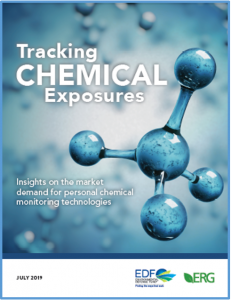
When I first started working at EDF in 2014, I learned a statistic that shocked me: We have human exposure data on less than 4% of the roughly half-million chemicals in commerce.[1] In other words, we know next to nothing about the vast majority of chemical exposures that people were experiencing on a daily basis.
Chemicals are found in nearly all commercial products and serve a foundational role in our economy. Yet this ubiquity comes with its downsides, as some chemicals are hazardous and can find their way into our environment and ultimately end up in our water, land, and air—and in our bodies. Exposure to certain chemical substances have been linked to a variety of adverse health impacts, including reproductive harm, disruption of normal hormone activity, and impaired neurological development in children.
The lack of knowledge about chemical exposures poses a major problem: Without better information on exactly which chemicals individuals are exposed to every day, it is challenging to develop effective policies and interventions to reduce harmful exposures and protect health.
Disrupting the status quo
But what if anyone could use a simple home-delivered kit or wearable device to reveal the chemicals in their environment—and in their body? Such technologies could make the invisible visible—providing individuals, as well as policy makers, businesses, health professionals, and others, with critical information needed to accelerate reductions in the public’s exposure to hazardous chemicals.
In 2017, EDF pursued a Year of Innovation to better understand opportunities to advance the market for personal chemical exposure monitors (PCEMs) – with the ultimate goal of improving public health. As part of this effort, we conducted interviews and convened an expert workshop to identify bottlenecks in the development and use of such technologies.
We learned that a significant gap exists between the demand and promise of PCEM technologies and the current cost or scalability of many of the available technologies today. Experts noted that while there is significant qualitative or anecdotal evidence of demand, a quantitative understanding of the potential market for these technologies is needed to drive a robust market.
EDF took that lesson and embarked on a two-part study to fill this gap.
Richard Denison, Ph.D., is a Lead Senior Scientist.
The American Chemistry Council (ACC) was up to all of its old tricks yesterday at the first day of the Environmental Protection Agency’s (EPA) panel that is conducting a peer review of EPA’s draft risk evaluation of the likely human carcinogen, 1,4-dioxane. We blogged last week about the extensive comments EDF submitted to the peer review panel on this flawed assessment.
Yesterday ACC rolled out the same game plan the industry has used for years to slow down, derail, or obfuscate chemical assessments conducted by EPA’s Information Risk Information System (IRIS), and more recently, the last Administration’s effort, now aborted by the Trump EPA, to restrict high-risk uses of the highly toxic chemical trichloroethylene (TCE).
In the public comment period yesterday afternoon, ACC Senior Director Steve Risotto revealed to the peer review panel that ACC has sponsored a new “study” that he says – lo and behold – supports all of the positions downplaying 1,4-dioxane’s carcinogenicity that ACC has espoused for years.
The aim of this is to get EPA to set the level of exposure to 1,4-dioxane that would be deemed acceptable well above the level EPA would set if 1,4-dioxane is assumed to pose a risk at any level of exposure. (Briefly, if EPA determines that 1,4-dioxane does not have a safe threshold, it must extrapolate exposures to zero to set acceptable risk levels in its risk evaluation. If, as ACC wants, EPA finds that there is a threshold below which exposure poses no risk, then the Agency’s risk calculations will be much less conservative.)
So, where is ACC’s new study? Well, it’s not public. It hasn’t been provided to the peer review panel. It hasn’t been published by ACC. There’s no indication it’s been peer-reviewed. (more…)
Aileen Nowlan, Senior Manager, EDF+Business
This post originally appeared on EDF+Business.
With the click of a button, our groceries, clothes, personal care products, household items – just about anything – could arrive on our doorsteps in a neatly packaged cardboard box. It’s convenience, delivered. But at what cost?
What happens behind-the-scenes to get a package delivered to your door is taking a toll on our planet and our health. Freight is the fastest growing source of greenhouse gases and a major source of local air pollution. The rise in e-commerce is a growing part of increased pollution and poor air quality.
The truth is, “free shipping” isn’t really free. We’re just paying for it in other ways.