Climate change solutions
We deliver game-changing environmental solutions that have a real impact for people around the globe.

Building resilient land and water systems that allow people and nature to prosper in a changing climate.
This post was co-authored by Pablo Garza and Ronna Kelly.
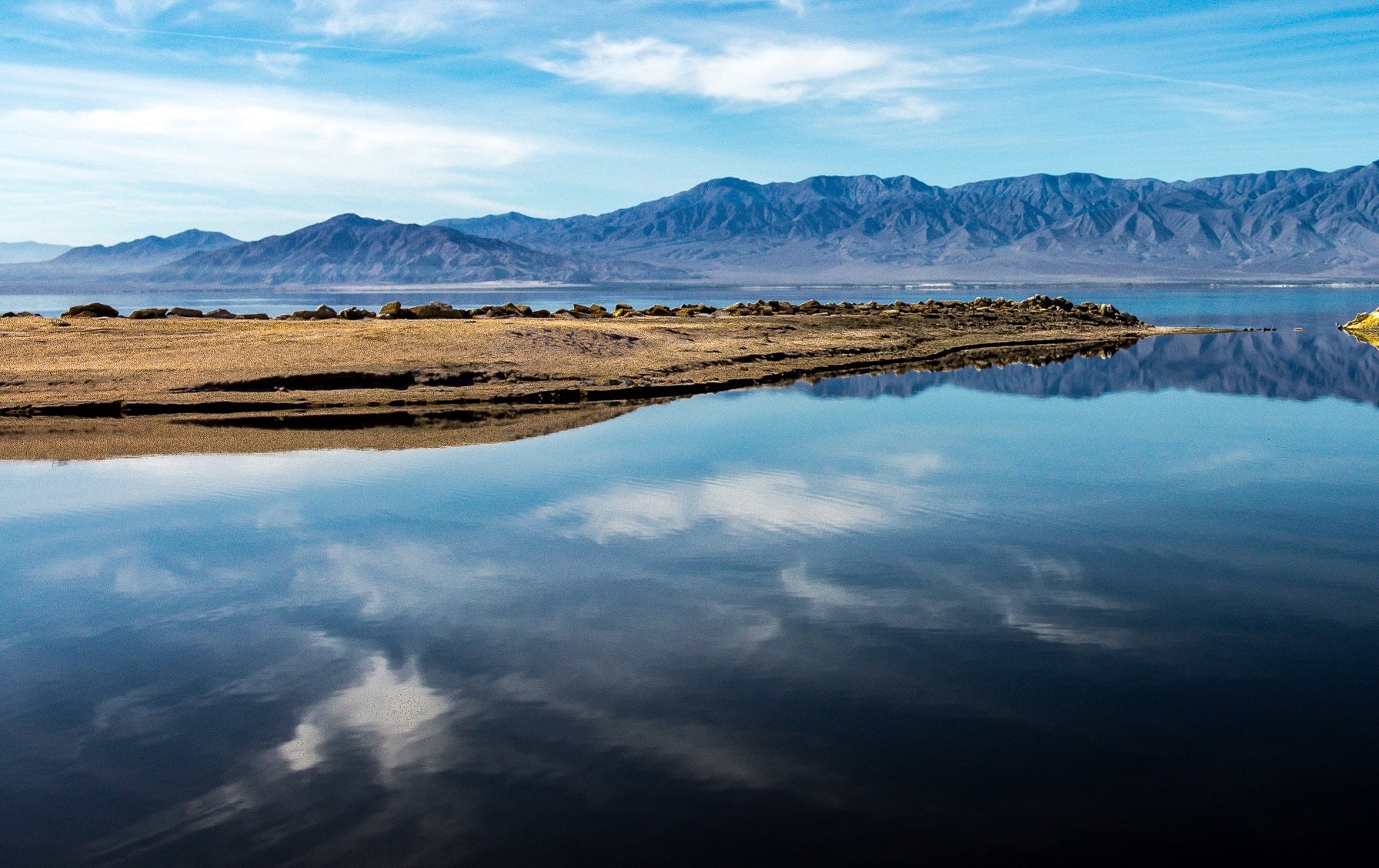
The Salton Sea is California’s largest lake, but it’s hard to grasp its immense size – and beauty – until you see it with you own eyes. Last week, roughly 200 people gathered in this unique area – both residents and leaders from around the Salton Sea and from outside the region – for the Salton Sea Summit, a conference that explored the many challenges and solutions facing the Salton Sea region.
The summit was important because, as California Secretary for Natural Resources Wade Crowfoot noted during his keynote on the first day, the Salton Sea has “major problems.”
Chief among these: The Salton Sea is receding.
The shrinking of the Salton Sea is a longer-term trend that was exacerbated by the largest rural-urban water transfer in the U.S., finalized in 2003. Under the transfer, the Imperial Irrigation District agreed to send up to 300,000 acre-feet of Colorado River water per year to Los Angeles and San Diego. Since 2003, the Sea has receded more rapidly, exposing some 40 acres of new shoreline and toxic dust. This dust, in turn, is contributing to already poor air quality and high rates of respiratory illnesses in the region.
As part of the transfer agreement, the state committed to thousands of acres of dust suppression and habitat restoration projects, and state lawmakers and voters have approved $365 million in funding for such projects. But action has long been stalled, and local residents and leaders are fed up.
This frustration was evident at the summit and reached a boiling point on Tuesday when the Imperial County Board of Supervisors voted unanimously to declare a local emergency for air pollution at the Salton Sea. The vote came just days after state leaders stressed efforts to jump-start long-delayed projects at the summit.
The Colorado River is a water workhorse for seven western states, supplying drinking water to 40 million people. But it’s not the region’s only important source of water.
Groundwater — the water underground that we can’t see — is also hugely important in the Colorado River Basin. Groundwater provides base flow to rivers and streams, supports groundwater-dependent ecosystems, serves as the primary source of drinking water for many rural communities and plays a key role in water supply balance.
Unlike the Colorado River, which is governed by multi-state agreements, groundwater management is generally most appropriately carried out at the state and local level because groundwater availability is highly localized and variable throughout the basin.
However, gaining a strong understanding of groundwater availability and use across the Colorado River Basin is more critical than ever to managing the system-wide supply and demand balance and long-term planning, especially as the climate becomes increasingly arid. New Colorado River story map highlights importance of groundwater sustainability in the West Share on X
EDF created an online story map at www.edf.org/colorivgw. The story map aims to provide a more holistic view of groundwater supplies and challenges in the seven-state Colorado River Basin (Arizona, California, Colorado, New Mexico, Nevada, Utah and Wyoming), drawing from recent research.
Here are four key highlights from the story map that demonstrate the importance of groundwater and the challenges of groundwater management in the arid West: (more…)
Earlier this week, North Carolina Gov. Roy Cooper signed a proclamation recognizing the imperative to think anew about how the state lives with climate change. The governor emphasized the importance of building resilience as North Carolina communities continue to recover from an onslaught of devastating hurricanes and other extreme weather events.
Flooding has been the biggest problem this year, from headline-grabbing events like Hurricane Dorian, to intense, fast-forming thunderstorms like those we experienced in June, when 3 inches of rain fell per hour. In fact, June was the eighth wettest month on record since 1895.
September, however, was among the driest months in a decade, contributing to what experts call a “flash drought.” For farmers, flash droughts are problematic because they can cause crop loss, especially when crops have shallow roots after being planted during a wet month. While farmers were able to harvest some crops this fall, other harvests are at risk from the dry weather.
This pattern of extreme rain combined with flash drought is straining already beleaguered farmers and residents. (more…)
Sunday’s edition of “60 Minutes” featuring an interview with Land O’Lakes CEO Beth Ford put an urgent spotlight on the struggles that farmers are feeling from weather, tariffs and low prices.
From massive rainfall in the Midwest to flash droughts across the South, extreme weather is becoming a top concern among farmers, many of whom are acknowledging that climate change is impacting their operations, and they’re committing to resilience strategies. EDF’s farmer partners are telling us firsthand how climate change is altering their livelihoods, and they are thirsty for climate-smart tools and practices.
Ford rightly hones in on the role that technology plays in helping farmers hedge against the unpredictable in today’s tough environment and economy. Precision ag tools and technologies optimize inputs to achieve a more robust crop yield, in addition to healthier soils, improved water quality and other environmental benefits.
Technology is essential to advancing sustainability, but not without the corresponding informational, financial and policy drivers that will ultimately help us reach the goal of a resilient agricultural system. (more…)
North Carolina’s barrier islands (aka the Outer Banks) received the brunt of Hurricane Dorian’s impact to the U.S. mainland, but the damage could have been a lot worse had the storm not been weakened after ravaging the Bahamas as a Category 5 hurricane.
With the devastation of Hurricanes Florence, Michael and Matthew still in recent memory, North Carolinians did not need another reminder of the destructive power of hurricanes. However, Dorian highlighted the particular vulnerability of North Carolina’s barrier islands, and the need for us to develop solutions now for how this region confronts sea level rise and more frequent and intense storms. (more…)
The famous line, “If you build it, he will come,” voiced by an anonymous actor sets the entire plot of Field of Dreams in motion. Kevin Costner as Ray Kinsella may be the star, but the movie depends equally on that unnamed voiceover artist and on the actors playing Kinsella’s late father and former baseball legends, who arrive to play ball on a diamond in the middle of an Iowa cornfield.
This baseball classic shows how leading characters are important, but it is often supporting characters who carry the show. The same is true in nature. Charismatic species get the spotlight, but it’s a biologically diverse ensemble cast that creates a healthy ecosystem.
In the drama to save rapidly declining pollinators, which provide $3 billion of pollination services to U.S. agriculture each year, monarch butterflies are the high-profile star. The species’ population has plummeted 90% over the past two decades, a decline emblematic of the larger challenges that all pollinators face. The monarch’s many fans — drawn in by the butterfly’s beauty and awesome migration — have rallied to save them, and conservation efforts are benefitting other lesser-known, critically important pollinators.
If we had the Oscars for pollinators, monarchs would likely be nominated for the best actor category. The best supporting actor category would be competitive, but these three species, which work alongside the famous butterfly, would be strong contenders. (more…)
This blog post was written by Sarah Fakhreddine, a former Lokey fellow in EDF’s Western Water program.
California’s Sustainable Groundwater Management Act (SGMA), signed into law five years ago, requires local leaders to balance groundwater demand and supplies for the first time. Groundwater is an important foundation of California’s water system, and SGMA is a crucial way of strengthening that foundation and creating a more resilient future for the state.
However, balancing groundwater budgets will not be easy. And this major challenge is further complicated by the fact that activities designed to increase groundwater supplies can unintentionally cause new groundwater quality problems or worsen existing contamination.
A new working paper that Environmental Defense Fund co-authored with Stanford’s School of Earth, Energy & Environmental Sciences; Green Science Policy Institute; and the Energy and Environmental Sciences Area of Berkeley Lab outlines how groundwater management activities can affect not only the quantity but also the quality of groundwater.
Our paper aims to help groundwater sustainability agencies and local communities avoid inadvertently contaminating supplies as they change management practices to comply with SGMA. In fact, it’s even possible for some SGMA projects aimed at increasing groundwater quantity to actually improve groundwater quality, too, the paper notes.
From widespread flooding to raging wildfires, communities across the country are feeling the effects of a changing climate and more extreme weather. These natural disasters are also impacting businesses with the potential to affect bottom lines and even survival.
40% of businesses do not reopen after a disaster, and 90% of small companies that do not resume operations within 5 days of a natural disaster fail within the year.
Flooding can damage everything from a business’s hard assets, such as buildings, equipment and inventory, to soft assets, such as records and data. Even if a business isn’t directly flooded, disruptions to transportation, energy and communications grids can cause trouble, for example, if suppliers are unable to fulfill businesses’ needs.
The bottom line: interrupted business means lost profits and can result in lost clients.
Is your business prepared for a natural disaster? Here are five key strategies you could consider for your business, if you haven’t already. (more…)
Velvet Button’s parents, Ramona and Terry, started farming on a 10-acre allotment on the Gila River Indian Community Reservation south of Phoenix more than four decades ago. Today, the family farms 4,000 acres of alfalfa, Bermuda hay and four types of traditional beans. Ramona and Terry were inducted into the Arizona Farming and Ranching Hall of Fame in 2017, and at least 100 chefs from coast to coast are cooking or baking with their products.
“We’re bringing our traditional food crops to the modern table,” Velvet told us recently on a tour of Ramona Farms. Here are some highlights from our interview and tour with Velvet. (more…)
As my fellow North Carolinians prepared for the arrival of Hurricane Dorian last week, many were still reeling from the devastation that Hurricane Florence inflicted upon communities and businesses last year. And that’s to say nothing of the misery that Hurricane Matthew wrought upon residents two years before that – or the smaller flooding events that are now challenging folks with more regularity.
As we work toward recovery, we need to think about how we adjust to this new normal and build resilience in the face of increasingly intense storms and sea level rise.
As Gov. Roy Cooper said when testifying before the U.S. House Natural Resources Committee in February, “When storms are becoming more destructive, it’s not enough to pick up the pieces. We must take action to prevent this kind of devastation in the future.” (more…)