









Hat Trick: Canada/Japan exchange in Tokyo highlights a Triple win for climate, trade, and energy security
Posted: in General
Written By

Share
Summary
- The Embassy of Canada to Japan in Tokyo hosted a panel discussion featuring Japanese and Canadian perspectives focused on how stronger methane performance benefits both producers and importers.
- Disruptions to global trade are driving countries like Canada and Japan to explore decarbonization as a solution to help address energy insecurity and benefit their economies.
By Ari Pottens and Mina Berkow
A period of massive economic disruption is reshaping how countries understand the links between energy security, trade, and decarbonization.
In the Persian Gulf, the closure of the Strait of Hormuz has cut off 20% of the LNG supply the world relies on. In North America, U.S. tariffs have prompted allies such as Canada to pursue new trade relationships.
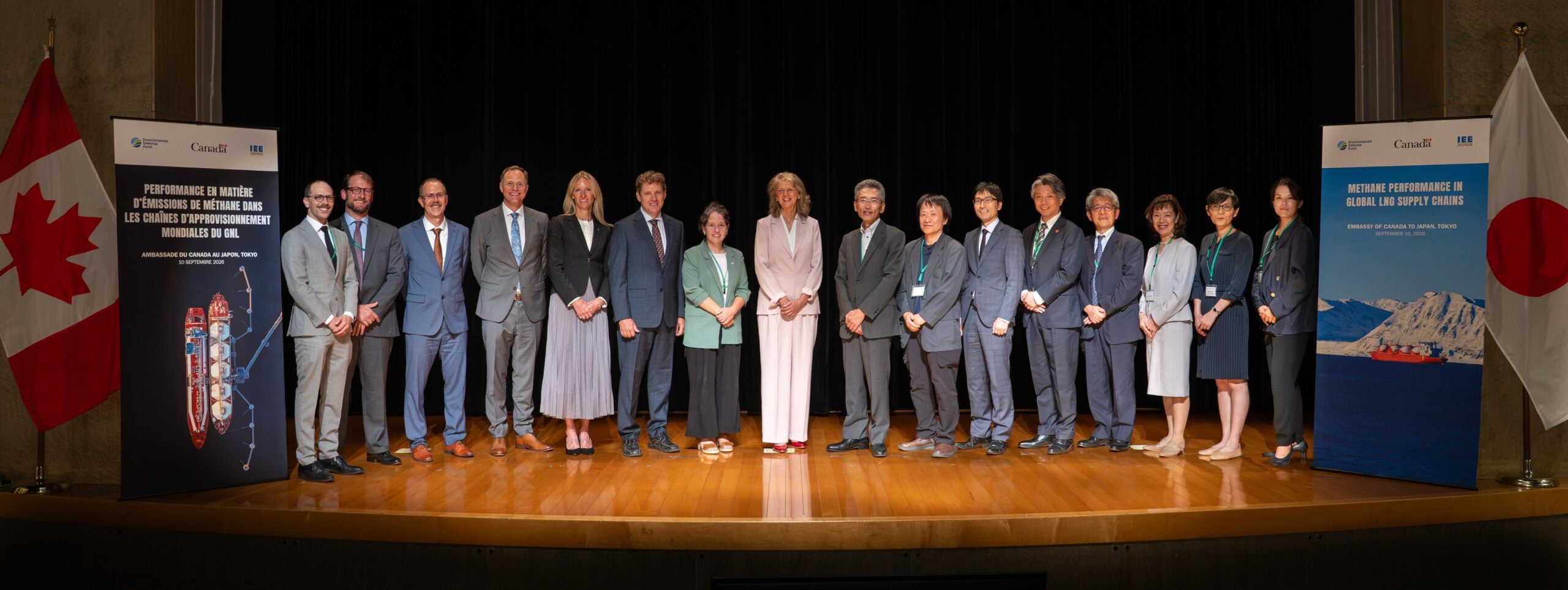
On September 10, EDF in partnership with Environment and Climate Change Canada (ECCC) and supported by the Institute of Energy Economics, Japan (IEEJ) organized a panel discussion hosted by the Embassy of Canada to Japan in Tokyo.
The event brought together Japanese and Canadian perspectives including the Japan Organization for Metals and Energy Security (JOGMEC), The Mitsubishi Corporation and GORads and, from Canada, Professor Matthew Johnson at Carleton University and PETRONAS Canada. Together, panelists explored a question at the heart of these economic disruptions: how can strong methane performance by energy-producing countries help meet the long-term energy security needs of major LNG importers?
Importers are seeking verifiable low-emission energy
After China, Japan is the world’s largest importer of LNG. It also coordinates the Coalition for LNG Emission Abatement Toward Net Zero (CLEAN), a public-private initiative launched by major LNG buyers in Japan and South Korea to improve emissions transparency and drive methane reductions across the LNG value chain. Several participants pointed to CLEAN as an indication that LNG buyers are paying increasing attention to methane performance and emissions transparency.
Canada is the world’s fifth-largest producer of natural gas. One major export facility is already operating with the capacity to send 14 million tonnes overseas each year, and planned projects could more than triple that capacity by the end of the decade. Canada also has some of the world’s leading methane regulations, which are estimated to reduce methane emissions by 72% by 2030 if every province implements them with the same stringency.
Panelists speaking from the importer perspective made clear that there is demand for low-emission natural gas that can provide a secure source of energy. The discussion highlighted that credible methane performance can support supplier credibility, improve transparency and strengthen the long-term competitiveness of LNG supply chains.
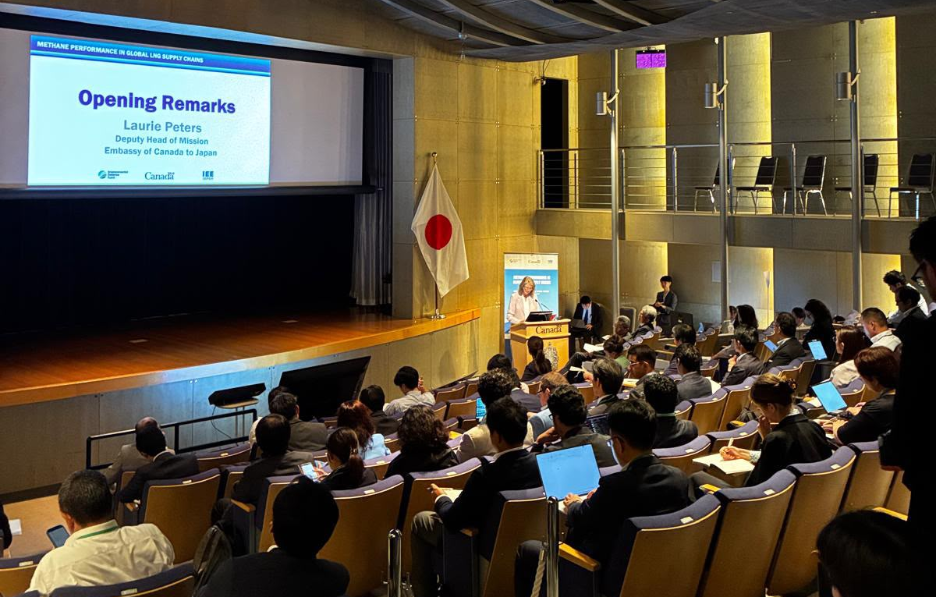
Canadian Minister and Deputy Head of Mission, Laurie Peters, delivers opening remarks at the Canadian Embassy’s Oscar Peterson Theatre
How to deliver emission reductions and transparency
Exporter representatives highlighted Canada’s progress in reducing methane emissions, the leadership of British Columbia, and the country’s potential to help meet Asian demand for lower-emission LNG. Realizing that potential depends on robust implementation of Canada’s national regulations across all major producing provinces.
For this to happen, Canada will need to determine that provincial regulatory proposals will have the same outcome as the federal regulation leading to the finalization of equivalency agreements. Any credible assessment of equivalency will need to be based on credible measured emission data found in Canada’s national inventory.
All too often stakeholder groups fall into competition or conflict. This is a rare example where stakeholders representing very different constituencies appear to have found common ground: mitigating methane is a win for the planet, for energy security and trade or, what hockey fans from the Canada panel might call a hat trick.