







States are powering the U.S. electric vehicle transition – even amid federal uncertainty
Posted: in Electric Vehicles, General
Written By

Share
Summary
- States across the country are driving forward clean, affordable transportation, with every state adopting multiple EV policies and many deploying ambitious incentives, infrastructure programs and fleet commitments.
- Even in a volatile federal landscape, states are driving the EV transition forward – expanding charging networks, lowering costs for drivers and proving that clean, zero-emission transportation is achievable and beneficial.
By Ryland Shengzhi Li and Ellen Robo
Even as recent federal actions have attempted to weaken or eliminate clean vehicle standards, states across the country are taking actions to support clean, affordable transportation – actions that cut pollution and save people money. EDF’s new U.S. Electric Vehicle State Policy Landscape Report provides a comprehensive assessment of how all 50 states and the District of Columbia are shaping the next generation of clean, affordable vehicles. The results are unmistakable: every state has taken steps to advance electric vehicles, and many are deploying innovative policies that deliver cleaner air, lower costs and create economic opportunity.
The report evaluates 16 distinct policy types across seven categories – from financial incentives to charging infrastructure to public fleet electrification. This nationwide assessment reveals both remarkable breadth and significant depth: many of the strongest EV policy portfolios span diverse states across the country like Arizona (14), Illinois (13), Alabama (12) and Colorado (13).
States are powering the U.S. electric vehicle transition – even amid federal uncertainty Share on XStates are making EVs more affordable
Direct financial incentives remain one of the most effective ways to put more drivers behind the wheel of a clean light-, medium-, or heavy-duty vehicle, and states are making that possible:
- Massachusetts provides $3,500-$6,000 in rebates for battery-electric vehicles and $1,500 for plug-in hybrids, with purchase price caps to ensure affordability.
- Colorado offers a rebate of up to $9,000 for buying or leasing a new EV, and up to $6,000 for a used EV to income-qualified residents who retire a higher-emitting vehicle.
- California offers point-of-sale vouchers to eligible fleets to lower the cost of qualified electric and hybrid trucks and buses. Available on a first-come, first-served basis, vouchers range from $7,500 to $330,000 by vehicle type and weight.
- The Texas Volkswagen Environmental Mitigation Program funds the replacement or repowering of diesel vehicles and equipment with all-electric models. Eligible projects span trucks, buses, port and airport equipment, forklifts and charging infrastructure, with at least 51% of operations required in designated priority areas.
These incentives make clean transportation an even more affordable option for households and companies.
Charging infrastructure is expanding rapidly
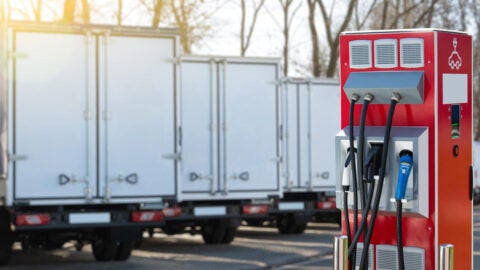
States are also dramatically expanding EV charging access – a foundational step for widespread adoption:
- Delaware offers rebates of up to $4,000 per port at multi-unit dwellings and $3,000 for workplaces and public sites.
- Georgia provides a 10% tax credit (up to $2,500) for publicly accessible charging installations.
- New York has committed $885 million to support make-ready programs, offsetting infrastructure costs to make many sites ready for charger installation.
And all states and DC have adopted fast-charging corridor plans through the bipartisan National Electric Vehicle Infrastructure program, helping ensure EV drivers can travel long distances with confidence.
Public fleets are going electric
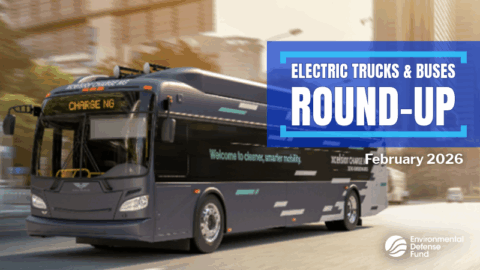
Many states are embracing EVs in transit fleets, school buses, and state agency vehicles, helping clean the air where people live, work and learn:
- Connecticut stopped procuring diesel-fuel transit buses in 2024 and requires 100% light-duty EV procurement by 2030.
- Maine has set a goal that 75% of new school buses be zero-emission by 2035.
- Every five years, the Alaska Department of Transportation and Public Facilities will review the cost and availability of alternative fuels and, when it makes sense, shifts its fleet to cleaner options while teaming up with public and private partners to make those fuels easier for everyone to access.
These commitments accelerate deployment, lower public-sector fuel and maintenance costs and EV use across communities.
Innovation and collaboration are accelerating progress
Some of the most innovative developments involve emerging technologies and regional coordination:
- Indiana and Purdue University are piloting a dynamic wireless charging roadway for heavy-duty trucks – the first of its kind in the U.S.
- Dominion Energy created interactive grid-capacity maps in North Carolina and Virginia to help identify optimal locations for fast chargers.
- Orlando Utilities Commission provides full-service fleet electrification planning for businesses and public agencies.
- Multi-state coalitions across the Mid-Atlantic and Midwest are coordinating regional charging corridors and advancing medium- and heavy-duty electrification.
These forward-looking strategies further expand the benefits of clean, affordable solutions.
The path ahead
Despite federal uncertainty, states continue to lead the way. In addition to analyses from partners across the clean transportation sector, EDF’s new report offers an overview that policymakers, utilities, advocates and industry leaders can use to accelerate this progress and ensure every community benefits from zero-emission transportation solutions. Explore the full report at https://www.edf.org/how-states-are-powering-americas-clean-transportation-future.