







Utility accountability and reformed liability have the power to reduce electricity costs
Written By

Share
Summary
- Wildfires are a major driver of high electricity rates, and are likely to continue increasing.
- Reforming how utilities make and spend money — and holding them accountable for safety — reduces costs for everyone.
- While healthy electric utilities are necessary to decarbonize and access to affordable insurance is essential to climate resilience, the only long-term solution to our wildfire crisis is significant and strategic investment in wildfire mitigation.
This post is part of a series examining Enhancing California’s Resiliency to Natural Catastrophes, a report prepared by the California Earthquake Authority in response to Senate Bill 254. The report presents policy options for addressing California’s interconnected wildfire, insurance and electric utility challenges. In this blog, we assess the report’s utility-related proposals and consider how California can reduce wildfire risk, protect survivors, maintain financially stable utilities, and keep electricity bills affordable.
As Californians across the state have experienced, wildfires are becoming more intense and dangerous, and catastrophic wildfires are becoming more frequent. Some of the most destructive wildfires have been caused by utility equipment, and costs for the state’s electric utilities to both pay damages associated with those fires and invest resources needed to reduce the risk of causing additional fires cost ratepayers a lot of money.
In other words, wildfire is adding significantly to your electricity bill, which both increases strain on budgets when families are already struggling to make ends meet and makes it harder for California households to electrify their cars and appliances. These wildfire expenses also make it harder for the utilities to attract investors and make those investments riskier — which means paying for necessary infrastructure and procuring clean energy to meet California’s climate goals becomes even more expensive.
California needs to reduce the cost of wildfires for ratepayers and utilities. Fundamentally, the only sustainable way to do this is to reduce the underlying risk of wildfire. Mitigating wildfire risk better prepares Californians for future conflagrations. But ratepayers need relief on their bills now, and utilities should be held accountable for their role in causing wildfires — without breaking the bank. The state can take immediate action to curb excessive utility wildfire costs while still prioritizing safety, ensure utilities’ financial health to keep our electric system safe and reliable, and decarbonizing the economy.
Wildfires are expensive — and utilities pass down the brunt of the costs
California’s electric utilities must cover the bulk of the costs for both wildfire mitigation and recovery. To help ensure public safety, regulators at the California Public Utilities Commission (CPUC) have ordered the utilities to reduce risk by spending billions of dollars each year on wildfire-related investments — the investments to both install equipment to avoid ignitions (e.g., smart reclosers, sectionalizers, covered conductor, undergrounding, etc.) and manage their system (e.g., vegetation management). When electric utilities’ equipment causes catastrophic wildfires, utilities can be held responsible for property damage caused by their equipment even without being found negligent (known as “inverse condemnation”). These wildfire-related investments quickly add up, especially when utilities are both responding to the present and mitigating for future conflagrations.
The CPUC reviews these investments — which ultimately get passed down through your electricity rates — to ensure that the electric utilities provide safe and reliable service at just and reasonable rates. California’s investor-owned electric utilities (PG&E, SCE and SDG&E) earn profit on their capital investments but not on expenditures related to operations and maintenance of their systems. For example, undergrounding a power line — a capital investment — is eligible to earn investors a reasonable profit on that investment, paid for by ratepayers. That capital investment also reduces future, and frequently ongoing, maintenance costs, the savings of which could get passed onto ratepayers.
All capital and maintenance investments deemed prudent — meaning a utility acted reasonably based on the information it had available at the time — by the CPUC are paid for by (or “recovered from”) their customers. If the utility was negligent in their responsibility (they did not act prudently), then recovery of funds would not be reasonable, and shareholders absorb the costs. While many are pushing for shareholders to pick up a larger share of the tab to save California ratepayers money, the reality is that shareholders cannot pay for all these investments alone. If utility shareholders are asked to make large investments without any cost recovery from their customers, utilities risk insolvency, and the cost to borrow money for future investments goes up – a cost ultimately passed on to ratepayers.
Utilities’ wildfire investments are driving high electricity bills — and these costs could keep rising
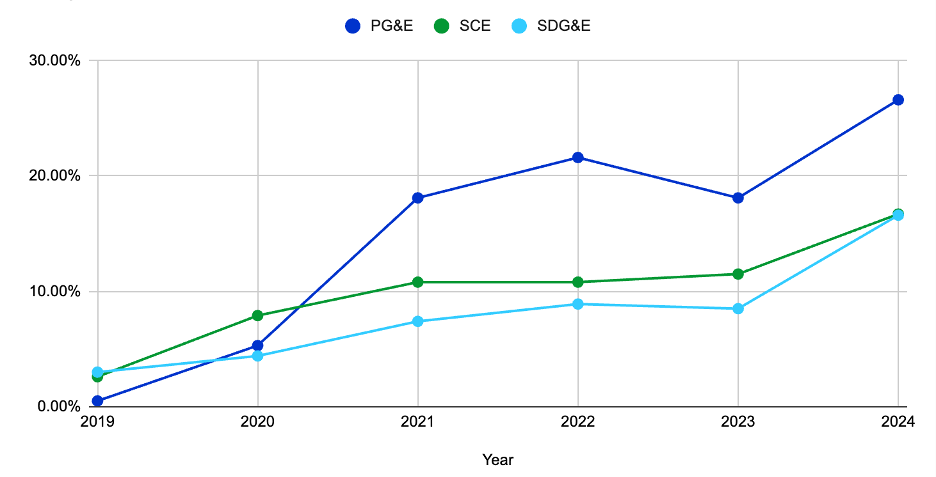
As a result of major wildfire-related expenses, California now has amongst the highest average electric bills in the country. The figure below shows just how much wildfire-related costs have increased as a share of total bill during the five years from 2019 to 2024.
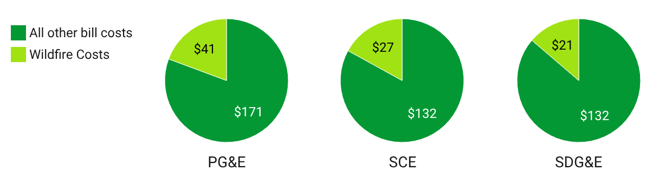
As noted in our previous blog and the SB 254 report, wildfire-related charges add an average of $21-41/month to residential electricity bills for California’s three largest investor-owned utilities.
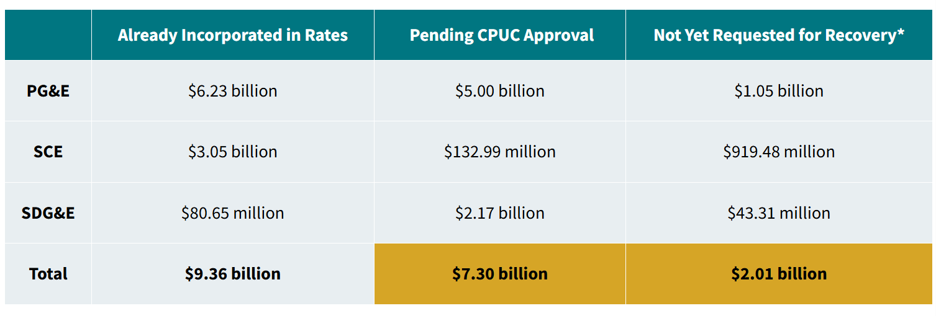
And it’s not just today’s bills that show the impact of wildfires. Utilities have separate memorandum accounts where they track significant, unpredicted costs incurred for catastrophic events like wildfires. Unlike the ratemaking process where a utility projects forward-looking costs and predictably incorporates those into rates (if deemed prudent by the CPUC), memorandum accounts allow utilities to track unforeseeable spending and retroactively bill it to their customers by increasing rates. There is currently $9.31 billion in wildfire-related costs in memorandum accounts across all three investor-owned electric utilities that could be added to customers’ bills in the future.
Ratepayers need immediate relief, and it comes from increasing accountability and reducing liability
California’s three investor-owned electric utilities need to reduce wildfire-related costs to not only lower electric bills, but also to remain stable and financially healthy. Reducing costs helps both ratepayers and shareholders. There are two categories of reform needed to cut down on costs: liability and accountability. We consider a few of the many potential reform options in each of those categories.
Any reforms to utility liability — a utility’s legal responsibility to cover impacts from their operations — need to result in tangible and immediate savings for ratepayers without compromising safety, not only benefit shareholders. The question is what is the most cost-effective way to reduce risk from infrastructure. Because of inverse condemnation, utilities can have an incentive to overspend to reduce risk, but not all of that spending is prudent. For instance, utilities shouldn’t be “goldplating” their investments, or making unnecessary investments, even though these maximize their profits because they recover costs from ratepayers. Instead, the CPUC should ensure that investments directly and cost-effectively reduce risk, thus balancing improving safety (and reducing liability) and preventing over-spending.
Additionally, memorandum accounts should be controlled and curtailed so utilities are required to spend within their budgets. For wildfire-related operation and maintenance expenses like equipment installations or grid and vegetation management, predictable utility spending should be included in the CPUC’s ratemaking process. Memorandum accounts should exist for only truly unforeseeable expenses. In the longer-term, as rightly noted in the SB 254 report, California should consider reforming inverse condemnation, which would limit utilities’ liability in cases where their equipment causes a fire but they are cleared of wrongdoing.
Utility accountability should be enhanced by directly tying safety to the bottom line. Strict executive compensation structures tied to performance improvements would incentivize those at the top to make sure the utility is performing at the highest standard of safety. Similarly, increased shareholder penalties for safety violations — if seriously enforced — would ensure shareholders are held responsible for the utility’s actions. This underscores a key point: while utilities will need to continue to rely on cost recovery for prudent activities to mitigate wildfire risk, those same ratepayers should not bear the costs of damages caused by wildfires when utilities are found to be responsible — this burden should be shifted to those who earn utility profits.
Utility and insurance stability is needed for California’s clean energy future
Electric utilities are central to California’s clean energy future, and keeping utilities financially sustainable and limiting further rate increases is critical to realizing that future. At the same time, utilities operate as part of a broader economic system, where insurance acts as a foundational tool for protecting households and communities, especially in the face of a changing climate. Any policy decisions to stabilize electric utilities cannot be taken at the expense of the stability of California’s insurance market. Doing so would risk robbing Peter to pay Paul, with potentially catastrophic financial consequences if the result exacerbated challenges accessing and affording homeowners’ insurance. The SB 254 report includes an option to eliminate insurance subrogation against utilities to limit utility cost, but as we explore in this previous post, this is a strategy EDF strongly cautions against.
Instead, California needs to better define the limits of utility companies’ expenditures (and confine its executives’ and shareholders’ profits) to cost-effectively reduce wildfire risk, reduce the cost of electricity, and prevent utility insolvency. We need the utilities to be financially healthy enough to attract the capital needed to keep our electric system safe and reliable, and to decarbonize the economy.
Utility stability doesn’t only result from addressing the ratepayer impacts described above. A resilient and cost-efficient electric system starts with mitigation. Utility wildfire mitigation investments should better align with investments made by communities, local governments, and state governments to reduce overall wildfire risk in California.
Expert contributors to this blog series include Jenna Knobloch, Katelyn Roedner Sutter, Michael Colvin and Katie Roback from Environmental Defense Fund and Jeremy Sokulsky and Brynn O’Donnell from Environmental Incentives.