








The Trump administration is propping up the coal industry. Our new tracker shows what that means for you.
Written By

Share
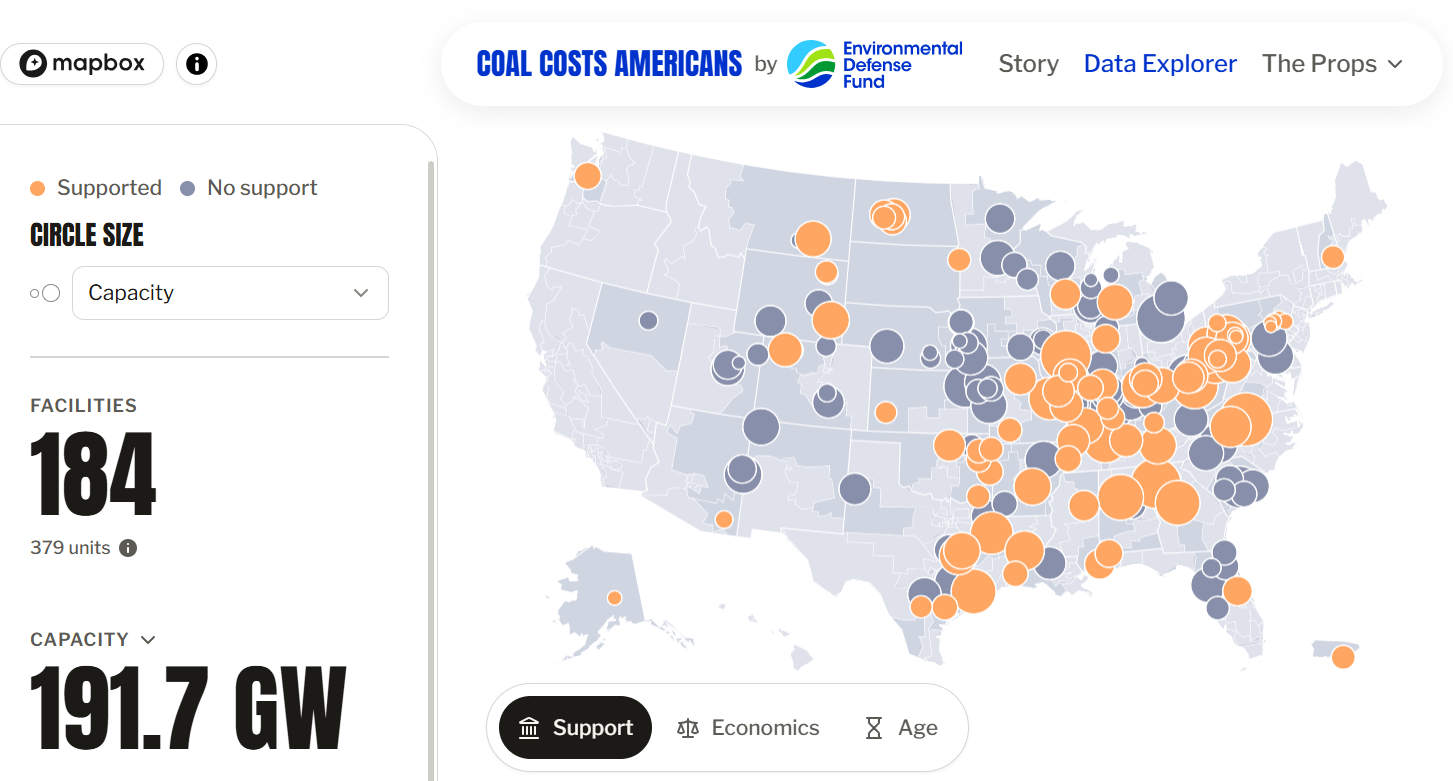
EDF just launched “Coal Costs Americans,” an interactive tool that allows you to visualize the impacts of the Trump administration’s playbook to put its thumb on the scale for coal.
Those actions include forcing aging plants to keep running past their planned retirement dates, handing out free passes to get out of complying with clean air rules, direct payments and more. On our new site, you can learn about 187 coal plants, dig into which ones have received direct federal support, and learn how much these facilities are polluting and what it’s costing Americans.
The timing could not be more important. Recent EDF and Atlas Public Policy analysis found that the U.S. power pipeline is shifting toward more costly, polluting fossil fuels, reversing years of clean energy growth. At the same time, America’s coal fleet continues to age, with the average coal plant now 44 years old.
Rather than allowing these aging facilities to retire, Trump administration policies are helping keep many of these facilities online longer than utilities had planned. Coal remains one of the most expensive and polluting sources of electricity, yet federal support is extending the life of plants that were already on their way out. Here are some of the worst offenders:
The coal plant receiving the most measures of federal support
Unit 1 of the Craig coal plant in Colorado has received a presidential exemption from compliance with the Mercury and Air Toxics Standards (MATS) and four extensions of its retirement date. The unit is 46 years old. Its repeated retirement extensions will cost ratepayers $82.4 million to pay for the unit’s continued operation and an estimated $2.2 to $2.8 million in health harms from the unit’s pollution during that time.
Craig is the only coal plant that has received three of the four types of federal support measures analyzed by EDF. The combination of a MATS exemption and retirement extensions means that Craig unit 1 gets to continue operating past its scheduled retirement date and continue to put Coloradans at risk.
The coal plants emitting the most harmful air pollution
Mercury
The Coal Creek plant in North Dakota emitted the most mercury of any U.S. coal plant in 2025 — 294.5 pounds. It also received a MATS exemption from the Trump administration.
Coal Creek burns lignite coal, a particularly dirty and inefficient power source. Lignite coal has higher mercury concentrations than other coal types and has a lower power content, meaning more of it needs to be burned to produce the same amount of energy, resulting in more pollution. This pollution is toxic; mercury causes brain damage in babies and is associated with heart disease.
Coal Creek is one of several large lignite-fired power plants operating in central North Dakota, alongside Antelope Valley, Coyote and Milton R. Young. This concentration of lignite generation means that residents are exposed not just to emissions from a single facility, but to pollution from an entire fleet of plants burning one of the dirtiest forms of coal in the country.
Sulfur dioxide
The 56-year-old Labadie plant in Missouri emitted 38,232 tons of sulfur dioxide in 2025, the most of any coal plant in the U.S. The Labadie plant also emitted the fourth most mercury of any coal plant in 2025 –167 pounds. Yet it too received a MATS exemption from the Trump administration.
Sulfur dioxide causes eye irritation, worsens asthma, increases susceptibility to respiratory infections, impacts the cardiovascular system, and contributes to acid rain as well as harmful soot pollution. Roughly 2,000 people live within three miles of Labadie, almost a quarter of whom are low-income.
Nitrogen oxides
Also in Missouri, the New Madrid coal plant emitted 14,335 tons of nitrogen oxides in 2025, the most of any coal plant in the U.S. Nitrogen oxides are a key contributor to smog pollution (also known as ground-level ozone). Exposure to nitrogen oxides can result in development and exacerbations of asthma and bronchitis and can lead to a higher risk of heart disease.
The coal plants that have been ordered to keep running past their retirement dates
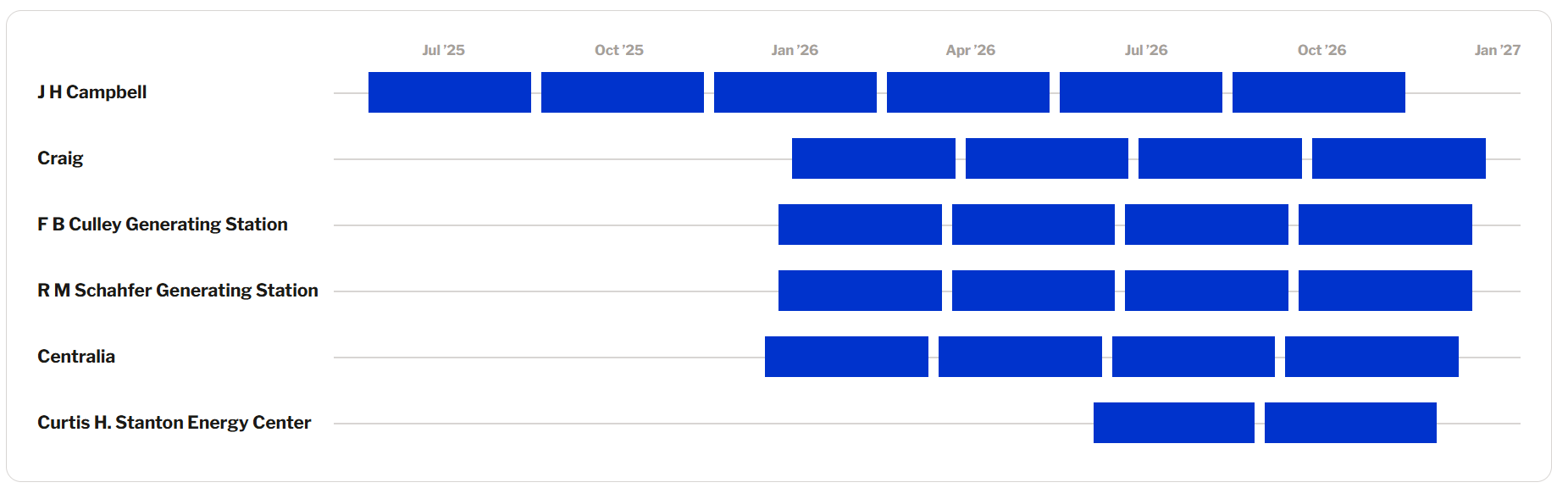
Units at six coal plants have been ordered to remain online past their planned retirement dates, in some cases for more than a year. Utilities had already determined that retiring these units was in the best interest of their customers, yet they were forced to continue operating.
These extensions come at a cost. Keeping aging coal plants running longer than planned saddles customers with additional operating expenses while exposing communities to more harmful air pollution. Collectively, these extensions have already cost ratepayers $593 million and have resulted in over $850 million in health harms.
Rather than improving reliability for the power grid, many extended coal plants have either broken down or have not been running at all. For example, unit 18 at the R.M. Schahfer coal plant in Indiana has not been operating because of mechanical issues. The Centralia plant in Washington has produced virtually zero electricity since it was first extended last December.
Learn more about EDF’s legal challenges to these unlawful extensions and the harms they pose to Americans.
The coal plants that received direct payments from the U.S. Department of Energy
Through Department of Energy grants, the Trump administration is doing more than simply delaying coal retirements. It is directly investing taxpayer dollars into coal facilities across the country.
DOE has awarded $950 million to 24 coal plants, providing financial support to an industry that has struggled to compete economically against cheaper clean energy resources and natural gas. This taxpayer money extends the life of facilities that are imposing significant health and economic burdens on Americans, while delaying the replacement of cheaper, cleaner energy.
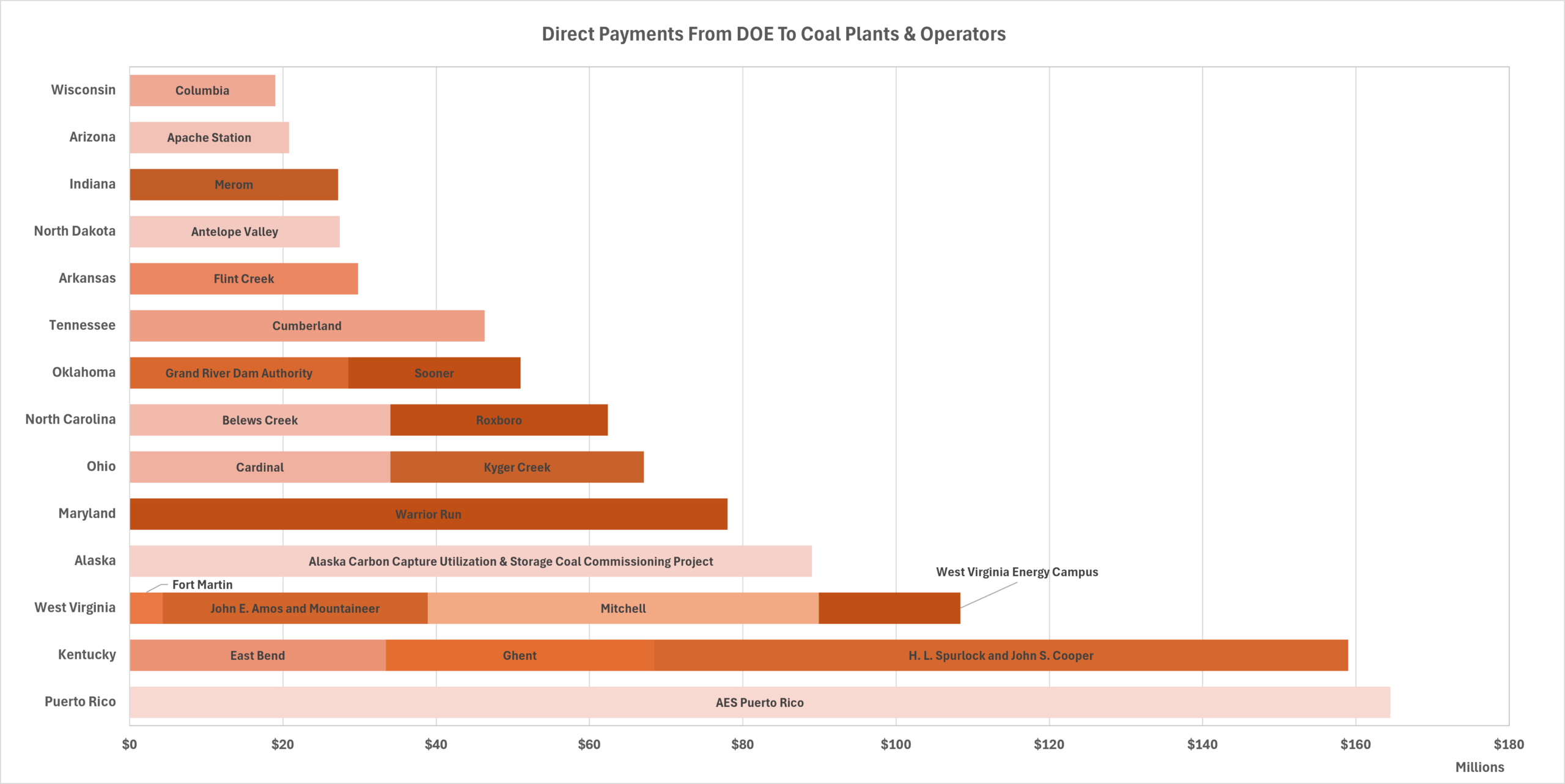
$107.54 million of this almost $1 billion has been given to build two new coal-fired power plants in Alaska and West Virginia – the first new coal plants to be constructed in over a decade. And the Trump administration awarded $78 million to Warrior Run, a Maryland plant that retired in 2024 because it could not produce energy economically. In fact, the grid operator called the plant “extraordinarily uneconomic.”
The Trump administration’s actions hurt us now, and later
The Trump administration’s efforts to prop up coal are a part of a broader set of policies aimed at tilting the market in favor of fossil fuels, threatening to reverse years of progress in reducing harmful pollution from power plants. Right as electricity demand surges, the Trump administration is delaying, blocking and cancelling low-cost wind and solar projects around the country. Recent analysis by EDF and Atlas Public Policy found that these lopsided policies are having an impact: planned fossil fuel power capacity surged 45% in just six months, with roughly 68 gigawatts expected to come online between 2026 and 2030 – nearly all from new natural gas. If these projects move forward, fossil fuels could account for 70% of new power capacity by 2030, compared to just 5% in 2024.
Keeping aging coal plants online, along with actions the Trump administration has taken to weaken pollution protections and make clean energy harder to build, risks locking Americans into higher electricity costs and more harmful air pollution for decades. Americans could pay the price twice: through higher energy bills and the health costs of increased air pollution.