8 things about the Trump administration’s rollback of mercury pollution protections
Written By

Share
(This post was co-authored by EDF technical analyst Grace Hauser)
The Trump administration just finalized its repeal of the 2024 Mercury and Air Toxics Standards – a suite of lifesaving protections against highly dangerous air pollution from coal-fired power plants.
That action cancels stronger safeguards against pollution from lignite-fired coal plants, which are among the highest emitters of mercury pollution in the U.S.
It also rolls back protections against other toxic pollutants like arsenic and lead from all coal plants, and reverses a requirement that coal plants use modern monitoring technologies to continuously monitor their toxic pollution.
EDF will go to court to defend the 2024 Mercury and Air Toxics Standards. We will continue fighting to advance cleaner, healthier air for all Americans.
Here are eight things you should know:
- The Trump EPA’s rollback means there will be more dangerous mercury in our air, water, and food — particularly from high-emitting lignite coal plants
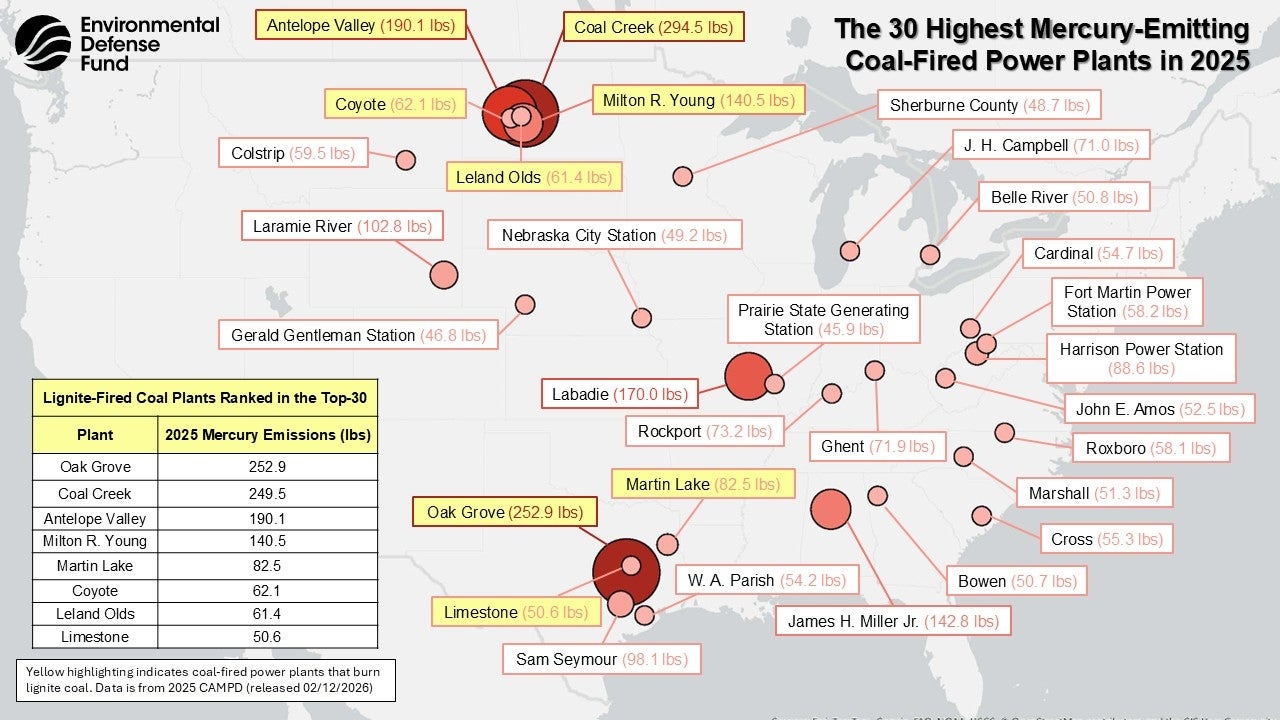
At Environmental Defense Fund, we recently updated our map of the top 30 mercury-polluting power plants to include 2025 emissions data. (You can see the updated map above.) It shows significant mercury emissions concentrated near a small set of high-emitting facilities in North Dakota and Texas, many of which burn lignite coal.
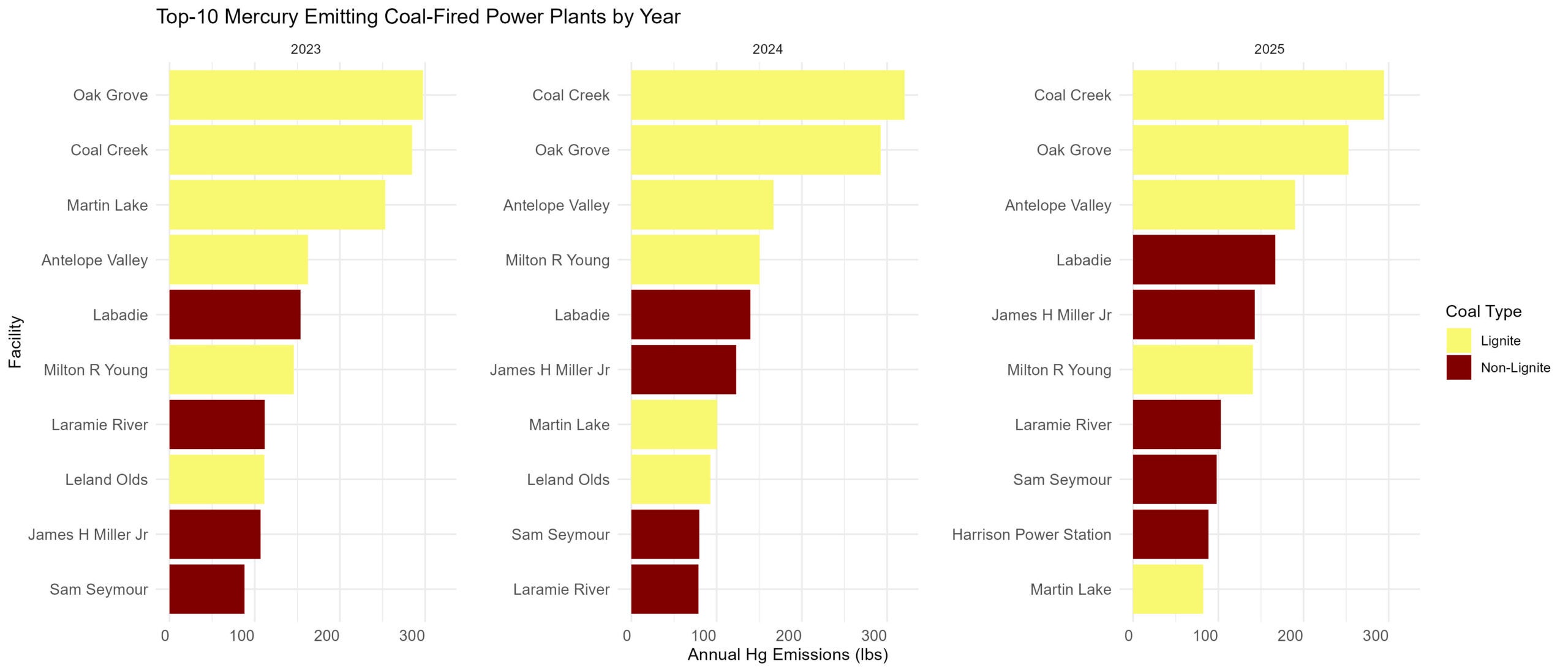
You can see the top 10 emitters from 2023 to 2025 in the chart below:
This is especially concerning because EPA’s own final rule analysis predicts that lignite coal use will increase by 10.5% per year by 2035 as a direct result of its repeal of the 2024 Mercury and Air Toxics Standards.
EPA’s projection for all mercury emissions is even more alarming – a 23% increase by 2030, which means up to 1,500 additional pounds of pollution per year. That’s pollution that EPA admits will increase deposits of mercury in our ecosystems and lead to the accumulation of methylmercury in fish.
(Read more findings from our updated map and analysis here)
- The Trump EPA ignores the significant public health costs of repealing the 2024 Mercury and Air Toxics Standards
The Mercury and Air Toxics Standards guard against mercury, arsenic, nickel and other pollutants that can cause brain damage in babies, cancer, and serious heart and lung diseases.
In its rollback, the Trump EPA claims it cannot put a dollar value any of the rule’s health harms.
That’s a stark departure from EPA’s decades-long practice of estimating the health impacts of its rules. And it’s a sudden reversal from the Trump EPA’s own proposal for the rollback — which monetized the lost benefits of reducing just some of the pollutants affected by the rule at $340 million.
The Trump EPA announced in its final rule that it will no longer calculate the monetary value of the lives saved and illnesses avoided from reducing fine particulate matter and ozone. The agency conducted the air quality modeling and health impact analysis, but then chose not to present it or rely on its resulting dollar values, citing newly-claimed “uncertainties” that did not prevent them from monetizing these same impacts just months earlier. The Trump EPA also failed to consider the cost of health harms from mercury pollution itself.
By continuing to quantify compliance costs for industry while refusing to quantify health costs the Trump EPA has skewed the cost-benefit analysis in favor of eliminating safeguards for our health.
- Independent researchers estimate at least $200 million per year in health harms from increases in mercury pollution
Unlike the Trump EPA, independent researchers have estimated the cost of health harms from mercury pollution.
A 2025 analysis by Harvard University estimated the health costs of repealing the 2024 mercury standard would be $200 million per year – more than two-and-a-half times the Trump EPA’s own estimated savings from the entirerepeal.
The costs are due to reductions in children’s IQ levels and to premature deaths from heart and lung disease, both of which are caused by an increase in mercury pollution. These harms fall most heavily on subsistence fishers and their children, whom EPA previously found are more likely to be racial minorities and low-income families who would most benefit from reducing mercury in fish.
- EPA’s repeal reopens the dangerous lignite coal loophole
Lignite coal is one of the dirtiest types of coal to burn. It contains higher levels of mercury and other toxics than other types of coal, and more lignite coal must be burned to generate power compared to other types of coal, which then produces even more emissions.
Before the 2024 Mercury and Air Toxics Standards, lignite coal plants were allowed to release more than three times as much mercury as other coal plants. Some coal plants took advantage of this loophole, burning a small amount of lignite coal and claiming to be subject entirely to the lax standards.
The 2024 Mercury and Air Toxics Standards closed this loophole, and required lignite plants to meet the same mercury pollution standard that all other coal plants have been subject to since 2012.
- EPA’s repeal weakens pollution monitoring
The 2024 Mercury and Air Toxics Standards required continuous emissions monitoring systems for coal plants — modern technology that provides real-time data about emissions — to ensure compliance with limits for toxic pollutants.
Under the Trump EPA’s repeal, coal plants will be allowed to conduct short monitoring tests much more infrequently – four times a year, for some, or as infrequently as once every three years.
In other words, the Trump EPA is charting the way for these large emitters of arsenic, lead and similar toxic metals to obscure their pollution levels almost every day of the year instead of requiring transparent continuous monitoring of their toxic pollution based on accessible, widely available technologies.
- The 2024 Mercury and Air Toxics Standards are achievable and reasonable in cost using proven, widely-used pollution control technologies
In 2024, EPA found that power plants that burn lignite coal could lower their mercury emissions to the levels allowed for all other coal plants just by using more of the same chemical additives they already use to control mercury pollution.
The agency also found that coal plants can readily meet stronger limits for nickel, arsenic, lead and other toxic pollution by using widely-available controls that many coal plant owners have already installed. In fact, they found that 93% of the U.S. coal fleet is already meeting the more protective 2024 Mercury and Air Toxics Standards, and most of the other 7% can meet the standards through relatively simple upgrades.
EPA also found that the continuous monitoring systems needed to meet the 2024 Mercury and Air Toxics Standards are in widespread use and are only marginally more costly than the previous antiquated requirements. One-third of the U.S. coal fleet is already using continuous emissions monitoring systems.
- EPA’s weakening of coal plant standards is occurring alongside a rise in coal generation
Recent analysis of 2025 energy sector trends shows that, for the first time in years, U.S. coal generation is increasing. This trend isoccurring simultaneously with increased data center power demand (and concern that consumers will end up paying the tab for it).
Pollution standards based on modern control technologies are more important than ever considering this reality.
Notably, the Trump EPA’s own modeling for its final repeal of the 2024 Mercury and Air Toxics Standards shows that the repeal has zero impact on coal plant retirements, total capacity, electricity generation mix, and retail electricity prices — undermining the administration’s claim that the repeal is needed for grid reliability and energy security. In fact, EPA projects 36 gigawatts of coal plant retirements by 2035 regardless of whether the 2024 Mercury and Air Toxics Standards are in place.
- Repealing the 2024 Mercury and Air Toxics Standards follows many other steps the Trump administration has taken to prop up the coal industry
Repealing the standards is another in a long line of Trump administration giveaways for the coal industry.
They include newly-announced subsidies to the coal industry, a wasteful deal with the Department of Defense to procure electricity from burning coal, and grants of “pollution passes” – two-year exemptions from having to comply with national pollution standards – to 71 coal plants around the country after EPA invited the plant owners to request an exemption via email. Newly-released EDF analysis of the requests shows that exemptions were far broader than what coal plants requested. (EDF is one of a dozen groups suing over those unlawful exemptions.)
President Trump has also issued a series of emergency orders forcing aging, costly and unreliable coal plants to stay open long after they had planned to retire – and passing the costs along to families and businesses. The ratepayer cost for just one of those plants, the J.H. Campbell power plant in Michigan, is over $600,000 each day – a cost that will be passed on to American families as higher power bills.
The Trump EPA’s attack on the Mercury and Air Toxics Standards won’t do anything to bring those bills down – but it will expose Americans to more toxic air pollution and increased health costs. EDF is determined to defend these vital public health safeguards.