








The Hidden Price Tag of Flaring: Why Burning Off Natural Gas Costs Society Billions
Posted: in Cap and Trade, Climate Change, Economics, emissions, Energy efficiency, Energy Transition, Markets 101, Social Cost of Carbon
Written By


Share
This blog post was authored by Lauren Beatty, EDF Economist; Mark Agerton, Assistant Professor in the Department of Agricultural and Resource Economics at UC Davis; and Sophia Salzer, pre-doctoral researcher at UC Davis.
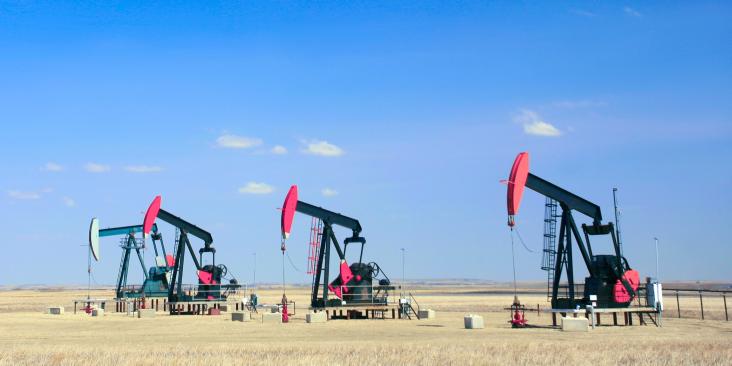
From space, parts of West Texas and North Dakota shine brightly at night the same way that sprawling metropolises do. However, the glow isn’t from skyscrapers or highways: it’s from natural gas flares. Flaring — the burning of excess natural gas at oil and gas wells — is a frequent part of oil production. Operators flare gas they can’t economically capture and sell, often because pipeline capacity is limited or because the cost of building infrastructure exceeds what the gas is worth on the market.
Some flaring is unavoidable. At times, operators must flare for safety reasons. In other cases, they flare because it’s too expensive to transport and process the gas. But how much flaring is too much, and how should policymakers respond? A new EDF discussion paper finds that the environmental and health costs society bears from flaring are large. Evaluating the three largest flaring basins in the U.S., the study estimates that flaring imposed roughly $5.6 billion in climate and health damages in 2023.
A Textbook Externality: When Private and Social Costs Diverge
A firm deciding whether to flare gas or invest in capturing it makes a simple comparison: what does it cost to capture the gas, and what can it sell that gas for? As long as the marginal cost of capture exceeds the market value of the gas, flaring is the profit-maximizing choice. Firms flare up to the point where those two are equal.
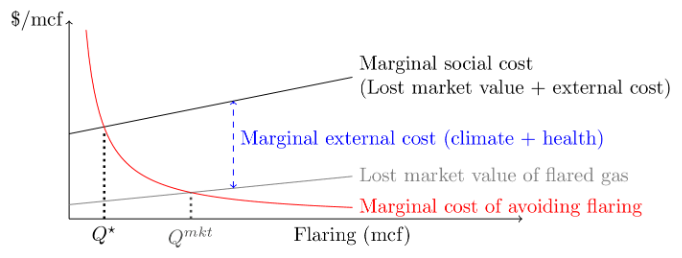
The figure below translates that decision rule into the familiar Econ 101 framework. The downward-sloping red curve shows the marginal cost of avoiding flaring (i.e., capturing gas), while the gray line reflects the market value of the gas that would otherwise be burned. Their intersection determines the privately optimal level of flaring, Qmkt.
The complication is that flaring creates damages through greenhouse gas emissions and local air pollution that firms do not pay for. In other words, part of the full cost of flaring is borne by the public rather than the firm — a classic externality. In the figure, adding those climate and health damages shifts the relevant comparison from the gray line to the higher black line, the marginal social cost. Once those external costs are included, the efficient level of flaring falls to Q*.
The gap between Qmkt and Q* is the core economic problem: firms respond to prices they face, not to the full social costs their decisions impose, leading to higher-than-efficient levels of flaring.
The Climate Costs Are Much Larger Than You’d Think
The paper calculates that the climate cost of flaring typically runs between $17 and $24 per mcf across the three major U.S. flaring regions (the Permian Basin, the Bakken in North Dakota, and the Eagle Ford in Texas). Compare that to the $2–7 per mcf market value of the gas, and the gap between private and social costs becomes stark.
Across just these three basins in 2023, the market value of flared gas was $559 million – enough gas to power roughly 2.5 million homes for a year. While the market value is large, the climate damages alone exceeded $4 billion, almost an order of magnitude larger.
It’s Not Just About Methane
A core finding of the paper is that carbon dioxide, not methane, is responsible for the majority of climate damages from flaring. This matters because recent U.S. climate policy (particularly the now-delayed Waste Emissions Charge), focused exclusively on methane emissions.
Why does CO2 dominate? When gas is flared, most of the hydrocarbons are combusted and converted into CO2. A well-functioning flare destroys at least 95% of the gas, meaning only a small fraction escapes as methane. Meanwhile, the EPA’s updated Social Cost of Carbon nearly quadrupled relative to previous estimates (from about $66 to $248 per metric ton), while the Social Cost of Methane increased by only 17%. The combination of high destruction rates and a sharply higher carbon cost means that CO2 drives 85-95% of the climate damages from flaring. This has a direct policy implication: a methane-only fee would dramatically underprice the climate cost of flaring relative to the cost it imposes on society through climate change.
Composition Matters: What’s in the Gas Changes the Damages
Wells produce different amounts of hydrocarbons in their gas streams: some are “dry,” composed primarily of methane, while others are “wet,” containing heavier hydrocarbons like ethane, propane, and butane. When these heavier hydrocarbons are flared, they generate more CO2 per unit of gas burned, increasing climate damages. This means that two wells flaring the same volume of gas can generate very different social costs depending on the composition of the gas stream.
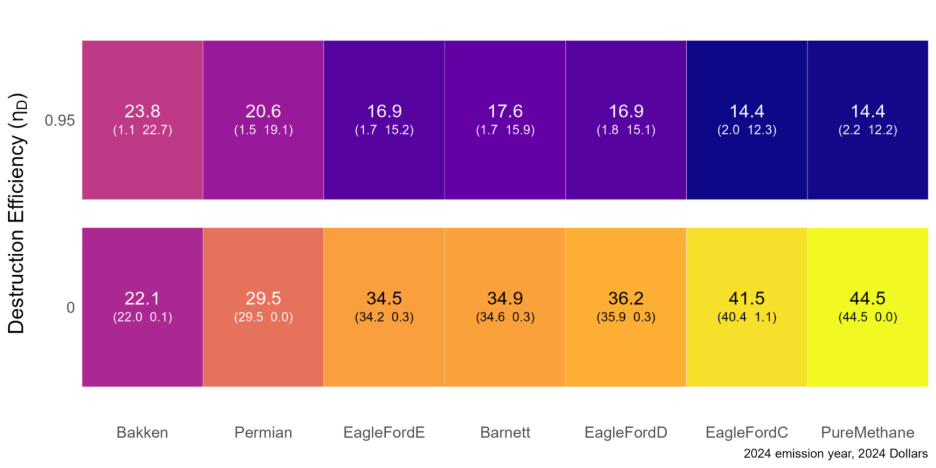
The figure above shows how climate damages vary systematically across samples taken from different basins for flared gas (0.95 destruction efficiency) and vented gas (0 destruction efficiency). Gas streams richer in heavier hydrocarbons, like the sample taken from the Bakken, produce substantially higher damages per mcf compared with dryer gas streams like those from the Eagle Ford. This compositional heterogeneity creates meaningful variation in the true social costs of flaring.
Health Costs Vary Dramatically by Location
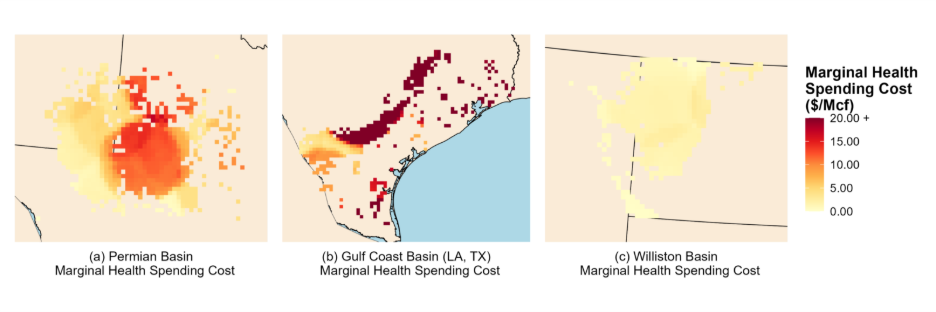
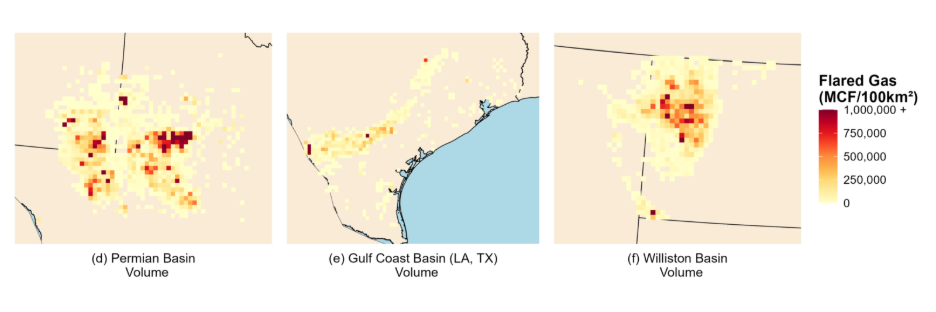
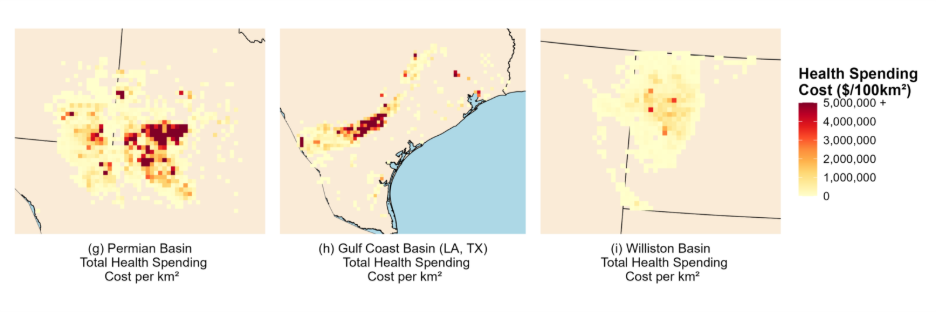
In addition to global climate impacts, flaring generates fine particulate matter and other pollutants linked to respiratory and cardiovascular disease. If flares operate near homes, schools, and hospitals, then nearby residents—including children and other vulnerable populations—can be exposed to them. The paper finds that health expenditures from local air pollution vary 18-fold across basins, driven by differences in the average population density near flares. In the sparsely populated Bakken of North Dakota, health costs from flaring run about $1.70/mcf. In the Eagle Ford region of Texas, near the metropolitan areas of San Antonio and Austin, health costs jump to $31.49/mcf. The Permian Basin falls in between at $7.91/mcf.
In total, health costs across the three basins added roughly $1.6 billion to the total cost of flaring in 2023. These estimates are actually fairly conservative: they only capture increased hospital expenditures and exclude mortality, lost productivity, and quality-of-life impacts.
Adding It All Up
Combining climate and health costs, flaring in these three basins imposed roughly $5.6 billion in damages on society in 2023. The gas that was burned was worth about $559 million. Society bore costs that were about ten times larger than the private value of the gas.
The paper’s findings point to several challenges for policymakers:
Methane-only policies underprice flaring. Because CO2 from combustion drives the bulk of climate damages, regulations that only price methane, like the Waste Emissions Charge, leave most of flaring’s climate costs unaddressed. An efficient policy would price both CO2 and methane at their full social costs.
One-size-fits-all regulations are inefficient. Both the 18-fold variation in health costs across basins and the substantial variation in climate costs across gas compositions mean that a uniform national flaring standard could be too strict in some places and too lenient in others. Efficient policy would be stricter where more people are exposed to flaring pollution and where gas streams rich in heavier hydrocarbons increase climate damages.
The bottom line is that flaring represents a large, mostly unpriced externality. While some flaring is necessary, current levels impose billions of dollars in damages that operators have little private incentive to reduce. Closing this gap between private and social costs is the central challenge for flaring policy.