








Statistics 101: Climate policy = risk management
Posted: in 1000 words, Climate science
Written By

Share
Bjørn Lomborg reviewed my book, Climate Shock (Princeton University Press, 2015), joint with Harvard’s Martin L. Weitzman, for Barron’s over the weekend. He started it by stating that “global warming is real.”
So far, so good.
But the book is not about whether the climate is changing. It is.
The book is about whether we are getting the order of magnitude of its effects right. Weitzman and I argue forcefully — in prose in the text, supported by a significant amount of research going into the 100-page end notes — that it’s what we don’t know that really puts the “shock” into Climate Shock. Lomborg asks how we can know that, if apparently we don’t.
The answer is simple, and it’s a statistical point that can’t possibly be lost on Lomborg, a former lecturer on statistics. The set of distributions that most directly represent climate uncertainty — the link between concentrations of carbon dioxide and eventual temperature outcomes — is inherently skewed. We know, and Lomborg agrees, that adding carbon dioxide increases temperatures. (Back to 19th century science.)
So we can very clearly cut off the distribution linking a doubling of pre-industrial concentrations to temperatures at zero. In fact, we can cut it off at least at around 1 degree Celsius (almost 2 degrees Fahrenheit). The world, after all, has already warmed by over 0.8 degrees Celsius (around 1.5 degrees Fahrenheit), and we haven’t yet increased pre-industrial concentrations by even 50 percent.
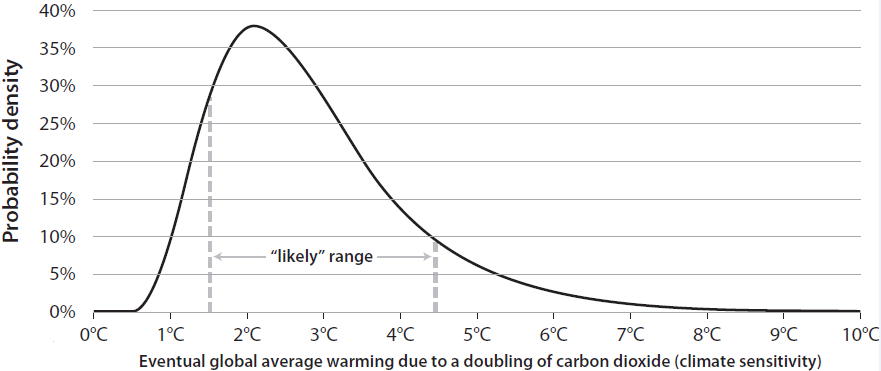
That skewedness of the underlying distribution is real. It’s important. The correct response, then, to those who are too sure about where the climate system will go isn’t to say, “cool it.” It’s to take the uncertainties seriously. Those, sadly, are skewed in one direction.
Climate risk is not our friend. It ought to prompt us to rethink not just how we talk about climate change. It should also inform our response. The burden of proof clearly rests on those who argue against these statistical facts.
First posted on Climate411.