Climate change solutions
We deliver game-changing environmental solutions that have a real impact for people around the globe.
Richard Denison, Ph.D., is a Lead Senior Scientist.
On Friday, the Environmental Defense Fund (EDF) filed extensive comments on a draft risk evaluation for the likely human carcinogen 1,4-dioxane EPA issued on July 1. While the formal public comment period runs until August 30, Friday was the deadline EPA set for comments if submitters want them to be considered by the Scientific Advisory Committee on Chemicals (SACC), which will be conducting peer review of the draft risk evaluations for this chemical and another, the flame retardant hexabromocyclododecane (HBCD), next week.
In its draft risk evaluation for 1,4-dioxane, the Environmental Protection Agency (EPA) has grossly understated the risks that workers and the environment face from exposure to the chemical. EPA has also abdicated its responsibility under the Toxic Substances Control Act (TSCA) to identify and evaluate the risks the chemical presents to consumers and the general population by excluding from its risk evaluation conditions of use and exposures that are known or reasonably foreseen. EPA has not met its mandatory duty under TSCA to identify and evaluate the risks to vulnerable subpopulations, falsely asserting there is no evidence that certain subpopulations are or may be more susceptible to adverse effects from exposure to the chemical. EPA has utterly failed to utilize the enhanced authorities Congress granted it in 2016 to ensure that it has or obtains robust information on 1,4-dioxane’s uses, hazards and exposures, resulting in serious information and analytic gaps and deficiencies that severely undermine the scientific quality of its risk evaluation.
EDF’s comments raised numerous major concerns with EPA’s draft. Among them are the following (see the noted section of the full comments for the details):
Tasha Kosviner, Environment Writer/ Editor
This blog originally appeared on Medium.
Most Fridays, my eight-year-old son and I take a walk. Our route takes us across some of the busiest traffic intersections in Brooklyn. As we walk, we talk. My son has lots to say and he bounces from topic to topic in funny and unexpected ways. This being New York, we often have to shout over the sound of car horns, sirens and buses roaring away from curbs.
Earlier this year, our conversation centered around the little white gadget clipped to my bag. Known as an AirBeam, it was personal air quality monitor, able to sense and measure the pollution in the air around us as we walked. The data it gathered was fed, via Bluetooth, to an app on my phone, giving us real time information about what was in the air we were breathing. What we saw was sobering.
With increasing global concern about air pollution, the availability of, and interest in, wearable air quality monitors has accelerated in recent years. In addition to the AirBeam, there is now also the Tzoa, the Flow, the ATMOtube, the CleanSpace Tag. A quick search of crowdfunding sites like Kickstarter and GoFundMe reveals multiple new monitors under development all claiming to give us the lowdown on what’s in the air around us.
Many of these gadgets stream their measurements straight to your smartphone. The AirBeam uses an open-source platform, AirCasting, and the information appears in ever evolving graphs which dip and peak as you move through space and time.
For most of mine and my son’s Friday walk, the lines remained reassuringly green and steady. But as we crossed a bridge above the Brooklyn-Queens Expressway, with traffic flying beneath our feet, the PM2.5 line (so-called because the particles detected are less than 2.5 micrometers in diameter, or one-thirtieth the size of a human hair) suddenly spiked and turned a traffic light red. We stood together and watched it silently for a few seconds.
“What does it mean?” my little boy asked.
I hesitated. The air around us looked clear, the sun shone, the people looked the same. Whatever was happening in the air above that expressway, New York (no surprise here!) didn’t seem to care. Staring at that red line, I realised I didn’t really know what it meant either. Could we stay and safely breathe that air? How long before it started to affect our health? A minute? A week? A year? I did that parent thing and answered without really answering.
“It means we’re moving on,” I tell him. “Let’s walk.”
Richard Denison, Ph.D., is a Lead Senior Scientist.
[See UPDATE in brackets below.]
The Trump Environmental Protection Agency (EPA) has just released drafts of two more chemical risk evaluations it has conducted under the Toxic Substances Control Act (TSCA). One is for the likely human carcinogen and neurotoxicant 1,4-dioxane, which contaminates public water systems serving more than 7 million Americans in 27 states at levels exceeding the level EPA has traditionally (until now) aimed to meet for general population exposures. The other is for the flame retardant hexabromocyclododecane, or HBCD, a persistent, bioaccumulative and toxic (PBT) chemical – toxic to human development and highly acutely and chronically toxic to aquatic organisms – that has been banned or heavily restricted in most of the rest of the developed world.
As might have been expected of the Trump EPA, the draft risk evaluations wholly exonerate HBCD and largely do so for 1,4-dioxane. Especially in the latter case, EPA achieves its improbable finding through quite a sleight of hand: EPA simply excludes most exposures to the chemical from the scope of its risk evaluation.[pullquote]Trump EPA political appointees have repeatedly argued that the agency needs to be doing a better job at “risk communication.” I guess we now know what that means.[/pullquote]
Once finalized, EPA’s determinations that these chemicals “do not present an unreasonable risk” will mean it has no obligation or authority to impose any restrictions on their manufacture, processing, distribution, use, recycling or disposal.
We will be looking at these documents more closely in the very limited time EPA has provided for the public to review and comment on them. But I want to draw attention right off the bat to a telling aspect of how the Trump EPA has presented its risk determination for 1,4-dioxane.
Richard Denison, Ph.D., is a Lead Senior Scientist.
Yesterday Environmental Defense Fund (EDF) filed comments on two EPA proposals (here and here) that will have major impacts on what chemical information EPA obtains and the public has access to. While EPA risk evaluations and risk management actions (such as they are) often garner the lion’s share of stakeholder attention, the 2016 amendments to the Toxic Substances Control Act (TSCA) also made sweeping changes to EPA’s authority and duty to obtain better information on chemical uses, hazards and exposures, and to rein in rampant industry claims aimed at keeping much of that information hidden from public view.
As readers of this blog know, the extent of chemical information available to the agency and disclosed to the public has been a major point of controversy under the Trump EPA. Three years after passage of the reforms to TSCA, EPA has yet to use its expanded information authorities even once, despite major data gaps for the chemicals it is prioritizing and evaluating. In some cases, EPA has asked companies to voluntarily submit information without any safeguards against selective reporting. EPA has then sought to deny public access even to submitted health and safety studies, arguing they are confidential despite TSCA’s clear prohibition on protecting such information from public disclosure; see here and here.
So EPA proposals that directly affect both what information is submitted to EPA and public access to it warrant serious scrutiny. I’ll describe both proposals below, but as a preview I first want to highlight some of the key themes detailed in EDF’s comments:
Tom Neltner, J.D., Chemicals Policy Director
On December 21, 2020, EPA signed a final rule setting the lead-based paint dust clearance standard to match the hazard standard in June 21, 2019 of 40 µg of lead in dust per ft2 on floors and 250 µg of lead in dust per ft2.
Note that President Biden’s Executive Order on Protecting Public Health and the Environment and Restoring Science to Tackle the Climate Crisis directs agencies to review the former administration’s regulations and actions, including the lead-based paint hazard standard.
Last Friday, pursuant to a court order, the Environmental Protection Agency (EPA) signed a final rule[1] tightening its standards for lead in dust on floors and window sills for housing and child-occupied facilities built before 1978. The agency essentially finalized the version it proposed a year ago despite failing to address significant concerns from the lead poisoning prevention community.
While the rule is a long overdue step forward, the agency fumbled its responsibilities in several critical areas: (more…)
Sam Lovell, Project Manager.
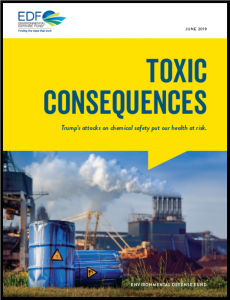
Today, EDF released a report detailing the major threats to public health and future generations from the Trump Environmental Protection Agency’s (EPA) attacks on the 2016 chemical safety law. Just three years after Congress passed bipartisan legislation, the Lautenberg Act, to overhaul the Toxic Substances Control Act (TSCA), implementation of the law has gone dangerously off the rails – putting public health at risk.
“At almost every turn, the Trump administration has failed to live up to the letter and spirit of the historic bipartisan reform of TSCA that Congress passed in 2016. Toxic chemicals can cause cancers and other life-threatening illness. The American people expect the Environmental Protection Agency to live up to its mission and to protect them from these threats. At the three-year anniversary of our overwhelmingly bipartisan reform of TSCA, EPA continues to ignore expert scientific staff and walk back protections for workers and consumers. ” said Senator Tom Udall. “EPA leaders – starting with Andrew Wheeler – must change course, commit themselves to protecting the public, and carry out the Lautenberg Act as Congress wrote it.”
The report notes that recent history holds countless stark examples of what can happen when chemical risks are not adequately addressed. We risk making similar mistakes unless the current EPA fundamentally changes course in its implementation of the law. The Trump Administration is allowing new chemicals onto the market with little or no health information and only cursory safety reviews; ignoring real-world exposures when evaluating chemicals already in use today; blocking needed restrictions on dangerous uses of toxic chemicals; and denying the public access to health information on chemicals. These are not merely process problems: the consequences of the Trump EPA’s actions will be felt by our children and subsequent generations.