







Collaboration can save the Mississippi River watershed
Posted: in Coasts and Watersheds
Written By

Share
By Suzy Friedman, Director, Agricultural Sustainability, Environmental Defense Fund and Max Starbuck, Director, Market Development, National Corn Growers Association
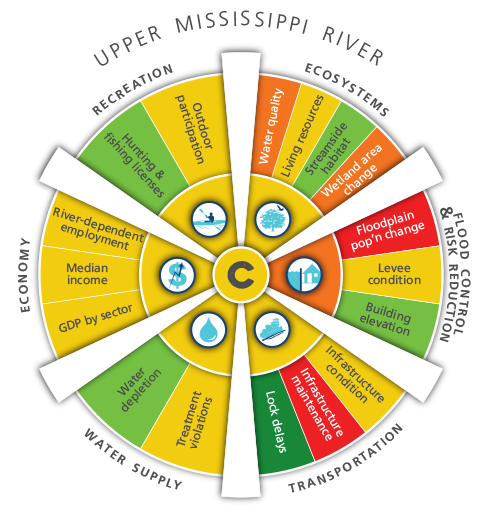
Today, a diverse group of more than 400 businesses, associations, government agencies, science organizations, academic institutions and non-profit organizations released the first-ever report card evaluating the condition of one of our nation’s most storied and central waterways. This effort, known as America’s Watershed Initiative, was undertaken to provide information on the challenges facing the waters and lands that make up the 31-state Mississippi River Watershed and the 250 rivers that flow into it.
The overall mark was less than stellar, a D+. However, the process of grading has yielded a pathway to improvement.
Why the poor rating? The watershed continues to experience increased pressure from the demands of urbanization, agriculture, transportation and land development.
Fortunately, moving from a “D+” to an “A” grade is achievable – with new levels of understanding and collaboration. That’s why the Environmental Defense Fund and the National Corn Growers Association have a real desire to work together on this and similar initiatives.
Although our perspectives may differ, we share a commitment to the economic and environmental resilience and sustainability of U.S. corn production – we both want to optimize the use of nitrogen fertilizer, increase soil health to increase food production, and enhance the environment in the future – and we can accomplish more together than on our own.
We rely on farmers
Because of the productivity and innovation of U.S. farmers, we have an abundant and affordable food supply. However, as the population grows, so does the burden on farmers to produce more on the same amount of land, while improving ecosystem health and water quality.
Increased pressures from development and the introduction of new regulations amid corn price fluctuations can place additional challenges on growers striving to maintain healthy soils, protect water resources and preserve wildlife habitat.
We believe sustainability and profitability go hand-in-hand
In a recent survey, Midwestern farmers ranked “land stewardship” as their top value. This isn’t surprising, since sustainability is in growers’ best interests. Improving soil health, increasing fertilizer use efficiency and reducing erosion potential will deliver significant benefits to water quality and produce the potential for greater yields.
The efficient use of fertilizer and maintaining good soil health save money. Keeping soil and nutrients on fields rather than in waterways, is the goal of both farmers and conservationists. Additionally, when farmers are profitable they can invest in technologies and tools that enable data collection and identify further efficiencies in their operations.
We recognize unprecedented demand
The pursuit of sustainable food production is reaching beyond the purview of farmers and conservationists. Food manufacturers are recognizing that sustainability makes good business sense. Already, 15 companies representing 30 percent of the U.S. food and beverage market have committed to promoting fertilizer use efficiency and soil health.
 Collaboration is key to creating better farming tools
Partnerships produce greater levels of engagement, deliver informed stakeholder decisions and focus investments. Working together, EDF and United Suppliers, a cooperative of 560 locally owned and controlled agricultural retailers, developed the SUSTAIN™ platform, a set of proven, effective tools that enhances crop production while improving nutrient use efficiency and reducing soil erosion.
NCGA has collaborated with several partners – including EDF – to implement The Soil Health Partnership. This farmer-led program identifies conservation management practices that improve soil health.
The more we take advantage of opportunities to coordinate efforts to foster healthy and viable U.S. waterways, the closer we’ll be to realizing an “A” grade for the Mississippi River Watershed.
Related Links
Sustainability and profitability go hand-in-hand, says Iowa corn farmer
Beyond regulation: making the business case for sustainable farming