







Proof on the Ground: How Natural Infrastructure is Reducing Flooding in North Carolina
Posted: in Coasts and Watersheds
Written By

Share
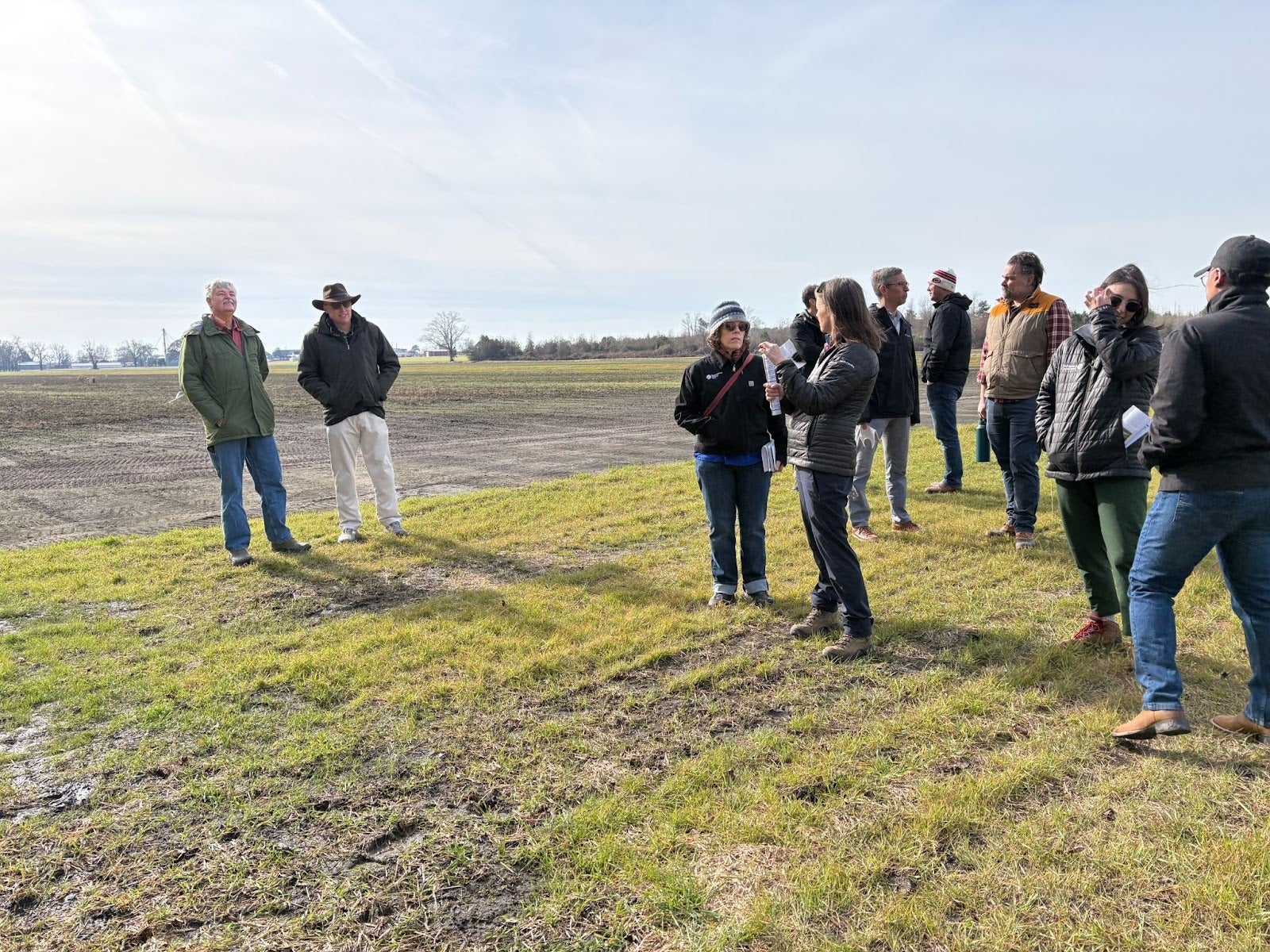
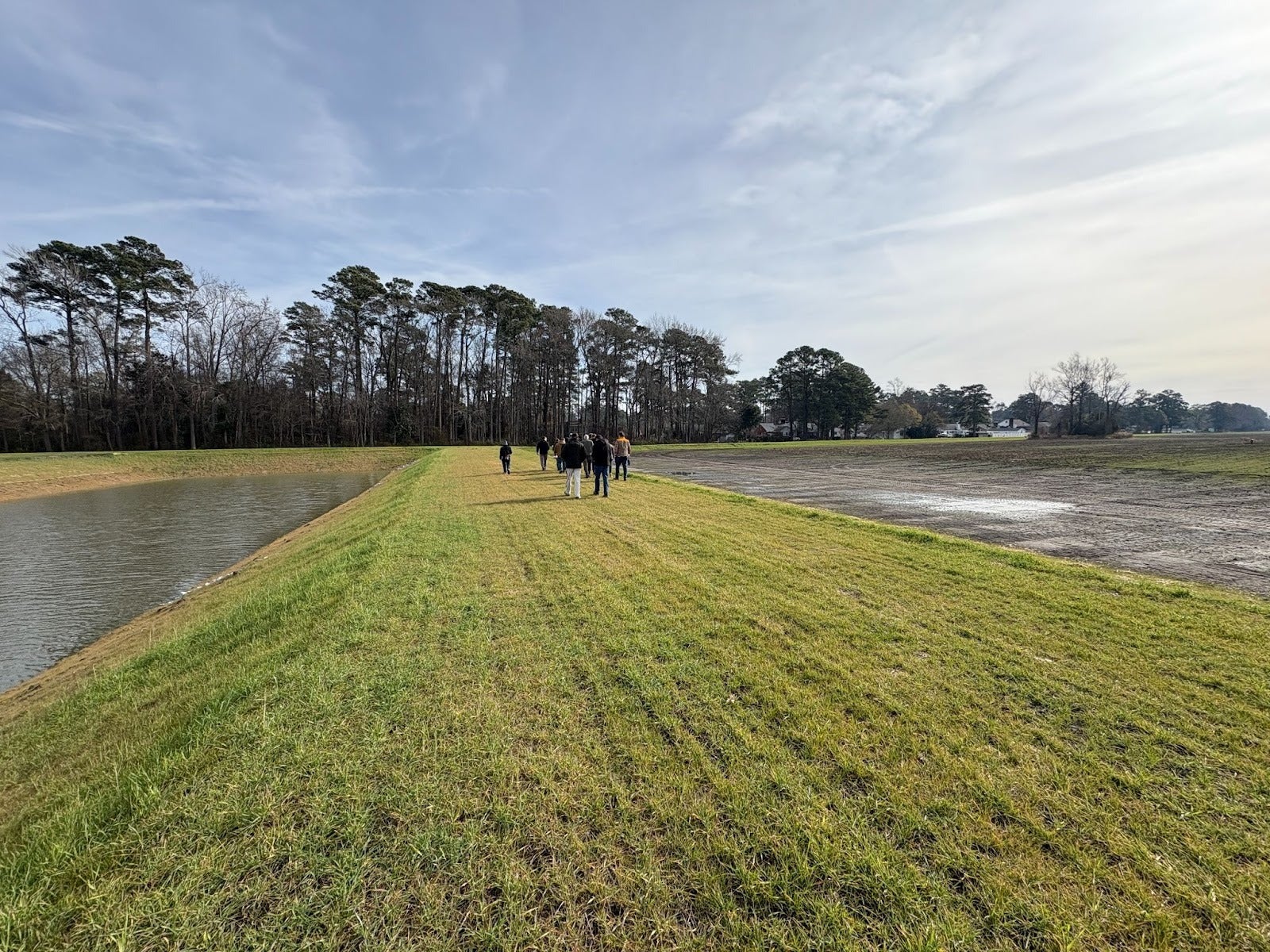
In December, a group of 15 people began walking a field at Caswell Research Farm, one of three water farming demonstration sites in North Carolina. The group—made up of state officials, Environmental Defense Fund (EDF) staff, conservation leaders and members of the agricultural community—had gathered for a firsthand look at how natural infrastructure solutions reduce flooding in real-time.
As the group moved across the farm, they viewed a row crop field intentionally redesigned to capture and hold excessive rainwater. Alongside it, they saw an irrigation pond engineered as additional capacity to also temporarily hold excess surface water. Researchers explained how the systems function, answered critical questions and shared early insights. Seeing an example of natural infrastructure fully implemented on agricultural lands—in a state where flooding challenges are growing—left many energized and eager to see resilience solutions expanded.
Like many states, North Carolina is facing more frequent and increasingly severe storms. In just the past decade, the state has experienced 3 hurricanes, Matthew and Florence along the coast, and Helene hitting the mountain communities in the west, all causing widespread flooding and devastation. These events have underscored a sobering reality for leaders: our society’s traditional approach to flood control is no longer sufficient.
In response, in 2019, researchers at North Carolina State University, led by Barbara Doll, began studying natural infrastructure solutions. Their goal was to better understand—and quantify—how nature-based practices could reduce flood risk for downstream communities. Their work expanded to the broader Neuse River Basin, providing critical data on where and how upstream interventions could make the greatest difference.
Armed with this science, and supported by partners such as EDF, the North Carolina General Assembly, in 2021 launched and funded the Flood Resiliency Blueprint—an effort designed to get ahead of future disasters by prioritizing flood resilience solutions, particularly nature-based approaches that slow and/or store water before it reaches vulnerable communities. In 2023, a suite of natural infrastructure pilots were funded with NC Land and Water Fund resources.
Natural infrastructure solutions–such as restoring streams, reconnecting floodplains or building wetlands–are designed to mimic the natural ecological processes of a landscape. But in regions with a strong agricultural presence, innovative approaches are needed that both manage water and work for farmers. Farmers themselves are experiencing negative impacts from flooding on their land and recognize the need for coordinated, regional water management. They are more willing to collaborate when solutions not only support conservation goals but also provide economic or operational benefits to their farms.
Water farming may be one such solution. Water farming involves temporarily holding back excess rainwater on upstream farms that sit near rivers or streams to lessen flooding impacts downstream. This can be done by allowing dedicated low-lying fields to ‘flood’ and hold excess rainwater. Another option is constructing a drainage pond on marginal or unused farmland specifically reserved for collecting excess surface water. By storing water during heavy rain events, these systems reduce the volume and speed of water flowing into rivers. If these practices are implemented at scale, they can help prevent rivers from becoming inundated and flooding nearby communities. For farmers, the stored water can be repurposed for supplemental irrigation, providing value during dry periods.
Water farming is not entirely new—the concept originated in Florida’s citrus groves as a way to manage hurricane floodwaters and has been tried in the plains of North Dakota as well. But it is new to North Carolina and holds promise for other states with extensive agricultural landscapes.
Similar practices are being explored by other states as well. In Iowa, for example, farms are piloting a practice called drainage water recycling, which uses an irrigation pond to capture, store and repurpose excess water from tile drainage systems, reducing downstream impacts while providing an additional water source for crop irrigation.
In North Carolina, three water farming demonstration sites are now up and running. Together, these pilots will allow researchers to observe the benefits of the practice in real time, evaluate the economics for farmers and study how these practices can be scaled across a watershed in the future.
Caswell Research Farm represents resilience building in action—proof that natural infrastructure solutions can provide valuable flood reduction benefits while also supporting farmers and other stakeholders. As flooding continues to pose a growing threat in North Carolina and across the United States, more real life efforts like these, backed by investment, collaboration and innovation, are needed to meet the challenge.