









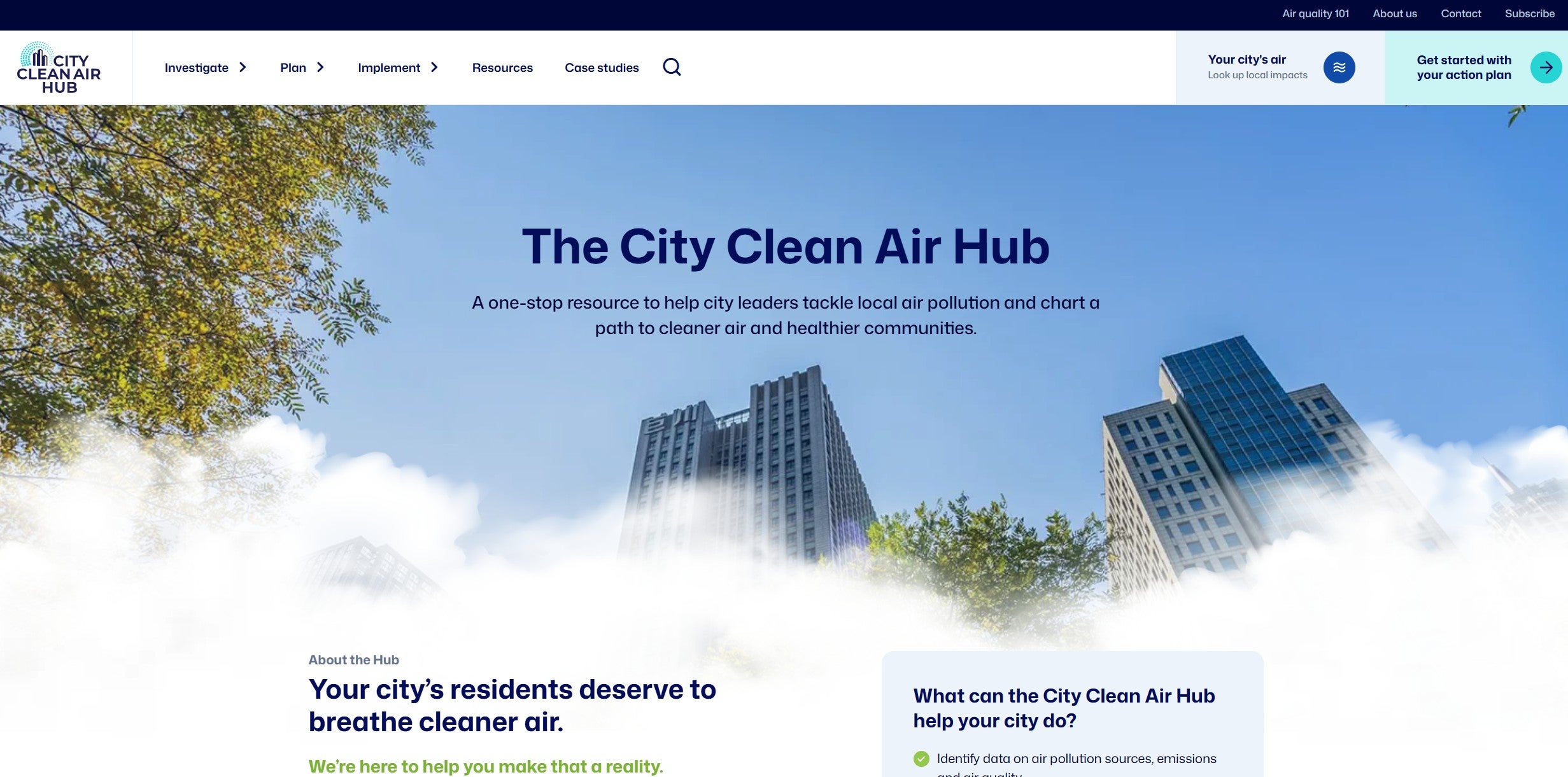
New City Clean Air Hub to help city leaders deliver clean air and healthy communities


What’s new: EDF and partners at the Community Data Health Initiative (CDHI) just launched the City Clean Air Hub — a one-stop resource to help Mayors and other city leaders chart a path to cleaner air. The hub connects local leaders in and out of government with the data, analytical tools, policy insights, best practices and implementation guidance they need to take action. It also allows users to look up the health impacts of air pollution in their U.S. city, county or metro area, providing a localized starting place for understanding the problem and designing solutions.
We launched the hub at a webinar (full recording above) featuring mayors and other local leaders from cities large and small sharing their experiences at various stages of their clean air journeys, including:
- Mayor Donya L. Sartor, PhD. of Jonesboro, GA
- Mayor Roderick D. Hampton of Haynesville, LA
- Trisha Stein, Chief Strategy Officer, Detroit, MI
- Dr. David Margolius, MD, Director of Public Health, Cleveland, OH
- Komal Sheth, MPH, Senior Analyst, Houston Health Department
The City Clean Air Hub marks the most recent phase of EDF’s work as part of CDHI, which seeks to expand cities’ capacity to take on environmental challenges that directly affect people’s health — starting with air pollution and extreme heat. CDHI is a collaboration between the Data-Smart City Solutions program at the Bloomberg Center for Cities at Harvard University, Environmental Defense Fund, the African American Mayors Association and Meharry Medical College.
Why it matters: Air pollution is a silent and often invisible killer — the second leading risk factor for early death worldwide. It also shares many of the same root causes with climate change and is being worsened by it. Across the United States, air pollution contributes to more than 15,000 new childhood asthma cases, 50,000 emergency room visits and 100,000 deaths every year. It carries enormous economic costs, too — more than $1 trillion every year, or 5% of GDP.
Local impacts need local solutions: The health and economic effects of pollution are felt locally, with each city’s air quality challenges varying depending on factors like location, local pollution sources, weather, demographic patterns and state and local policies.
Local leaders know more than anyone about their communities’ unique air pollution challenges — and are uniquely positioned to take action to improve residents’ quality of life. By deepening their understanding of local air quality sources, impacts and susceptible populations, and learning from best practices, city leaders can better target policies to serve their constituents and maximize health and economic benefits.
Local leadership in action: The importance of local action was highlighted in Detroit in mid-July 2026, as cities across the northern United States dealt with hazardous levels of air pollution from wildfire smoke. Leveraging previous investments in air quality monitoring networks and careful integration with emergency response planning, Detroit was able to spring into action – issuing alerts and guidance to the public, checking in on seniors (who are often more vulnerable to health impacts from air pollution) and distributing thousands of masks to residents.
As climate change makes events like this more common, cities will play an even more essential role in protecting their constituents from the health risks of poor air quality – whether from wildfire smoke or ozone episodes on hot summer days. At the same time, cities can take action to reduce local emissions through strategies like ordinances, permitting, building codes, land use planning and transportation policies. The City Clean Air Hub can help cities and towns of all sizes find the data analysis, policy design tools, community engagement and funding strategies needed to identify high-impact policies and implement them to deliver cleaner air.
What does the City Clean Air Hub offer cities?
The hub provides city leaders a simple framework for developing an air pollution action plan structured around three key steps: Investigate, Plan and Implement.
- Investigate the problem: This section encourages cities to start by first taking the time to understand their unique air quality challenges by assessing trends, identifying top pollution sources and learning who is most exposed and at risk.
- Plan solutions: This section helps cities move from understanding pollution sources and health impacts to identifying evidence-based solutions and putting them into action.
- Implement policies and programs: This section guides cities to move toward implementing their solution, surfacing key considerations to consider along the way, such as potential community-level impacts, long-term funding options and how to set up an evaluation plan to measure results and guide future improvements.
Curated resources and case studies: At each of the three stages, the hub offers detailed guidance, handpicked resources and tools and a checklist to help cities build their action plan. It also features a collection of case studies from cities around the United States that have taken innovative clean air actions. The goal of these case studies is to help cities gain inspiration, learn how other cities did it and apply relevant lessons learned to their own work. Several of the cities featured in the case studies were also represented at the City Clean Air Hub webinar launch (view recording above), where they shared additional insights and answered audience questions.
What’s next: Over the coming months, EDF and our CDHI partners will work with city partners to apply the City Clean Air Hub to real-world air quality challenges. As we continue to learn from cities and other partners, we will integrate their insights and feedback into the hub and add more resources and case studies to continue informing and inspiring action.
Does your city want to work with us to tackle local air pollution or do you have a question about the City Clean Air Hub? Reach out here.