Climate change solutions
We deliver game-changing environmental solutions that have a real impact for people around the globe.
Medium- and heavy-duty electric vehicles are hitting the road in 2026, and we’ve collected last month’s most exciting news. In 2025, EDF delivered monthly deployment updates on the biggest zero-emission transportation stories. By the end of 2025, it was clear that momentum was sustained throughout a challenging year. This year will undoubtably see more big announcements, and we’ll be here to showcase the biggest orders and deployments of zero-emission trucks happening around the country.
March announcements included transportation improvements for ADA-accessible routes and students in Texas and Arizona, respectively and progress on zero-emission drayage systems in California.
Sun Metro unveils first zero-emissions electric fleet for Lift program in El Paso
Sun Metro introduced its first fleet of 45 zero-emission electric vehicles, a significant investment in cleaner, more dependable transit. The new vehicles will be added to the city’s LIFT program, which offers curb-to-curb transportation for individuals covered under the Americans with Disabilities Act. In addition to the new vehicles, Sun Metro plans to introduce charging stations as part of the rollout. The project is funded through the Federal Transit Administration’s Low or No-Emission program.
Hight Logistics highlights new Tesla Semi as it expands zero-emission fleet
Hight Logistics, a California based drayage company, recently debuted a new Tesla Semi during the TPM logistics conference. The electric Class 8 truck was used to transport a customer container directly to the event, highlighting an important step in the company’s move toward a zero-emission fleet. The company has emphasized a strong commitment to zero-emission trucks, noting that more customers are choosing Hight Logistics to help lower their carbon footprint and comply with evolving regulatory requirements. Hight Logistics currently operates 25 electric trucks, mostly Volvo VNR Electric models, and the company intends to expand its fleet with additional Tesla Semis. To support this growth, it has already installed six dual-charging stations at its facility, enabling up to 12 electric trucks to charge at the same time between port trips.
Tucson schools go green with new electric bus fleet
The Tucson Unified School District has introduced a new fleet of 10 electric school buses. This deployment will replace 10 older diesel buses, and it is projected to cut approximately 17,000 tons of carbon dioxide emissions. The buses were acquired through RWC Group, with funding coming from a $4 million grant through the Environmental Protection Agency’s Clean School Bus Program, $1.1 million in rebates from Tucson Electric Power and $1.2 million from the TUSD Bond Project. The deployment focuses on improving community health by providing a quieter, cleaner ride for students while helping reduce air pollution across local neighborhoods, contributing to a healthier future for the region.
Now is a critical time for fleets to invest in medium- and heavy-duty electric trucks. These vehicles improve public health and help combat the climate crisis by reducing greenhouse gas emissions and air pollution. Unlike traditional diesel-powered trucks, electric trucks produce no tailpipe emissions, which significantly cuts down on health-harming pollution. Adoption represents a key step toward a more sustainable and resilient transportation industry.
Check back here next month to see a collection of the most exciting zero-emission vehicle announcements from April. In the meantime, check out EDF’s Electric Fleet Deployment & Commitment List to track announcements as they happen in real time, and view all March announcements.
Check out last month’s announcements here.
By Jolette Westbrook and Rishab Jagetia
Massachusetts has some of the highest utility rates in the country. In response, on February 26, 2026, the state House passed a landmark energy affordability bill, H5151, aimed at lowering costs. The bill takes important steps to expand clean, affordable energy and provide near-term relief for customers.
But it also contains misguided cuts to energy-saving programs that benefit customers. The legislation directs utilities to cut $1 billion dollars from Mass Save, the Commonwealth’s nation-leading energy efficiency program. New analysis shows that this move risks driving costs higher, especially for low-income households.
Energy efficiency is a proven cost saver
For more than 15 years, Mass Save has helped Massachusetts residents and businesses cut energy use and lower bills. The program funds upgrades such as insulation, efficient appliances and modern heating and cooling systems that reduce waste, lower emissions and save money.
“Residents pay a monthly fee to fund Mass Save on their electric bill, but what’s less visible is how they benefit from all the costs they avoid,” said Chris Neme, a Principal at Energy Futures Group. “That includes energy they don’t use, power plants that don’t get built and price spikes that never happen.”
Mass Save reduces the need for costly infrastructure, lowers wholesale electricity prices and shields customers from fuel price swings. These system-wide benefits flow to every ratepayer. From 2022-2024, the program delivered nearly $2.4 billion in energy bill savings for MA families and businesses. Mass Save is projected to remain highly cost-effective, returning more than $2 in benefits for every dollar invested.
Mass Save prioritizes those who need it most
Energy efficiency programs are sometimes criticized for favoring wealthier households because they require upfront costs and are easier for homeowners – not renters – to access. Mass Save does the opposite.
The program directs significant funding to low- and moderate-income households and renters, who face the greatest barriers to lowering their energy bills. For 2025-2027, 26.2% of program spending is dedicated to low-income households, even though such households account for only about 13% of total electricity use in the state. From offering upgrades and improving language access support for non-English speakers to increasing support for renters, Mass Save helps the communities hit hardest by rising energy costs.
The program also strengthens the state’s workforce. In 2024, Mass Save supported over 76,000 jobs with median wages well above the state average. This is equivalent to three times the amount of renewable energy jobs and two-thirds of all the clean energy jobs in the state. In 2025 alone, the program invested $24 million in workforce training to grow the clean energy economy.
Cuts to Mass Save will hurt residents, not help them
H5151 suggests cutting $1 billion in administrative and marketing costs. In practice, such cuts will inevitably slash essential programs that reduce energy costs, lower bills, support higher-paying jobs, and expand access for environmental justice communities. Cuts would also jeopardize outside funding that state regulators have worked to secure, increasing the share of costs borne by ratepayers.
With energy bills skyrocketing in Massachusetts, the state should move quickly to accelerate clean, affordable energy development and avoid investment in unnecessary fossil fuel infrastructure. Cutting energy efficiency undermines those goals.
A proven solution we cannot afford to cut
Mass Save lowers bills, reduces pollution, and directs resources to the families that need them most. It is a cost-effective solution that continues to provide necessary benefits. If lawmakers want to address affordability and protect vulnerable communities, they should fully fund Mass Save, not cut it.
By Sofia Esquivel-Elizondo, Environmental Defense Fund, and Ilissa Ocko, Spark Climate Solutions
As countries and industries work towards decarbonizing sectors that are difficult to electrify – including aviation, shipping, heavy industry and commodity chemicals production – interest in alternative fuels is surging. Hydrogen, ammonia, methanol, synthetic methane and related fuels are attracting billions in investment and growing policy support. But these fuels are not inherently sustainable simply because they can be produced with low-carbon methods. Their climate and other environmental impacts depend on how they are produced, handled and used across the entire value chain. Getting these details right will determine whether alternative fuels deliver real climate progress or create new environmental risks.
Environmental Defense Fund’s new scientific perspective article, ‘Ensuring the climate and environmental integrity of alternative fuels’, published in Environmental Science & Technology, offers timely guidance on how to ensure that alternative fuels can deliver on their promise. The best results occur when alternative fuel value chains are thoughtfully designed and deployed from the start, and this paper offers insight into how to do so responsibly.
Alternative fuels can be powerful tools – when viewed as systems, not just molecules.
A key insight from this work is that sustainability is not an inherent property of a fuel itself. The same fuel molecule can have very different impacts depending on how it is produced, transported, stored, and used.
For example, a hydrogen molecule produced with low-emissions (“clean”) electricity and with tight emissions controls during its production, handling, and use can significantly reduce climate pollution in steelmaking or shipping. However, that same molecule produced with fossil energy that comes with high methane emissions, low carbon capture rates or leaky infrastructure can deliver far fewer climate benefits, and potentially even harms. This is especially relevant for the near term, when climate-warming emissions like methane and hydrogen are most potent in the atmosphere.
By focusing not just on individual fuels, but entire value chains, decision-makers can distinguish between pathways that truly support climate goals, environmental sustainability and long-term energy competitiveness and security, and those that fall short.
Climate and environmental integrity require looking beyond carbon dioxide alone.
Carbon dioxide matters, but it is not the whole emissions story. Other climate warming pollutants such as methane, hydrogen and nitrous oxide can have outsized impacts. Methane and hydrogen – both part of many alternative fuel value chains – are short-lived but potent climate warming gases, and therefore particularly relevant over the next few decades. Methane has more than 80 times the warming power of carbon dioxide over the first 20 years after it reaches the atmosphere, and hydrogen’s climate impact is estimated to be 37 times that of carbon dioxide over the 20 years following its release. Nitrous oxide, which is especially important in biomass, and nitrogen-based fuel pathways, is a long-lived gas that accumulates in the atmosphere. It is around 275 times more potent than carbon dioxide per mass on the 20-year and 100-year timescales.
Beyond climate impacts, non-carbon emissions also pose significant risks to air, water and ecosystems. Reactive nitrogen emissions, including ammonia (which is currently being considered for increased use in shipping and power systems) and nitrogen oxides and nitrogen dioxide (which occur during incomplete fuel combustion in engines and turbines), can degrade air quality, contribute to nitrogen pollution across land and water systems, and have either warming or cooling effects). Emissions of these climate and environmental pollutants occur – often unintentionally – through leakage, venting or combustion processes and are still under-measured in many assessments.
But these emissions are highly manageable. Monitoring technologies are progressing, mitigation strategies are well understood, and best practices are continuously improving. Accounting for these pollutants more comprehensively allows policymakers and industry to design and operate fuel value chains that maximize real-world climate and other environmental benefits.
Inputs and value chain decisions matter
The environmental performance of alternative fuels is shaped decisively by their inputs – the feedstocks and the energy used to convert them. Water and biomass residues and wastes can support climate and sustainability goals when sourced responsibly, while feedstocks that lead to water stress, compete with food production, drive land-use change or cause ecological harm can undermine them. Similarly, carbon-based hydrogen-derived fuels (e.g., e-methanol, e-diesel, and e-kerosene) perform very differently depending on where their carbon comes from. Using fossil-derived CO2 still contributes to warming because that fossil carbon is eventually released when the fuel is combusted, whereas atmospheric capture and sustainable biomass sources can be closer to carbon-neutral over time. Moreover, fuels produced with truly clean electricity can have significantly lower lifecycle impacts than those relying on fossil-based energy sources – but emissions impact can vary based on location, time and competing uses.
Beyond production, every stage of the value chain can lead to emissions that significantly affect climate, air quality, ecosystems and communities.
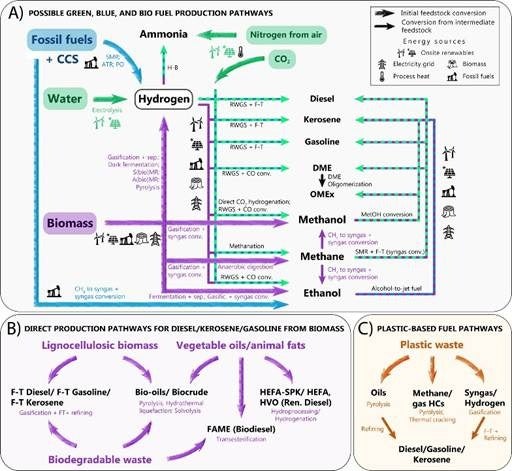
The science is clear: there are better and worse life-cycle pathways for every alternative fuel, and distinguishing between them early allows markets and policies to reward the best options.
Energy efficiency and smart prioritization accelerate progress.
Alternative fuels will be essential and could be truly sustainable but they should be used where they matter most. Producing fuels requires energy, often a lot of it. Each conversion step introduces energy losses, which means renewable electricity is generally most effective when used directly wherever possible.
This helps clarify the important role of fuels for specific purposes. Long-haul shipping and aviation, very high-temperature (>1000 °C) industrial processes and long-term energy storage are where alternative fuels offer the greatest system value. Prioritizing these uses ensures that limited renewable energy resources deliver the maximum climate and economic return.
This principle – sometimes described as the “best use of clean electrons” – helps align climate ambition with practical implementation.
Fuel diversity strengthens energy security and resilience.
Beyond reducing emissions, alternative fuels play an increasingly important role in energy security. A diversified energy system is more resilient to supply disruptions, price volatility, and geopolitical risk. Fuels that can be produced domestically from renewable electricity, sustainable biomass, or captured carbon offer countries new options to strengthen energy independence and build local economies.
But diversity alone is not enough. To fully realize these benefits, fuel systems must be built on durable foundations: reliable feedstocks, low life-cycle emissions, efficient infrastructure and strong environmental safeguards. Doing it right from the beginning avoids costly retrofits and ensures that today’s investments remain valuable in a net-zero future.
A practical, science-based roadmap for action.
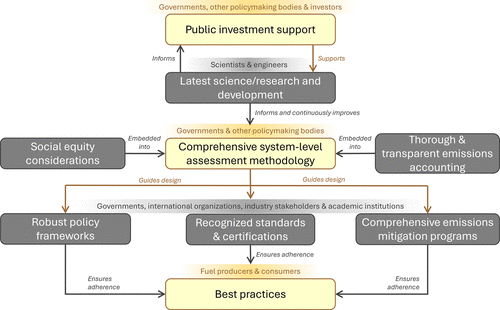
What the scientific paper ultimately provides is a roadmap. It highlights the best-in-class practices for producers, investors, and policymakers – from sourcing truly clean electricity and sustainable (climate-beneficial) feedstocks to controlling unintended and operational emissions, minimizing pollution, and protecting communities.
It also outlines what comprehensive assessments should include if alternative fuels are to scale with integrity: thorough and transparent lifecycle accounting, short- and long-term climate impacts, air quality and health considerations, ecosystems and biodiversity impacts and opportunity costs. These recommendations are not barriers; they are tools for better decision-making.
The opportunity ahead
Alternative fuels can play a pivotal role in building a secure, resilient and climate-safe energy system. The technologies are advancing, the momentum is real, and the potential benefits are substantial. By applying systems thinking and ensuring science-based standards and best practices now, we can ensure that scale-up delivers lasting value – for the climate and environment, for communities and for the global economy.
This is how we move faster and smarter. Getting alternative fuels right from the start is not a constraint on the energy transition, but one of its greatest enablers.
By Nini Gu
Cleaner air and climate progress aren’t about winning one big battle or passing one magic bill. They’re an outcome of steady improvements that prioritize healthy and resilient communities. Many of those improvements happen thanks to regulatory agencies and their air quality programs.
Colorado and New Mexico are two of the nation’s standout examples for state-led climate action thanks to the regulatory leadership of the Air Pollution Control Division under the Colorado Department of Public Health and Environment and the New Mexico Environment Department.
Both states are undergoing rulemakings to update the permit fees that companies pay before any development activities that could lead to air pollutant emissions, a category of chemicals including greenhouse gases, hazardous air pollutants and ozone precursors.
The purpose of permit fees is to cover costs associated with air pollutant emissions, and these fees are a key source of funding for agency air quality programs. Many states use this mechanism to fund their air agencies and programs. In both Colorado and New Mexico, the current fees are not sufficient to sustain these important programs. If fees are not updated to meet the real cost of pollution control, communities will suffer while companies profit.
It’s crucial that each state equips its agency with the resources and stability required to be more efficient, more effective and to continue delivering results.
New Mexico
The New Mexico Environment Department is seeking to increase both its emissions and construction permit fees in accordance with state and federal law, which requires NMED to collect enough fees to cover the operation of key air programs. In recent years, NMED’s workload has increased dramatically: oil and gas-related general construction permits have increased by roughly 2,100%, minor source permitting has increased by more than 200%, and total permitting actions have increased by approximately 126% overall in recent years.
Each permit action requires technical review, analysis, and documentation. Permitting expansion has increased much faster than staffing has, leading to a multi-year enforcement backlog. Underfunding and understaffing does not lead to efficiency; it just leads to less oversight for companies, longer permit times and more pollution exposure for frontline communities.
NMED’s proposed fee updates will shift the cost of dangerous air pollution from the public to the companies that benefit financially from state-issued permits. If the New Mexico Environmental Improvement Board fails to adopt NMED’s proposal, the state will see staff reduction, less monitoring, fewer inspections and delayed enforcement – all to the detriment of New Mexicans who want to breathe clean air.
NMED has a proven track record of progress indicating that air quality regulations can lead to better pollution outcomes. To continue that progress and prevent backsliding, EIB must support the NMED’s proposed fee increases.
Colorado
The Colorado Air Pollution Control Division is proposing to increase emissions permit fees to cover the direct and indirect costs of developing and administering its air quality programs, as the current revenue from fees has not increased as quickly as the APCD’s workload has. Like New Mexico, underfunding and understaffing leads to slower permit approvals for companies and less accountability for the public.
Colorado has made a lot of progress reducing air pollutants, including a 70% reduction in methane emissions following the adoption of the nation’s first-ever set of oil and gas methane regulations. However, the state continues to struggle when it comes to ozone pollution in the state’s most populous areas, threatening the quality of life and health of millions of Coloradans.
Colorado has continued to improve existing regulations while adopting new ones to fulfill state and federal requirements and address shortcomings in public health protection. However, air quality regulations only work if they can be reliably implemented and enforced. Due to the $7 million gap between expected revenue and estimated program costs, APCD’s updated fees will provide much needed funding security to ensure the agency meets its statutorily obligated requirements to improve air quality and reduce greenhouse gas emissions.
Colorado’s Air Quality Control Commission should adopt APCD’s proposed updates to Regulations 3 and 7. Doing so would be a recognition that air quality programs and regulations are an indispensable part of protecting the public health, safety, and environment of Colorado.
Clean air and climate progress take many shapes and forms. In Colorado and New Mexico, it’s a small group of hard-working regulators making steady improvements for the public. Both states now have a great opportunity to continue the path they’ve been on towards cleaner air and healthier communities if they ensure the funding their air quality agencies desperately need.
The Canadian federal government has an important decision to make that will determine if it will follow through on the promise of the December 2025 methane regulations. Millions of metric tons of methane, thousands of jobs and more than a billion dollars’ worth of energy are at stake.
The decision is whether the federal government will enforce consistent standards across the country or give Alberta special treatment: will Alberta get a five-year delay, and will Alberta get to use its own problematic data to set the emissions reduction target?
EDF crunched the numbers, and it’s clear that capitulating on either of these issues will seriously undermine the regulations’ effectiveness:
For some background, in 2021, the federal government promised to reduce oil and gas methane emissions by at least 75% from 2012 levels, with a 2030 deadline. Last December, the federal government finalized regulations that are estimated to reduce methane emissions by 72% from 2012 levels, with that same 2030 deadline.
Provinces can create and enforce their own regulations, as long as they achieve a result that is equal or better than the federal rule—known as an equivalency agreement. The recently signed federal-Alberta Memorandum of Understanding calls for a finalized equivalency agreement by April 1 that achieves a 75% reduction by 2035—with no mention of the 2030 deadline to reduce emissions by 72%.
Despite a clarification from Canada’s Environment Minister that all provinces are subject to the new regulations and their 2030 target, Alberta appears to have adopted an interpretation that it will only need to adhere to the 2035 deadline, effectively a special five-year delay that other provinces won’t get.
Worse still, the Canadian Association of Petroleum Producers is demanding that Alberta’s equivalency agreement be based only on provincial data, and not the federal data collected by Environment and Climate Change Canada . This is concerning because Alberta’s methane emissions data is primarily based on estimates from industry, which as many peer-reviewed studies have shown, severely understate emissions. The Canadian federal government was the first government in the world to use aerial measurements of methane emissions, an approach that is far more accurate.
In the chart below, EDF modelled the amount of methane that could be mitigated from 2028 to 2040 for scenarios where Alberta is granted special treatment.
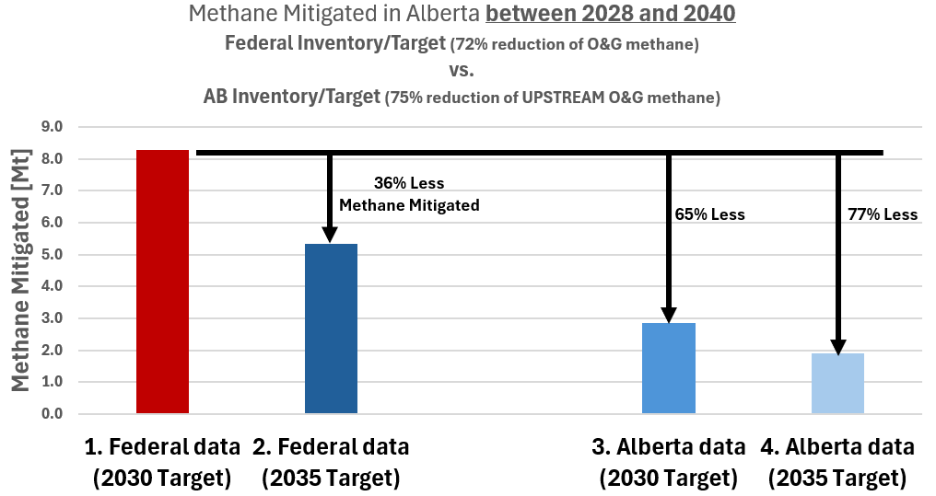
The data makes it clear that a later deadline seriously reduces the regulation’s effectiveness, and using Alberta’s data would undermine it even further:
Our analysis underlines the importance of accurate and speedy implementation of the federal methane requirements. Equivalency agreements need to result in equivalent outcomes and only one scenario achieves them: the scenario where Alberta does not receive special treatment. If a five-year delay is granted and/or the province is allowed to use its own data, then Alberta will come nowhere close to the government’s target.
Prime Minister Carney’s government can hold to its initial promise of strong federal regulations, follow the legal guidelines for equivalency agreements under the Canadian Environmental Protection Act, and cut more than an estimated 8 million metric tons of methane emissions. The cost of a five-year delay would be nearly a thousand jobs in Alberta, a critical blow to Canada’s climate goals, and millions of extra metric tons of methane emissions. Using Alberta’s inaccurate data drives those costs even higher.
The decision in front of the federal government is essentially a binary question of which matters more: Canada’s promised climate goals, or special treatment for Alberta.
Medium- and heavy-duty electric vehicles are hitting the road in 2026, and we’ve collected last month’s most exciting news. In 2025, EDF delivered monthly deployment updates on the biggest zero-emission transportation stories. By the end of 2025, it was clear that momentum was sustained throughout a challenging year. This year will undoubtably see more big announcements, and we’ll be here to showcase the biggest orders and deployments of zero-emission trucks happening around the country.
February announcements included expansion in the refuse industry, Rivian’s customer base and continued progress for transit buses.
Royal Waste Services adds three more Mack LR Electric trucks to growing fleet
Royal Waste Services announced the deployment of three additional Mack LR Electric refuse trucks in New York, after the successful deployment of the company’s first electric unit in December 2025. The vehicles received funding from the New York Truck Voucher Incentive Program. Royal Waste Services took delivery of its first LR Electric in early 2025 through the The Bronx Is Breathing initiative, which was supported by additional funding from the New York Clean Transportation Prizes program. The trucks have been well received by drivers, with operators citing less fatigue thanks to the elimination of engine vibration that comes with traditional diesel engines, as well as sharper handling and smoother responsiveness than conventional trucks on frequent stop-and-start routes.
Rivian expands commercial van customer base with Illinois service firm
Wm. Masters, a maintenance and repair company, is reportedly the first commercial fleet customer to purchase and deploy a Rivian electric van outside of the manufacturer’s deal with Amazon. Wm. Masters is located in Bloomington, IL, a short drive from the Rivian manufacturing plant in Normal, IL. Outside of the purchase order of 100,000 vans for Amazon, Rivian has partnered with HelloFresh, Slice and Cintas to expand their customer base.
New Flyer receives order for 100 additional transit buses for the Washington Metro Region
New Flyer of America announced that the Washington Metropolitan Area Transit Authority has placed an order for 25 Xcelsior battery-electric transit buses (and 75 hybrid buses). The purchase will be supported by federal, state and local funding as well as funds awarded through the Federal Transit Administration Low or No Emission grant program. The new buses will contribute to the Metro’s Strategic Transformation Plan. The Metro is America’s fifth-largest bus network in the United States.
Now is a critical time for fleets to invest in medium- and heavy-duty electric trucks. These vehicles improve public health and help combat the climate crisis by reducing greenhouse gas emissions and air pollution. Unlike traditional diesel-powered trucks, electric trucks produce no tailpipe emissions, which significantly cuts down on health-harming pollution. Adoption represents a key step toward a more sustainable and resilient transportation industry.
Check back here next month to see a collection of the most exciting zero-emission vehicle announcements from March. In the meantime, check out EDF’s Electric Fleet Deployment & Commitment List to track announcements as they happen in real time, and view all February announcements.
Check out last month’s announcements here.