








Special treatment for Alberta would cost Canada more than $1 billion in methane waste and severely undermine its methane regulations
Posted: in Methane, Methane regulations
Written By


Share
Summary
- The Canadian federal government will soon finalize an agreement with Alberta to determine how the province will implement methane regulations. Alberta is asking for a five-year delay, and asking to use its own data to set the reduction targets.
- The government must hold Alberta to the same timeline and data collection standards as other provinces. EDF research found that yielding on either factor will seriously weaken the regulations.
The Canadian federal government has an important decision to make that will determine if it will follow through on the promise of the December 2025 methane regulations. Millions of metric tons of methane, thousands of jobs and more than a billion dollars’ worth of energy are at stake.
The decision is whether the federal government will enforce consistent standards across the country or give Alberta special treatment: will Alberta get a five-year delay, and will Alberta get to use its own problematic data to set the emissions reduction target?
EDF crunched the numbers, and it’s clear that capitulating on either of these issues will seriously undermine the regulations’ effectiveness:
- Delaying five years and letting Alberta use its own data would be 77% less effective at mitigating methane emissions, resulting in up to $1.15 billion of natural gas wasted (enough to heat 332,000 Alberta homes per year from 2028 to 2040) and the forfeit of more than 4,200 jobs.
- Delaying five years and using federal data would still reduce the regulation’s effectiveness by nearly a third and allow three million extra metric tons of planet-warming methane into the atmosphere.
- Keeping the 2030 target but setting it based on Alberta’s data would reduce the regulation’s effectiveness by almost two-thirds.
For some background, in 2021, the federal government promised to reduce oil and gas methane emissions by at least 75% from 2012 levels, with a 2030 deadline. Last December, the federal government finalized regulations that are estimated to reduce methane emissions by 72% from 2012 levels, with that same 2030 deadline.
Provinces can create and enforce their own regulations, as long as they achieve a result that is equal or better than the federal rule—known as an equivalency agreement. The recently signed federal-Alberta Memorandum of Understanding calls for a finalized equivalency agreement by April 1 that achieves a 75% reduction by 2035—with no mention of the 2030 deadline to reduce emissions by 72%.
Despite a clarification from Canada’s Environment Minister that all provinces are subject to the new regulations and their 2030 target, Alberta appears to have adopted an interpretation that it will only need to adhere to the 2035 deadline, effectively a special five-year delay that other provinces won’t get.
Worse still, the Canadian Association of Petroleum Producers is demanding that Alberta’s equivalency agreement be based only on provincial data, and not the federal data collected by Environment and Climate Change Canada . This is concerning because Alberta’s methane emissions data is primarily based on estimates from industry, which as many peer-reviewed studies have shown, severely understate emissions. The Canadian federal government was the first government in the world to use aerial measurements of methane emissions, an approach that is far more accurate.
In the chart below, EDF modelled the amount of methane that could be mitigated from 2028 to 2040 for scenarios where Alberta is granted special treatment.
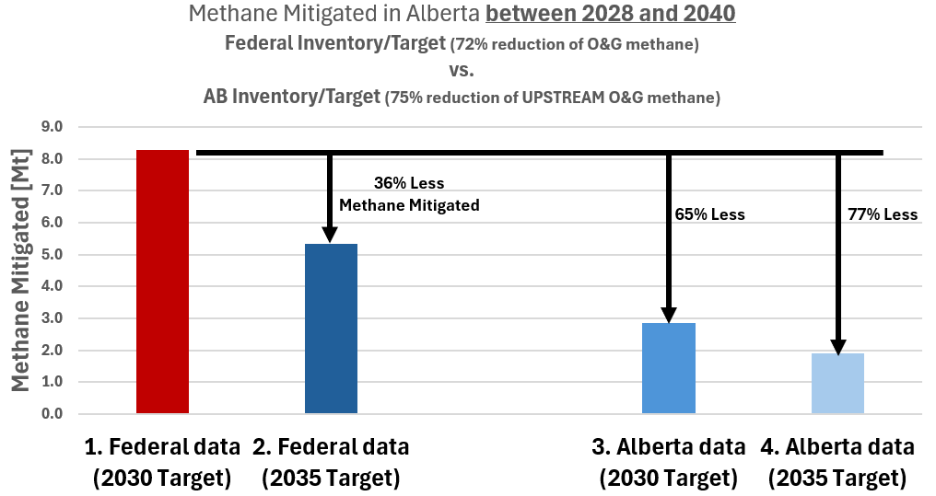
The data makes it clear that a later deadline seriously reduces the regulation’s effectiveness, and using Alberta’s data would undermine it even further:
- The difference between the 1st scenario on the left (ECCC data, 2030 deadline) and the 4th scenario on the right (Alberta data, 2035 deadline) would result in up to $1.15 billion of natural gas wasted (enough to heat 332,000 Alberta homes per year from 2028 to 2040.) and would see over 4,200 jobs forfeited.
- Using ECCC data but still giving Alberta a special five-year delay (Federal data, 2035 target) would reduce the regulation’s effectiveness by nearly a third due to slower adoption of emissions-reduction technology and practices. That decision would lead to three million extra metric tons of planet-warming methane and up to $530 million of gas wasted between 2028 and 2040.
Our analysis underlines the importance of accurate and speedy implementation of the federal methane requirements. Equivalency agreements need to result in equivalent outcomes and only one scenario achieves them: the scenario where Alberta does not receive special treatment. If a five-year delay is granted and/or the province is allowed to use its own data, then Alberta will come nowhere close to the government’s target.
Prime Minister Carney’s government can hold to its initial promise of strong federal regulations, follow the legal guidelines for equivalency agreements under the Canadian Environmental Protection Act, and cut more than an estimated 8 million metric tons of methane emissions. The cost of a five-year delay would be nearly a thousand jobs in Alberta, a critical blow to Canada’s climate goals, and millions of extra metric tons of methane emissions. Using Alberta’s inaccurate data drives those costs even higher.
The decision in front of the federal government is essentially a binary question of which matters more: Canada’s promised climate goals, or special treatment for Alberta.