










Integrated resource planning is key to a cleaner, more affordable energy future
Posted: in General
Written By

Share
Summary
- Today's electricity decisions will shape costs, reliability and pollution for decades as utilities face growing demand and pressure to build new infrastructure.
- Integrated resource planning helps utilities and regulators compare energy options, identify ways to avoid unnecessary costs and make more informed decisions about future investments.
By Christen Chappelle, Legal Intern & Jolette Westbrook, Director & Senior Attorney, Regulatory Solutions, Environmental Defense Fund
America’s electricity demand is surging, driven in part by data centers and industrial growth, while utilities face decisions that could lock in higher costs and pollution for decades. New research from Environmental Defense Fund and Atlas Public Policy reveals just how dramatically the landscape is shifting. Fossil fuels accounted for just 5% of new U.S. power capacity in 2024. By 2030, that share could reach 70% if currently planned projects move forward.
States can meet this growing electricity demand without driving up bills, compromising reliability or sacrificing public health and environmental protections, using a process called integrated resource planning (IRP). By looking at investments needs at a systems level, integrated resource planning helps utilities and regulators make sure they are building a system that is reliable, affordable and meets customers’ needs.
What is integrated resource planning?
Integrated resource plans, or IRPs, are long-term roadmaps utilities develop, often with oversight from state energy regulators, to guide electricity investments. Well-designed IRPs forecast energy needs over roughly 10 to 20 years and compare ways to meet demand while considering cost, reliability, equity, environmental impacts and public health.
IRP requirements vary by state and depend in part on how electricity markets are structured. Utilities typically update their plans every two to four years, giving regulators and the public opportunities to evaluate whether their long-term strategies can deliver clean, affordable, reliable electricity. Regulators have varying levels of authority to review and influence these plans, and in most states, an IRP does not automatically approve future investments or their costs.
Why are IRPs important?
Effective integrated resource planning helps utilities and regulators look beyond immediate energy needs to make decisions that serve customers and communities for decades. By comparing options – from new power plants and renewable energy to energy efficiency, battery storage and programs that reduce demand during peak periods – IRPs can help identify more affordable, reliable and cleaner ways to meet future energy needs.
These decisions affect more than electricity supply. They shape household bills, local economies, air quality, public health, and progress toward climate goals. Just as important, the IRP process gives communities, advocates, and other stakeholders a voice in decisions that affect their lives. This participation helps ensure plans reflect the needs and priorities of the people they serve.
Nationwide, more than 40 states have formal IRP requirements that are typically updated every two to four years, and that number is growing. Table 1 shows differences in market structure, IRP planning requirements and status in a sampling of states.
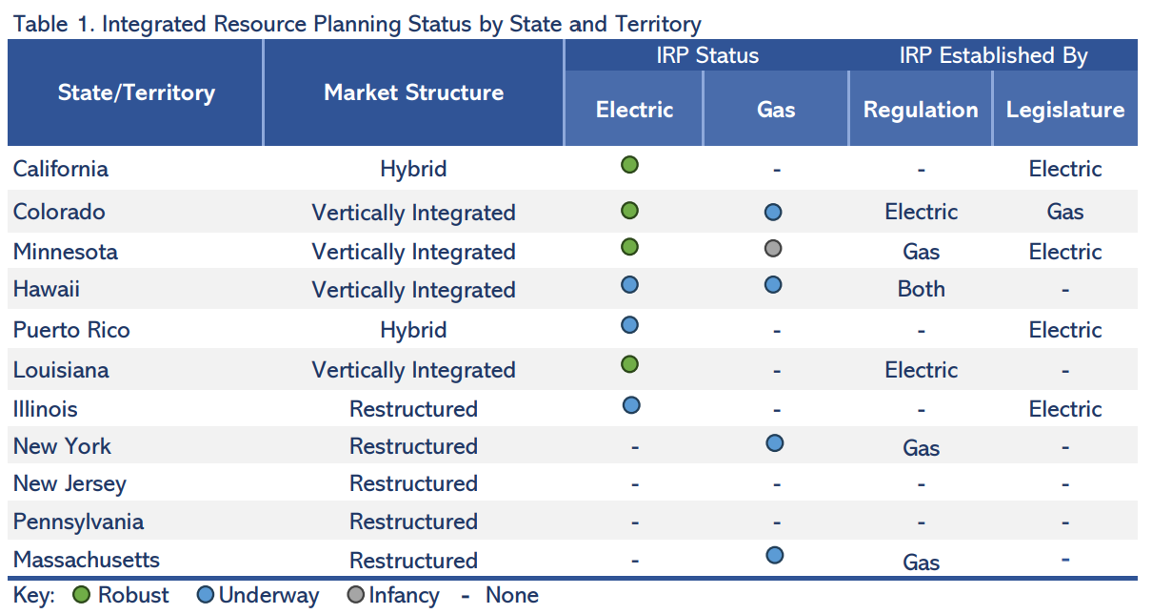
Note: Planning status reflects three stages: Infancy means a formal commitment exists, but no plan has been completed. Underway means planning has begun. Robust indicates an established process with multiple planning cycles that inform energy decisions.
How to influence IRP outcomes
You don’t need to be an energy expert to have a say in decisions that affect your community. In Detroit, for example, a coalition of community and advocacy groups participated in an IRP proceeding and helped secure an $8 million commitment from DTE Energy to support a community-led program providing home repairs and energy efficiency improvements to help residents lower their electricity bills.
Start by visiting your state’s Public Utility Commission’s website to see whether your utility has an active IRP proceeding. You may be able to review proposed plans and submit public comments to let the utility and commission know your desired outcome and the impact of their decisions on your community.
To learn more, including how to draft and submit public comments, explore EDF’s integrated resource planning fact sheet and visit Community Voices in Energy for resources to help make your voice heard.