







New York’s state energy plan falls short
Posted: in General
Written By

Share
Summary
- The 2025 State Energy Plan is inconsistent with New York’s climate law and fails to sufficiently prioritize proven and affordable clean energy solutions, instead clinging to fossil infrastructure and charting a path that misses net-zero targets while leaving billions in potential health and cost savings on the table.
- By excluding cap-and-invest and failing to prioritize efficiency and electrification at scale, the Plan forgoes major opportunities to cut pollution, lower household energy bills, and deliver equitable economic benefits – despite clear evidence these approaches work.
By Kate Courtin & Magdalen Sullivan
Last month, New York State officials adopted the 2025 State Energy Plan, which will guide energy policy and investment decisions for the next 15 years. This is the state’s first energy plan since the passage of the Climate Leadership and Community Protection Act in 2019 – a landmark law that commits New York to cutting greenhouse gas emissions to net zero by 2050.
Because state agencies must align their decisions with the Energy Plan, it represents an important opportunity to drive full implementation of the CLCPA. In fact, state law explicitly requires the SEP to incorporate the Climate Action Council’s 2022 Scoping Plan – the state’s roadmap for achieving its climate targets through a managed, equitable energy transition.
Instead, the final plan falls short
The SEP ignores key Scoping Plan recommendations, under-prioritizes the most affordable clean energy solutions and doubles down on costly, polluting fossil infrastructure. It embraces an “all of the above” fallacy that fails to center clean energy – despite clear evidence that these solutions deliver long-term financial benefits while reducing health and environmental harms.
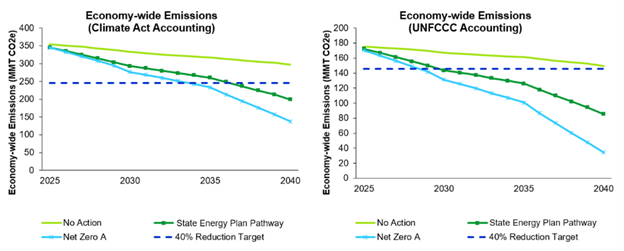
New York’s state energy plan falls short Share on XAs written, the SEP puts New York’s energy system on a trajectory that is incompatible with achieving net-zero emissions by 2050. The state’s own modeling shows that emissions between 2030 and 2040 exceed levels consistent with a net-zero pathway, regardless of whether emissions are measured using CLCPA or conventional United Nations Framework Convention on Climate Change accounting.
The state leaves billions on the table
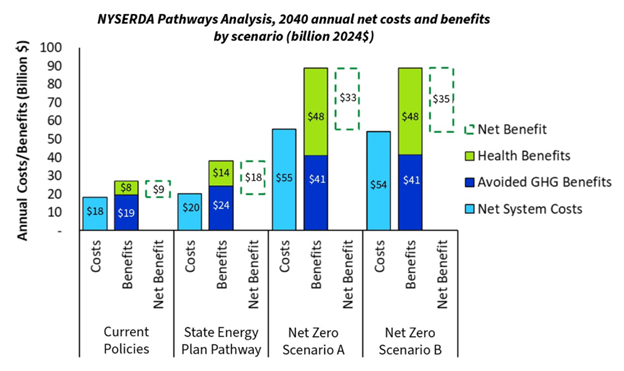
New Yorks’s own modeling also makes the consequences of this failure unmistakable. A Net-Zero Pathway strategy could generate up to $35 billion in net benefits by 2040, from avoided health costs – like reductions in nonfatal heart attacks, asthma-related ER visits and lost workdays – and reduced climate damages. By contrast, the SEP’s chosen planning scenario delivers only $18 billion in net benefits – roughly half of what the state could achieve by committing fully to net zero.
The plan omits one of the state’s most powerful tools
Most glaringly, the SEP excludes a commitment to cap-and-invest regulations – known as the Clean Air Initiative – despite the Scoping Plan identifying such a program as a core strategy for meeting New York’s emissions limits. Cap-and-invest is projected to generate at least $3 billion every year to invest in programs that lower energy bills, create good jobs and deliver major health benefits, especially in communities burdened by air pollution. After years of policy development and stakeholder engagement, the program is ready for implementation. Its absence from the SEP underscores the plan’s failure to meet New York’s climate and affordability promises.
Clean energy saves New Yorkers money – if the state acts
The SEP itself acknowledges that efficiency and electrification deliver significant cost savings. State modeling shows that by 2031, households prioritizing high-efficiency electrification could save an average of $175 per month on combined energy and transportation costs – with savings reaching up to $335 per month for some households.
The SEP also recognizes that policies reducing upfront costs and adoption barriers are essential to realizing these savings and alleviating energy insecurity and burdens. That is exactly what cap-and-invest revenue is designed to do – scale investments in weatherization, public transit and efficient electric appliances and vehicles so that all New Yorkers can benefit.
Last year’s state budget took an important step by allocating $1 billion to clean energy and efficiency programs through the Sustainable Future Program. But one-time funding is not enough. To deliver lasting savings, healthier schools and homes and family-sustaining jobs, the state must sustain and scale these investments – including another $1 billion commitment in the FY2027 budget, followed by cap-and-invest.
Where the plan gets it right
The SEP does include several constructive elements that state agencies should embrace:
- It exercises caution around “differentiated,” or “certified,” natural gas programs and indicates a pathway to further assess responsible utilization of this emissions mitigation tool.
- It rejects blending hydrogen into the natural gas system due to safety concerns.
- It promotes the development of thermal energy networks, a critical component of the clean energy transition.
- It warns against double-counting environmental attributes associated with “renewable” natural gas credits sold out of state.
While these provisions matter, they do not compensate for the SEP’s broader failure to prioritize clean energy at the scale and speed that the climate crisis demands.
New York must close the gap
New Yorkers deserve clean air, affordable energy, healthy communities, and a livable future. The CLCPA – passed with broad statewide support – can deliver on all of this. But only if the state follows through.
Especially now, in the face of federal opposition to thoughtful policy, New York cannot afford to retreat. The State Energy Plan does not reflect the clean energy future New Yorkers have demanded. State agencies must act now to close the gap and put the state back on track to meet its climate commitments.