








Newsflash! Warming oceans=changes in fish populations and ecosystems
Posted: in Science/Research
Written By

Share
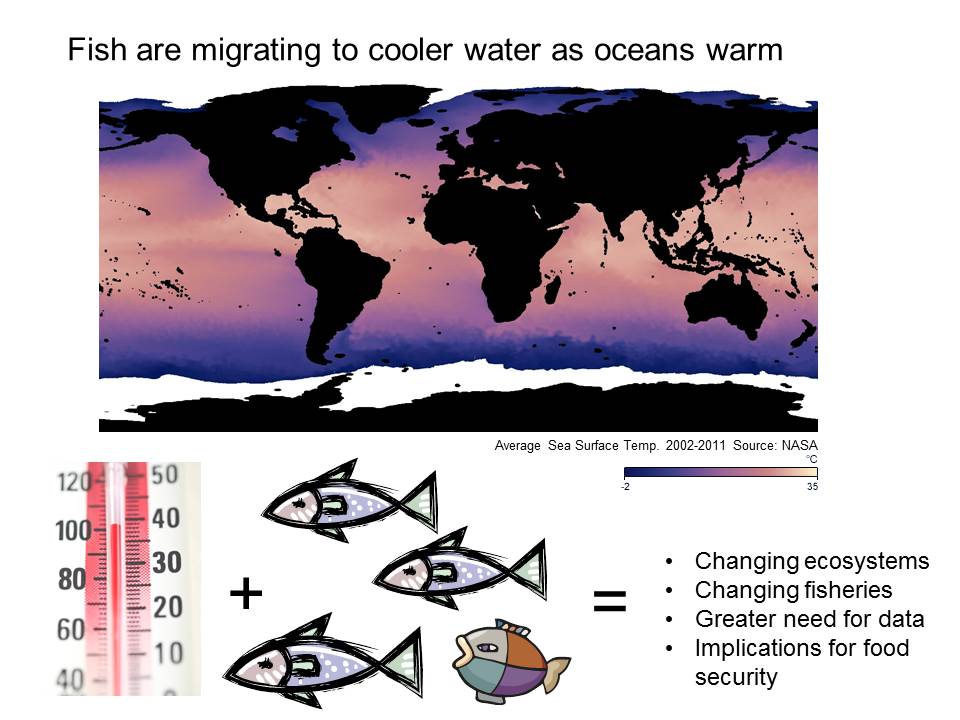 A number of scientific studies indicate that warming waters are affecting fish populations globally—and often in unpredictable ways. This finding is significant for fisheries management because as fish populations shift, whole ecosystems are changed. A recent study covering 40 years of data illuminates these changes in fish distributions and a Huffington Post article examines the research conducted to date and highlights the uncertain implications of this knowledge. The article extensively quotes our own scientist and Director of Spatial Initiatives, Jake Kritzer. Jake comments on the difficulty of making management predications without a complete understanding of how complex underwater ecosystems are shifting:
“It’s an immensely complicated situation. You have climate change overlaying everything, and it seems to be changing the way everything works, which means we have a lot of problems. It’s getting harder and harder to assess the stocks, to model them and understand their dynamics and predict what’s going to happen. Because those models are based on years and years of experience reading fish stocks and studying them, they have been tested over a long time and they rely on a certain set of assumptions and conditions that now seem to be rapidly changing. Tools that have been fairly well established and worked well in the past just don’t seem to be working as well anymore.”
Read the full Huffington Post article: http://www.huffingtonpost.com/2013/05/17/ocean-climate-change-fishing-industry_n_3275505.html
Access the recent study published in Nature from researchers in British Columbia: http://www.nature.com/nature/journal/v497/n7449/full/497320a.html