






New analysis shows a clear need for stronger protections from coal plant mercury pollution
Posted: in News
Written By

Share
Summary
- New analysis from Environmental Defense Fund shows a clear need for stronger, not weaker, protections against pollution from coal-fired power plants.
- Plants that burn lignite coal – an especially dirty power source, with higher levels of mercury and other toxic pollution – remain the biggest cause for concern.
- The worst polluters are getting worse or holding steady, and some of the most striking increases in mercury pollution in 2025 were seen in coal-fired power plants that previously did not make the list of top polluters.
(This post was co-authored by EDF technical analyst Grace Hauser.)
The Trump administration has rolled back the 2024 Mercury and Air Toxics Standards.
Those standards guard against mercury, arsenic, lead and other dangerous pollution from coal-fired power plants – pollution that causes brain damage in babies, cancer and serious heart and lung diseases.
But at Environmental Defense Fund, we just did an analysis of 2025 coal plant mercury data that shows a clear need for stronger protections – not their abandonment.
That new data is included in our map of the top 30 mercury-polluting power plants, which you can see below.
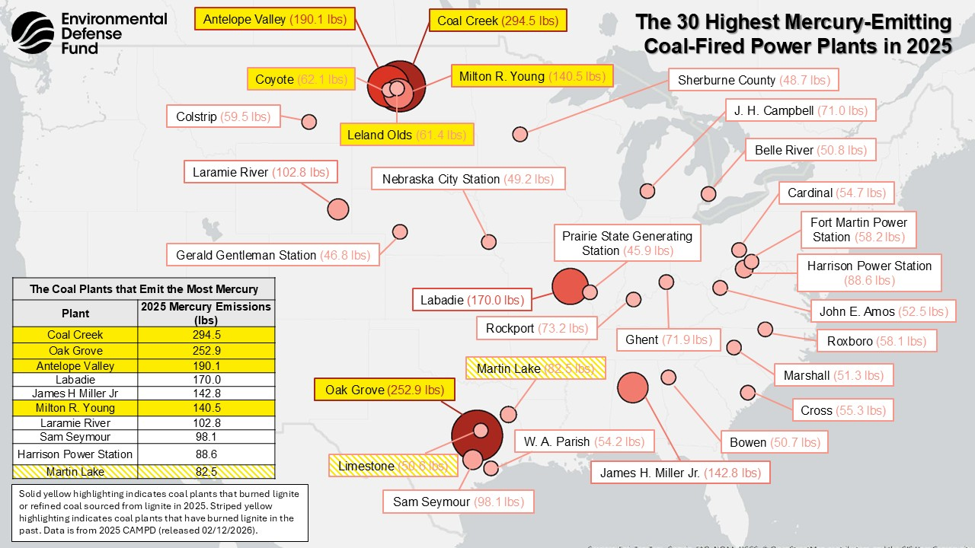
Our updated map shows significant mercury emissions concentrated near a small set of high-emitting facilities in North Dakota and Texas, many of which burn some amount of lignite or have burned some amount of lignite coal in the past. Coal plants may qualify for a less stringent (or higher) mercury standard if they are located near a lignite coal mine, are designed to fire lignite coal and do fire some lignite coal or refined coal sourced from lignite coal. Plants meeting these conditions are part of a “lignite-fired” subcategory. EPA regulations do not require coal plants to burn any minimum amount of lignite coal to qualify for lignite-fired subcategory and the laxer lignite mercury standard.
Lignite coal is an especially dirty power source. It contains higher levels of mercury and other toxics than other types of coal, and more lignite coal must be burned to generate power compared to other types of coal, which then produces even more emissions.
Before the 2024 Mercury and Air Toxics Standards, plants in the lignite-fired subcategory were allowed to release more than three times as much mercury as other coal plants.
The 2024 Mercury and Air Toxics Standards closed this loophole and required lignite plants to meet the same mercury pollution standard that all other coal plants have been subject to since 2012. Now, with the Trump EPA’s repeal, the lignite loophole is reopened.
Here are more highlights from our updated analysis:
Plants that burn lignite coal remain the biggest cause for concern
Our analysis finds that, while only six of the 30 most-polluting plants burned lignite coal in 2025, those plants are heavily concentrated at the very top of the list – all three of the nation’s highest mercury emitters burned lignite in 2025 (see map above).
Texas and North Dakota contain the most extensive lignite deposits in the U.S. – and our analysis finds that those two states have the highest coal plant mercury emissions (see the chart below).
| State | 2025 Mercury Emissions (lbs) | Number of Coal-Fired Power Plants in the Top-30 Mercury Emitters |
| North Dakota | 748.69 | 5 |
| Texas | 538.30 | 5 |
| West Virginia | 199.27 | 3 |
| Missouri | 166.99 | 1 |
| Alabama | 142.77 | 1 |
The worst polluters are getting worse or holding steady
For example, the Coal Creek plant in North Dakota emitted the most mercury of any coal-fired power plant in the country at over 294 pounds in 2025, an increase of 3.5% since 2023. The Coal Creek plant burned refined coal sourced from lignite coal in 2025, as shown in their second and third quarter MATS compliance reports.
Another lignite-burning plant in North Dakota, Antelope Valley, also increased its mercury emissions by 17% since 2023 and was the third-highest mercury-emitting plant in the country in 2025.
See more in the chart below:
| Facility | State | Burned Some Amount of Lignite in 2025 | Hg 2023 (lbs) | Hg 2025 (lbs) | Percent Change |
| Coal Creek | North Dakota | Yes* | 284.56 | 294.51 | +3.50% |
| Oak Grove | Texas | Yes | 297.57 | 252.93 | -15.00% |
| Antelope Valley | North Dakota | Yes | 162.47 | 190.14 | +17.03% |
| Labadie | Missouri | No | 153.66 | 166.99 | +8.67% |
| James H. Miller Jr. | Alabama | No | 106.88 | 142.77 | +33.57% |
| Milton R. Young | North Dakota | Yes | 145.70 | 140.50 | -3.57% |
| Laramie River | Wyoming | No | 111.69 | 102.84 | -7.92% |
| Sam Seymour | Texas | No | 87.82 | 98.11 | +11.71% |
| Harrison Power Station | West Virginia | No | 68.22 | 88.59 | +29.85% |
| Martin Lake | Texas | No** | 253.11 | 82.45 | -67.42% |
*The Coal Creek plant burned refined coal sourced from lignite coal in 2025.
**The Martin Lake plant did not burn lignite coal in 2025 but has burned lignite coal in the past.
We saw some alarming spikes in mercury pollution
Some of the most striking increases in mercury pollution in 2025 were seen in coal-fired power plants that previously did not make the top 30 list.
The Roxboro plant in North Carolina shows how increased operation of fossil generation can drive pollution. From January 2023 through November 2025, Roxboro increased its generation by roughly 50% and its mercury emissions rose by 192.8% (2023 and Nov. 2025 Form EIA-923). That caused it to jump from the 75th-highest mercury emitting coal plant to the 19th.
Mercury cuts were sometimes driven by reduced operations, not improved controls
Several coal-fired power plants reduced their mercury emissions from 2023 to 2025, but much of this decline reflects reduced coal use and lower electricity generation during that period rather than cleaner operations.
For example, the Martin Lake plant – a Texas plant that did not burn lignite in 2025, although it has in the past – reduced its mercury emissions by roughly 67% (see the chart above) while its electricity generation fell by 30% due to one of its units being offline for the entirety of 2025 (2025 and Nov. 2025 Form EIA-923).
Coal plants could be abusing the higher allowable mercury limits for the lignite coal plant subcategory
In 2024, EPA discussed its longstanding concern that plants may be burning very little lignite but still subject to the higher mercury standard for the lignite subcategory. For example, EPA documented how the Martin Lake and Limestone plants burned no lignite coal in 2022, despite being “permitted to fire lignite.” In addition, EPA documented how Limestone did not burn any lignite in 2021. That means that for years, one or more plants may have been permitted to emit mercury at more than three times the rate that would have applied to a comparable non-lignite plant — despite not burning a single ton of lignite.
The solution is simple, and it is exactly what EPA did in its 2024 rule: close the lignite loophole for coal plants and ensure all coal plants use proven technologies and methods to bring their mercury levels down. In addition to closing the lignite loophole, EDF has long advocated for strengthening the Mercury and Air Toxics Standards for non-lignite coal plants.
One example of why is the non-lignite Harrison plant (see the chart above). It increased its mercury emissions by approximately 30% since 2023, which contributed to West Virginia’s status as the state with the third-highest coal plant mercury emissions in 2025.
Cost reasonable and technologically feasible control solutions are also readily available for these plants.
You can explore the full data set on 2025 mercury emissions here. And read more about the Trump EPA’s rollback of the 2024 Mercury and Air Toxics Standards here.
This blog was originally published in March 2026 and has been updated to clarify the status of the Limestone and Martin Lake plants and that Spiritwood and Coal Creek burned refined coal sourced from lignite coal.