









How cap-and-invest can cut pollution and bring down costs for Coloradans
Written By


Share
Colorado is facing rising costs, a rapid increase in energy demand and attacks on clean energy from the federal level. On top of all of this, the state is far from meeting its climate targets as climate-related disasters, like wildfires and droughts, become more frequent and extreme.
As Colorado leaders confront these challenges, they should consider policies that cut costly pollution and improve people’s lives right away. Cap-and-invest is a proven program that offers a two-in-one solution: Driving down dangerous pollution, while investing in stronger communities and Colorado businesses and lowering energy costs to help meet our climate goals.
Colorado Senator and candidate for Governor, Michael Bennet, just published a proposal that would create a cap-and-invest program in the state. In this blog, we will break down the basics of cap-and-invest, and how this type of program can deliver a stronger and more affordable Colorado.
How cap-and-invest drives down pollution
Colorado has committed to taking ambitious action to tackle climate change, with targets in law to reduce climate pollution across its economy: 26% by 2025, 50% by 2030, 65% by 2035, 75% by 2040, 90% by 2045, and 100% by 2050 (all relative to a 2005 baseline). The state has made progress on cutting emissions, primarily through policies aimed at specific sectors such as reducing methane pollution from the oil and gas industry, requiring power companies to bring more clean energy online, and a clean heat standard requiring investment in decarbonizing buildings. However, even with these many policies in place, Colorado is still off track from its legally required pollution reduction targets.
Cap-and-invest can complement these policies and accelerate additional pollution reductions to close the gap between actual pollution levels and statewide targets.
How does this work?
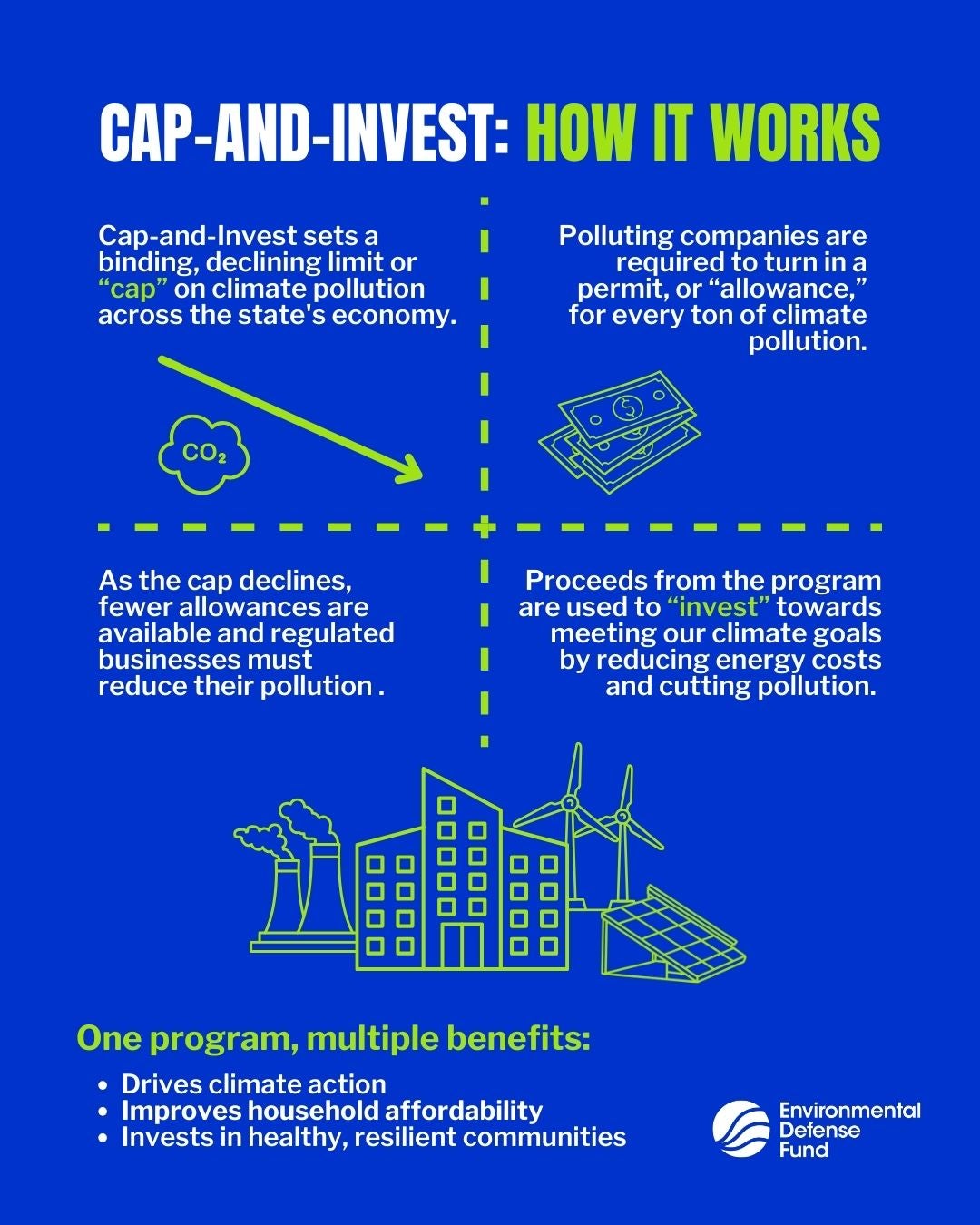
- A cap-and-invest program puts a firm limit – or ‘cap’ – on the total amount of greenhouse gas pollution that can be released, with the cap reduced each year to levels that would meet Colorado’s climate targets.
- A limited number of emissions permits – or “allowances” – are issued each year, and pollution sources are required to turn in one allowance for every ton of greenhouse gas they emit. As the cap declines each year, fewer allowances are available – and regulated companies must cut their pollution.
- Proceeds from selling allowances are reinvested to help meet the state’s climate targets by protecting consumers, reducing energy costs, supporting businesses to upgrade to clean technologies, and more.
If Colorado adopts a cap-and-invest program with a declining cap aligned to meet the state’s emissions targets, it could reduce a cumulative one billion tons (one gigaton) of climate pollution through 2050, relative to the state’s estimate for emissions under current policy. Those emissions cuts would help secure a brighter future for all Coloradans — and communities that are impacted by pollution and climate change more than others stand to gain the most from healthier air quality and less severe climate change impacts.
A Colorado cap-and-invest program would cut costs and grow the economy
The other super-power of cap-and-invest: It’s ability to drive down energy costs alongside cutting pollution — an especially important benefit as electricity price increases are expected to accelerate over the next several years. Proceeds from the sale of emissions allowances are reinvested to help meet the state’s climate targets by improving energy efficiency, lowering energy bills, supporting a transition for Colorado businesses to cleaner and more efficient operations, and much, much more. We’re already seeing the cost-savings for households from other cap-and-invest programs around the country:
- In California, households have already seen more than $16 billion off their electricity and natural gas bills through utility bill credits funded by Cap-and-Invest.
- Since the Regional Greenhouse Gas Initiative (RGGI) began, the program has raised more than $9 billion in revenue — providing direct benefits to over 8 million households, including over $20 billion in energy bill savings.
- New York’s proposed Cap-and-Invest program is also expected to provide significant cost savings to households. Resources for the Future and the NYC Environmental Justice Alliance found that with a targeted dividend approach, nearly all households earning under $200,000 per year — about 85% of New York households — will see net savings under Cap-and-Invest. These savings grow as households electrify or improve efficiency — actions that the program incentivizes. A separate study by Switchbox on New York’s proposed program shows that Cap-and-Invest could help nearly half of New York of households upgrade to clean, efficient heat pumps by 2035, saving the average household up to $1,022 per year.
- A study recently published by Resources for the Future found that in eight leadership states, Cap-and-Invest programs that cut electricity emissions 80% by 2030 can make electricity more affordable for households. The modeling found that Cap-and-Invest proceeds would reduce household electricity prices by 6% on average — for context, twice the cost savings that were projected for full implementation of the Inflation Reduction Act.
In addition to lowering energy costs, cap-and-invest programs can drive economic growth. Washington state’s Cap-and-Invest program has already generated over $3 billion in revenue since its first auction in February 2023 and has supported, among many other projects, investments in infrastructure and skilled workforce development in renewable energy, purchasing food from farmers that would otherwise have gone to waste and distributing it through hunger relief organizations, expanding public transit (including free transit for passengers under 18), and funding wildfire resilience efforts.
Momentum for cap-and-invest is building across the U.S.
Cap-and-invest is already delivering lower bills, cleaner air, new jobs, and stronger economic growth across the country — all while tackling climate change by driving cost-effective and enforceable cuts in greenhouse gas pollution. These significant community and economic benefits have helped make cap-and-invest programs politically popular where voters are experiencing their benefits firsthand:
- Last month, voters in Virginia and New Jersey elected Governors by wide margins who committed to keeping their states part of RGGI — a longstanding multi-state Cap-and-Invest program that slashes power plant pollution — defeating candidates actively campaigning against the program.
- After championing Cap-and-Invest as a tool to address affordability, Governor Newsom signed into law an extension of California’s program in September. The legislation was supported by two-thirds of each chamber in the California legislature.
- And in Washington, voters successfully defended their Cap & Invest program on the ballot in 2024, beating a well-funded repeal attempt by a 24-point margin. An unprecedented coalition of 500+ groups including major businesses, labor unions, environmental, environmental justice, and community groups came together, championed the tremendous benefits that were at stake with the program, and won.
Cap-and-invest programs across the country are cutting pollution, reinvesting in communities, and making energy more affordable. Colorado could be the next state to reap the rewards of a program tailored to its communities.