Lead in food – An overlooked, but meaningful, source of children’s exposure to lead
Written By

Share
Tom Neltner, J.D., Chemicals Policy Director and Maricel Maffini, Ph.D., Consultant
By now, it is well known that lead exposure is a significant human health concern, especially for young children. While most of the discussion about lead exposure has involved paint, drinking water, and contaminated soil or dust where young children live, play, and learn, EDF’s new report shows reason to pay more attention to another source: our food.
Until recently, we have known very little about the contribution of food to children’s lead exposure. In January 2017, an Environmental Protection Agency (EPA) draft report indicated that food is a meaningful source of children’s exposure to lead. Using EPA’s data, we estimated that over 1 million young children consume more lead than what the Food and Drug Administration (FDA) considers acceptable for children to eat every day. From EPA’s analysis, we calculated that that if lead in food were eliminated, millions of children would live healthier lives, and the total societal economic benefit would exceed $27 billion a year in increased lifetime earnings resulting from the impact of lead on children’s IQ.
To better understand the issue of lead in food, EDF evaluated over a decade’s worth of data collected and analyzed by the FDA as part of the agency’s Total Diet Study (TDS). Since the 1970s, the TDS has tracked metals, pesticides, and nutrients in up to 280 types of food yearly.
What did we find?
Overall, 20% of 2,164 baby food samples and 14% of the other 10,064 food samples had detectable levels of lead. At least one sample in 52 of the 57 types of baby food analyzed by FDA had detectable levels of lead in it. Lead was most commonly found in the following baby foods:
- Fruit juices: 89% of 44 grape juice samples contained detectable levels of lead, mixed fruit (67% of 111 samples), apple (55% of 44 samples), and pear (45% of 44 samples)
- Root vegetables: Sweet potatoes (86% of 44 samples) and carrots (43% of 44 samples)
- Cookies: Arrowroot cookies (64% of 44 samples) and teething biscuits (47% of 43 samples)
Percentage of composite samples of selected baby foods with detectable lead based on 2003-2013 FDA Total Diet Study data
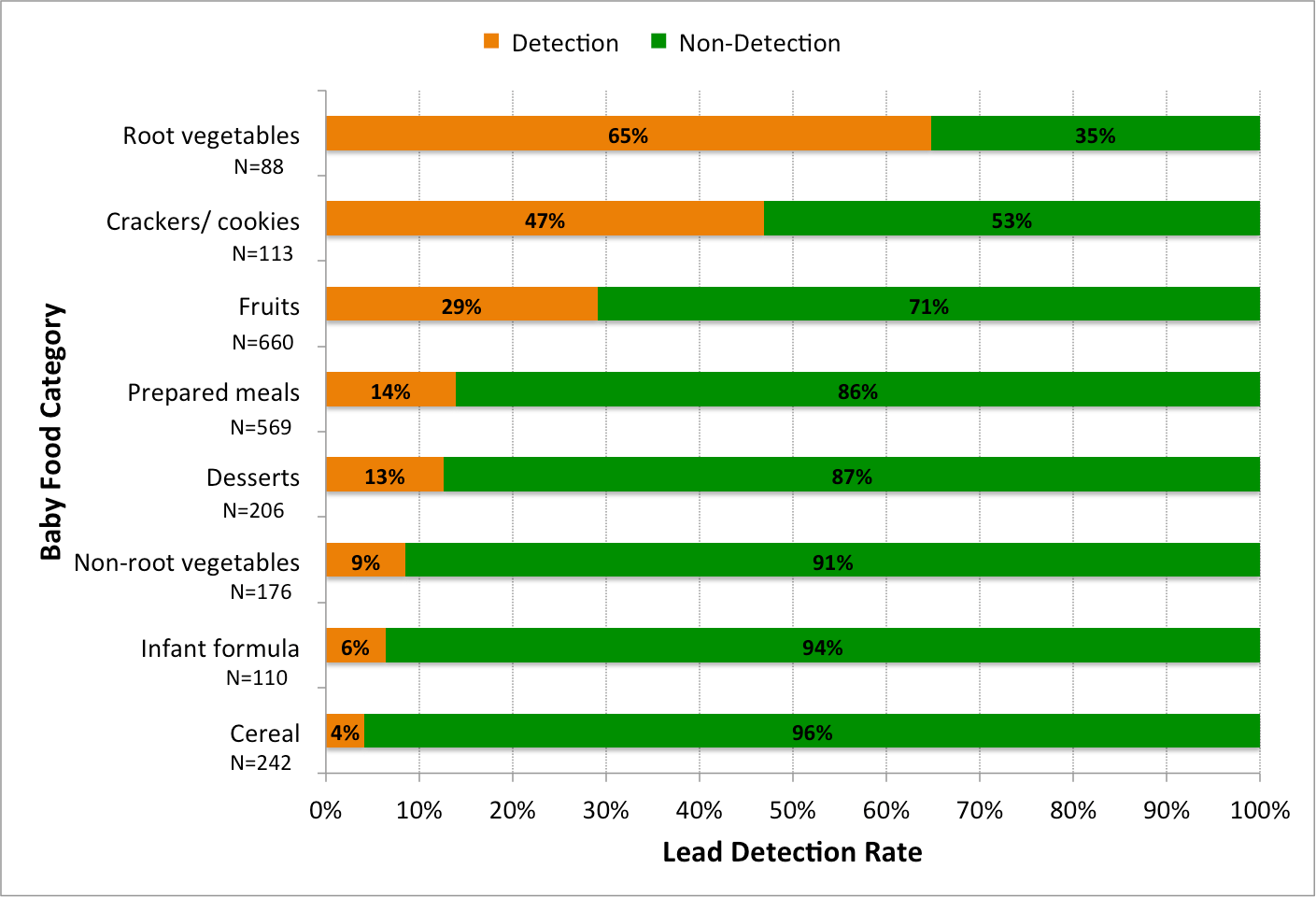
In addition, we found that lead was more frequently detected in samples of the baby food versions of apple juice, grape juice, and carrots than their regular versions.
These findings raise important questions that need further investigation:
- Are foods marketed for infants and babies more likely to have lead contamination when compared with similar products not marketed to infants and babies?
- If there is a significant difference, what are the contributing factors? These might include the source of the crop, growing conditions, varieties, food and juice processing and preparation.
Opportunities to reduce lead contamination in food
Lead in food is a problem that FDA and food manufacturers can and must address. EDF has identified actions for FDA and the food industry to take to reduce lead contamination in food.
EDF recommends that FDA:
- Ensure lead is not added to any food contact material where it is reasonably expected to get into food;
- Make clear that the international standards for fruit juice are inadequate;
- Update its limits and food safety guidance to reflect current scientific understanding of lead risks that better protect children; and
- Encourage manufacturers to reduce lead levels in food, and take enforcement action when limits are exceeded.
Manufacturers need not wait for FDA to act. EDF recommends companies:
- Set a goal of less than 1 ppb of lead in baby food and other foods marketed to young children;
- Continue to prioritize lead contaminant minimization when sourcing ingredients;
- Test more frequently during processing to identify additional sources of lead, and take appropriate corrective actions; and
- Publicly commit to consumers to drive down lead levels through health-protective limits and robust product stewardship.
Parents should consult with their pediatricians to learn about all the ways to reduce lead exposure. They should check with their favorite brands to ask whether the company:
- Regularly tests their products for lead; and
- Ensures that, especially for baby food, there is less than 1 ppb in the food they sell.
Healthy eating requires safe, nutritious food. We can and must do more to reduce and eliminate lead in our food supply.