


How groundwater accounting supports local water management in Kansas
Posted: in Groundwater, Kansas
Written By


Share
As conditions get drier across southwest Kansas, producers and water managers are making increasingly difficult decisions about how to sustain agriculture while extending the life of the Ogallala Aquifer for future generations.
The challenges came up multiple times during the 15th annual Kansas Governor’s Water Conference last week, where Gov. Laura Kelly noted that decisions today will affect the state’s future.
“While we’ve made lots of progress, we cannot mistake progress for a finished job,” the outgoing governor said.
Kansas has made great strides in the past 15 years to address declining groundwater supplies with frameworks such as Local Enhanced Management Areas (LEMAs). To support that work and help prepare for new plans, the Groundwater Accounting Platform is being piloted in Groundwater Management District No. 3 (GMD3) in southwest Kansas on land owned by The Garden City Company.
EDF and Environmental Science Associates (ESA) first co-developed the Platform in 2018 as an open-source tool to more easily provide water managers and landowners with information about water supply and use. It was later expanded through collaboration with Olsson and the California Water Data Consortium.
Groundwater accounting for multiyear allocations
In response to declining groundwater levels, GMD3 is developing an Action Plan that sets strict water use goals in five-year increments, with the long-term goal of stabilizing the aquifer to support existing agriculture and demands from cities and industry.
The district is pursuing development of the Groundwater Accounting Platform to provide in-season data, which will be critical to setting future water allocations that meet their Action Plan goals, while also helping irrigators manage more complicated and restrictive multiyear water supplies.
Turning groundwater data into practical decisions
Kansas has been metering irrigation wells for decades and has some of the most comprehensive groundwater use data in the nation. However, data alone does not answer the key management questions producers and water managers face daily — questions that are more important than ever as water supplies decline.
Questions, for example, include: How would different conservation strategies affect water availability and agriculture production over time? What do proposed management changes mean for a single pivot versus the whole operation? How can producers compare different on-farm scenarios to inform decisions and planning?
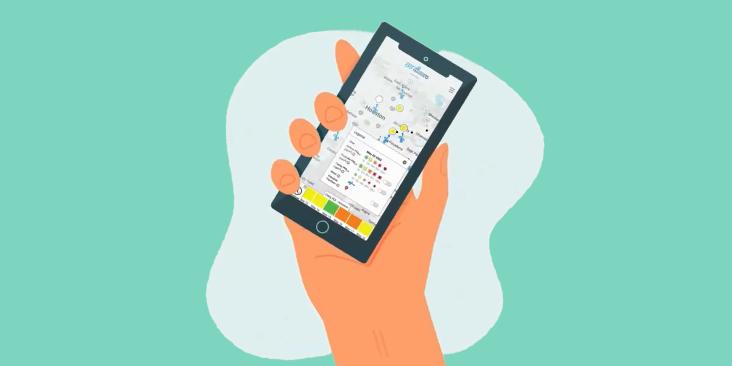
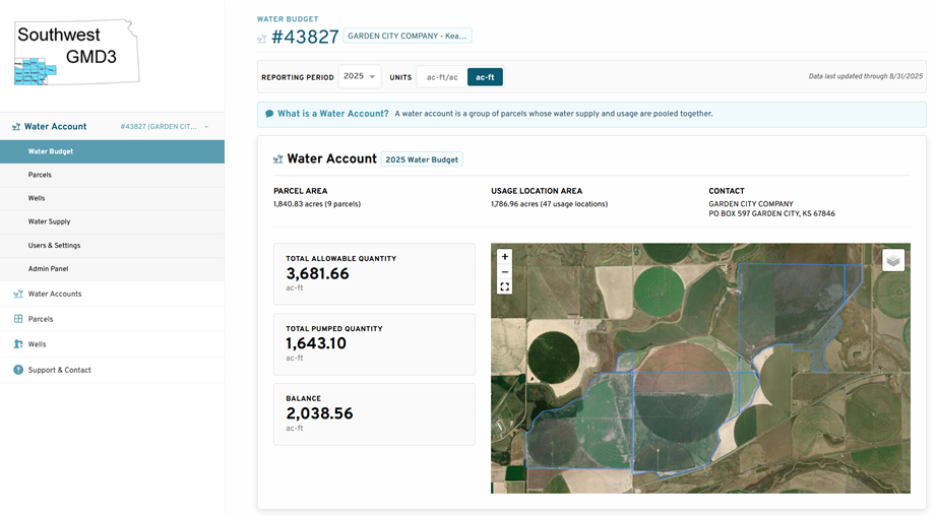
The Groundwater Accounting Platform brings together existing groundwater data into a secure, user-friendly platform to support visualizing water budgets, understanding groundwater use throughout the growing season, and evaluating future scenarios using a shared set of information.
By creating a visual representation of groundwater conditions, the Platform shifts conversations toward discussing solutions from a shared understanding of the data. In some regions, it’s unexpectedly become a helpful communication tool that fosters dialogues between water managers and producers around new policies and understanding water use.
“GMD3 plans to use the Platform to communicate with producers, providing results from field inspections, updates on modeled and measured water data, weather and climate information, and information on upcoming producer meetings,” explained Trevor Ahring, the civil engineer at GMD3.
Open source and data agnostic
Groundwater management context and challenges vary across geographies, as do priorities, governance structures and available data. Consequently, the Groundwater Accounting Platform was created as an open-source tool that allows water managers to choose which datasets to incorporate and customize to support the decisions most relevant to their management needs.
For instance, to track water use over time, a water district can choose from multiple data sources, including meter data that they already collect, remote-sensed satellite-based water use data or grower self-reported data. They can use the Platform to compare multiple datasets to strengthen their understanding of local groundwater conditions.
Because the Platform is open source, trusted local consultants working with a water district can also configure and use it on behalf of the agencies and districts they work with.
In each new location, including work in Kansas with local partners and GMD3, the Platform has been updated based on feedback and on-the-ground use. This iterative development has focused on improving data and policy visualization, comparisons of management scenarios, and configurations to reflect local groundwater governance and decision needs.
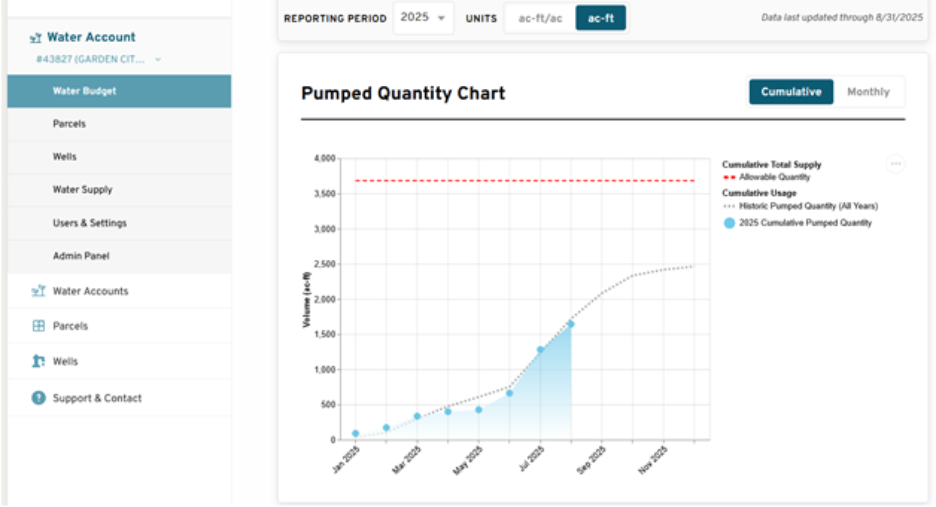
An online water bank account
The Platform’s simple interface enables a water user to pull up a map that shows all their fields and then click on a single field to see its water budget and water use history — just like they would check their online bank account.
The Platform includes permission-based access that allows producers to control who can view their information. Data sharing arrangements are tailored to local agreements and governance structures, ensuring communities retain control over how information is used.
Water managers, meanwhile, can also access aggregated data across their entire region to support district-wide planning and management.
Data-driven conservation
As water supplies decline and producers, districts and supply chain partners in Kansas consider new approaches, they need more robust groundwater accounting. The Groundwater Accounting Platform is one tool that can help to quantify how new practices are affecting water budgets in order to know what’s working and ensure there is enough water to continue farming long into the future.
For more information about the Groundwater Accounting Platform, see our two-page factsheet.