








Not green or brown, just good economics
Posted: in Climate science, Markets 101
Written By

Share
Lord Stern famously calls global warming “the biggest market failure the world has ever seen.” It would only be natural for any introductory economics textbook to prepare budding economists to address this problem.
You would think.
Yoram Bauman, otherwise known as the Stand-up Economist, put together a sobering report: Grading economics textbooks on climate change.
Only four of sixteen books received As.
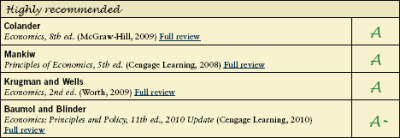
The others are either out of date, outright wrong, or worse.
It’s frustrating that even the best texts seem to banish the biggest market failure into sidebars or special chapters toward the end. Sadly that’s the typical treatment of environmental issues in introductory economics classes: “First, let’s discuss all the reasons why the economy is doing just fine. Then, if there’s time at the end, we’ll cover some exceptions to those rules.”
Krugman and Wells’s text appears to be the only one that integrates climate considerations into a key chapter, one on “long-run economic growth.” That’s not entirely surprising, given Paul Krugman’s other writings on the topic, but it’s good to know it starts with the introductory text. It would be even better if other texts followed that lead.