Climate change solutions
We deliver game-changing environmental solutions that have a real impact for people around the globe.
Lindsay McCormick is a Project Manager.
Yesterday, EPA proposed a rule to ban methylene chloride and either ban or restrict the use of N-methylpyrrolidone in paint stripping products, subject to certain national security exemptions. This proposal is the third such proposed action by the agency in the past month (see here and here). Below, find a short description of these chemicals and EPA’s proposed actions.
Richard Denison, Ph.D., is a Lead Senior Scientist.
The Environmental Defense Fund applauds the Environmental Protection Agency (EPA) for meeting a major milestone in implementing the Frank R. Lautenberg Chemical Safety for the 21st Century Act, the landmark legislation reforming the Toxic Substances Control Act (TSCA) that passed in June 2016 with overwhelming bipartisan support.
EPA reached this milestone this week when it released proposals for the three foundational rules that the Lautenberg Act mandates be finalized by June of this year, as well as three proposed rules restricting specific high-risk uses of several chemicals.
The management and staff of EPA’s Office of Chemical Safety and Pollution Prevention and Office of General Counsel deserve major kudos for their tireless work over these past seven months to reach this milestone. This should also bring satisfaction to the Members of Congress who authored the Lautenberg Act and included aggressive deadlines as part of the bipartisan effort to reform the law. (more…)
Tom Neltner, J.D., is Chemicals Policy Director
Communities around the country are testing their water for lead. But when they get the results, parents, public health officials, housing agencies and school officials have little guidance about what the number means and what actions to take or priorities to set. For lead in dust and soil in homes, child-care and schools, they have health-based numbers that serve as benchmarks for assessing risk. There is no such benchmark for drinking water. As a result, many are using the “Lead Action Level” of 15 parts per billion (ppb) as a surrogate. Yet, this level is based on the effectiveness of corrosion control; it has no relation to the associated health risks of lead exposure.
Yesterday, the Environmental Protection Agency (EPA) helped fill the void by releasing a draft report that provides three different approaches to setting a scientifically-robust “health-based benchmark” for lead in drinking water. The agency is seeking public comment on the draft and will convene a panel of scientific experts to consider each of the approaches.
The report is a critical step in implementing the recommendations of the agency’s National Drinking Water Advisory Council (NDWAC) which called for this type of health-based benchmark as part of an overhaul of the Lead and Copper Rule. The agency went a step further and provides alternatives to consider. We applaud EPA for its action and its rigorous, scientific analysis.
Accounting for the various models and assumptions, EPA developed a range of potential health-based benchmarks that range from 3 to 56 ppb of lead in water that people actually drink. However, you cannot readily compare these values to the typical water testing results reported by utilities or schools. Those tests are based on the first draw of water that has been sitting in the faucet and plumbing overnight and do not necessarily reflect what people drink over the course of a day. Later samples would likely be lower but could be higher if the building has a lead service line, especially if the line has been disturbed. (more…)
Jennifer McPartland, Ph.D., is a Senior Scientist with the Health Program.
The Environmental Protection Agency (EPA) took another significant step yesterday to protect against exposures to the highly toxic chemical, trichloroethylene (TCE), proposing a rule to ban its use as a vapor degreaser.
The proposed rule is the second issued under section 6 of the Toxic Substances Control Act (TSCA) as amended by last year’s Lautenberg Act. It follows on EPA’s proposed rule last month to ban the use of TCE as an aerosol degreaser and spot cleaning agent in dry cleaning facilities. Both proposed rules on TCE are critical to protecting consumer and worker health from the harmful effects of TCE and should move swiftly toward finalization. (more…)
Richard Denison, Ph.D., is a Lead Senior Scientist. Lindsay McCormick is a Project Manager.
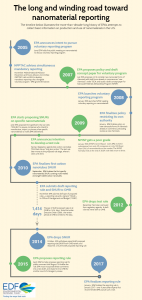
Today, EPA issued its long-awaited rule to gather risk-relevant information on nanoscale materials. The new rule will finally allow EPA to obtain basic data on use, exposure, and hazards from those that manufacture or process these materials, which has long been recognized by experts as essential to understand and manage their potential risks.
Nanomaterials – a diverse category of materials defined mainly by their small size – often exhibit unique properties that can allow for novel applications but also have the potential to negatively impact our health and the environment. Some nanomaterials: more easily penetrate biological barriers than do their bulk counterparts; exhibit toxic effects on the nervous, cardiovascular, pulmonary, and reproductive systems; or have antibacterial properties that may negatively impact ecosystems or lead to resistance.
Tom Neltner, J.D., is Chemicals Policy Director
Accelerating full replacement of lead service lines (LSL) – the lead pipes that run from the drinking water main under the street to homes – is a priority for EDF. These pipes are the primary source of lead in water and, when disturbed, may release lead particles that expose consumers, without warning, to extremely high levels. As part of the effort to encourage safe and effective removal of LSLs replacement, EDF helped launch a new Lead Service Line Replacement Collaborative with 23 national public health, water utility, environmental, labor, consumer, housing, and state and local governmental organizations to help communities develop and implement voluntary programs to eliminate these pipes.
Today, the Collaborative released an online toolkit to assist communities in lead service line replacement. The online toolkit includes:
USA Today highlighted the Collaborative and the toolkit in an article also released today.