Climate change solutions
We deliver game-changing environmental solutions that have a real impact for people around the globe.

NOTE: This is the second in a series about EPA’s regulation of new chemicals.
EPA recently proposed new regulations for its safety reviews of new chemicals under our nation’s main chemicals law, the Toxic Substances Control Act (TSCA). With this action, the agency has a big chance to solve major problems that have undermined scientific integrity, transparency, and public confidence in EPA’s ability to ensure the safety of new chemicals. Unfortunately, the proposed regulation that EPA put out for comment this year falls far short of this goal.
EDF has joined with other organizations, including AFL-CIO, the American Federation of Teachers, and the National Resources Defense Council, in a letter urging EPA to make fundamental changes (PDF, 178KB) to these proposed regulations. One of the most important is this: the agency should end its longstanding practice of sharing about the risks of new chemicals with only the companies that make them—and allowing those companies to dispute the results.
By Maria Doa, PhD, Senior Director, Chemicals Policy, Samantha Liskow, Senior Counsel, and Colin Parts, Legal Fellow
NOTE: This is the first of a series about EPA’s regulation of new chemicals.
EPA recently proposed regulations to govern how it reviews companies’ pre-manufacture notifications for new chemicals before those chemicals can go on the market.
Unfortunately, as we noted in our comments to EPA [PDF, 721KB], the proposal falls significantly short of implementing the fundamental changes needed to ensure the safety of any new chemicals allowed onto the market.
In the face of mounting evidence about the dangers posed by per- and polyfluoroalkyl substances (PFAS), one thing is clear: EPA needs to take urgent action to turn off the tap of these “forever chemicals” that have long-term consequences for our health and the environment.
As we discussed in a previous blog, it is imperative that the Environmental Protection Agency (EPA) use the Toxic Substances Control Act (TSCA) to regulate PFAS chemicals comprehensively—both those newly entering the market and those that have been in circulation for decades.
 What’s New?
Recently, the Environmental Protection Agency (EPA) embarked on a critical Toxic Substances Control Act (TSCA) supplemental risk evaluation of 1,4-dioxane [PDF, 8.7MB]– a highly carcinogenic chemical that contaminates drinking water supplies across the country and is present in products, such as cleaning supplies and personal care products.
This draft supplemental risk evaluation represents a significant step forward because it addresses many of the omissions from the original 1,4-dioxane risk evaluation. Unfortunately, as we noted in our comments to EPA, a closer examination reveals several shortcomings in how EPA addresses risks to fenceline communities—people living, playing, and working near industrial facilities that release toxic chemicals into the air and water. (more…)
The Environmental Protection Agency (EPA) recently released and solicited public comments on its draft Cumulative Risk Assessment (CRA) Guidelines for Planning and Problem Formulation. The purpose of a CRA is to determine the combined health and/or environmental risks from multiple stressors and chemicals that can cause the same harms. These guidelines, intended to be applied to all of EPA’s programs and regions, describe how the agency will determine when to use CRAs and the steps it will take to plan them.
Currently, many EPA programs assess the health and environmental risks of single chemicals, without considering the multiple chemicals that cause the same harms and non-chemical stressors we are exposed to every day. Assessing risks cumulatively, and making regulatory decisions based on this, represents real-world exposures more accurately than single-chemical stressor risk assessments. (more…)
By Tom Neltner, Senior Director, Safer Chemicals, Klara Matouskova, PhD, Consultant, and Maricel Maffini, PhD, Consultant
In our new study, we evaluated Generally Recognized As Safe (GRAS) notices—a total of 403 between 2015-2020—that food manufacturers voluntarily submitted to FDA for review. Our goal was to determine whether industry was adhering to FDA’s Guidance on Best Practices for Convening a GRAS Panel.
The guidance was designed to help companies comply with the law and avoid biases and conflicts of interest when determining whether substances added to food are safe and recognized as such by the scientific community. FDA published a draft of the guidance in 2017 and finalized it essentially unchanged in December 2022.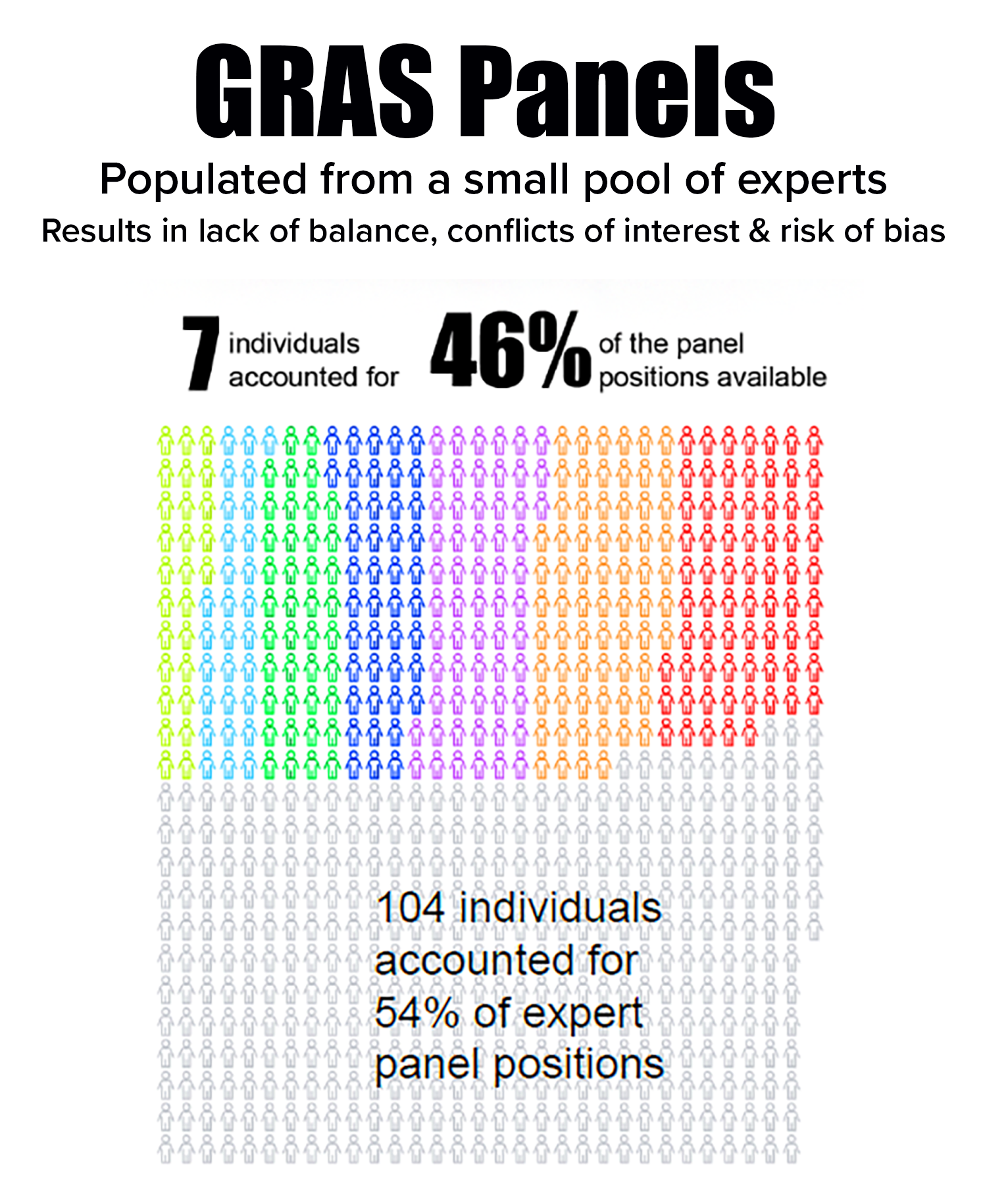
Our study found that no GRAS notices followed the draft guidance. Specifically, we also found there were high risks of bias and conflicts of interest because the companies: