










Why “feasibility” is a dangerous, slippery slope for chemical reviews
Posted: in
Chemical exposure, Congress, Health policy, Industry influence, Public health, Risk assessment, Rules/Regulations, TSCA
Written By

Share
In case you missed it, an out-of-touch, industry-first proposal from Republicans in the U.S. House of Representatives threatens to significantly weaken the Toxic Substances Control Act, a popular chemical safety law that helps keep dangerous chemicals out of our homes, workplaces and schools. A similar proposal from the U.S. Senate would also roll back these essential public health protections.
Why does this matter? The Toxic Substances Control Act gives EPA the authority and responsibility to review chemicals more effectively – before and after they enter the market. The law underwent a critical reform 10 years ago because it was not sufficiently protecting millions of Americans. Now, the Toxic Substances Control Act is working, and it’s keeping the most dangerous chemicals out of our lives.
Here are some ways our bedrock chemical safety law is working to protect us, and what’s at stake if Republicans in Congress weaken it. Over the next few weeks, we’ll dive deeper on how industry-first Republican proposals in Congress would put profits over health, and how the Toxic Substances Control Act keeps us safe – and is worth fighting for.
Note: this is the fifth in a series about how the House Republicans’ proposal would undermine EPA’s ability to protect public health and the environment from toxic chemicals.
Evaluating risks with health and safety in mind
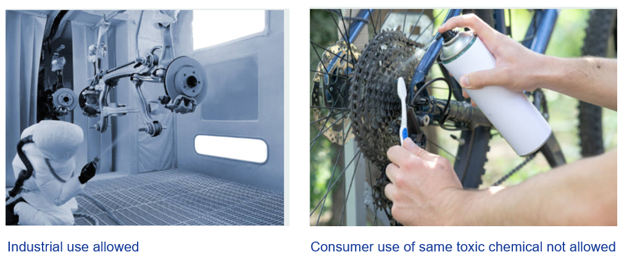
The Toxic Substances Control Act requires EPA to evaluate chemicals based on the risks they pose to people and the environment – without weighing other factors like cost, or how feasible the industry considers controls on the chemical, such as limiting its use in a consumer product. Factors other than risk are considered when EPA determines how to eliminate the unreasonable risk. This approach puts public health at the center of EPA’s decision-making, rather than industry interests.
And under the current law, once EPA identifies an unreasonable risk from a chemical, the agency has clear authority to act to mitigate these risks. Before the Toxic Substances Control Act was reformed a decade ago, the agency lacked this authority. Now, the law gives EPA the tools and authority to prevent these unreasonable risks from harming the public or environment.
“Reasonably feasible” for whom?
But the proposal from House Republicans undermines this public health approach, instead requiring EPA to base its evaluation of the risks on cost-effectiveness and feasibility. When making decisions about how to control the unreasonable risks for a chemical already on the market, EPA would be required to choose measures that would “minimize, to the extent reasonably feasible, such risk of injury to health or the environment.”
By centering concerns about industry’s feasibility from the outset during the risk evaluation process, the proposal ensures that industry’s economic preferences shape the outcome before protective options are even considered. This approach will likely create a dangerous disconnect between what industry deems feasible and what protections are needed to keep people safe.
Here’s what this could look like in practice. A chemical company may tell EPA that it’s only “reasonably feasible” to control a chemical’s risk by a small amount – say, 5% of what EPA considers health-protective. Under this proposal, EPA would have no choice but to take this industry claim at face value, leaving people at risk. With the “reasonably feasible” excuse, EPA would not be able to ban or meaningfully restrict the most toxic chemicals.
For decades, the industry has argued that meaningful protections – like swapping in a safer alternative or installing controls that limit exposure – aren’t economically feasible for them, regardless of how severely workers and people living nearby could be harmed by exposure. Embedding feasibility for the industry as a constraint in risk management virtually guarantees that the most protective options will be systematically underweighted.
Blocking state action
Restricting EPA’s protections to only what the industry deems feasible will inevitably lead to weaker protections at the federal level. But the proposal takes a dangerous step beyond this and blocks states from enacting stronger standards that fill the gap in federal protections.
Under this proposal, when EPA takes action on a chemical already on the market, states would be preempted from requiring stronger restrictions – no matter how weak and unprotective the EPA regulation. The Republican proposal would lock in federal regulations that are feasible for the chemical industry but leave families at risk. Under this weakened version of the law, the states will not be able to do anything to protect their citizens.
Incentivizing EPA to propose weaker protections
If EPA proposes a restriction that industry argues is not technically or economically feasible, the restriction – even if it is only labeling – would be considered to “substantially prevent the specific” use, effectively banning that use. This creates a Catch-22 for the agency: knowing that stronger proposed protections would trigger long, drawn-out battles with the industry over what’s feasible, EPA will be incentivized to propose weaker controls on a chemical, even in instances when the science clearly calls for something stronger.
Instead of framing the question as what’s needed to keep workers and families safe from chemical exposure, the agency would be encouraged to consider how much of a struggle it’ll be to require a company to control a chemical’s risk. Allowing feasibility concerns into the risk evaluation process opens the door to the chemical industry overriding risk-based protections at the expense of people’s health.
Go deeper: Dive into our analysis of the House Republicans’ proposal to gut the Toxic Substances Control Act, and read more about a similarly harmful proposal from Senate Republicans. ICYMI, our other pieces in this series are here: