










The Toxic Substances Control Act is working to keep potentially dangerous new chemicals off the market and out of our lives
Posted: in
Chemical exposure, Chemical regulation, Congress, General interest, Health policy, Public health, TSCA
Written By

Share
In case you missed it, an out-of-touch, industry-first proposal from Republicans in the U.S. House of Representatives threatens to significantly weaken the Toxic Substances Control Act (TSCA), a popular chemical safety law that helps keep dangerous chemicals out of our homes, workplaces and schools. A similar proposal from the U.S. Senate would also roll back these essential public health protections.
Why does this matter? The Toxic Substances Control Act gives EPA the authority and responsibility to review chemicals more effectively – before and after they enter the market. The law underwent a critical reform 10 years ago because it was not sufficiently protecting millions of Americans. Now, the Toxic Substances Control Act is working, and it’s keeping the most dangerous chemicals out of our lives.
Here are some ways our bedrock chemical safety law is working to protect us, and what’s at stake if Republicans in Congress weaken it. Over the next few weeks, we’ll continue to dive deeper on how industry-first Republican proposals in Congress would put profits over health, and how the Toxic Substances Control Act keeps us safe – and is worth fighting for.
Note: this is the third in a series explaining why TSCA works, and how the House Republicans’ proposal could undermine EPA’s ability to protect public health and the environment from toxic chemicals.
The Toxic Substances Control Act is successfully keeping toxic chemicals out of our lives
Thanks to the 2016 improvements to the Toxic Substances Control Act, many harmful chemicals have been kept out of our communities, homes and everyday products. The law requires EPA to make an affirmative determination about the safety of a new chemical, and companies may not begin manufacturing the chemical until this happens. By requiring chemicals to clear a basic safety bar, the law incentivizes innovation toward the development of safer chemicals.
This was a critical change from the pre-2016 version of the law, when a 90-day “shot clock” enabled some new chemicals to enter the market before EPA had reviewed the chemical or made any safety determination. Many chemicals that pose a risk to public health and the environment, like PFAS, made it onto the market this way.
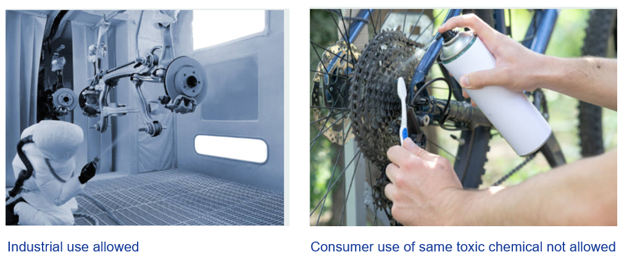
An important way the Toxic Substances Control Act keeps harmful chemicals out of our homes is by requiring EPA to consider whether a chemical can be used in a “reasonably foreseen” way that differs from a company’s stated intent for the chemical. For example, a company may intend for a chemical to be used as an industrial degreaser, but EPA may have data to indicate that similar chemicals have also been used as consumer cleaners. The law gives EPA the authority to restrict use of the chemical to industrial settings with safety controls in place if the agency determines the chemical wouldn’t be safe to use at home.
The law also ensures that new chemicals are not used in different ways that could harm public health or the environment. A company may submit a new chemical notice for EPA’s review and identify a limited purpose for the chemical. If EPA has information indicating that the new chemical can be used in other ways that may pose harm, the agency may issue a Significant New Use Rule (SNUR) to require an additional risk evaluation from EPA before the chemical can be used in the new or expanded way. If necessary, EPA can restrict or prohibit risky uses – before they begin. Without SNURs, companies could expand production, increase worker exposures or introduce a chemical into consumer products without thorough review.
While these common-sense standards under the Toxic Substances Control Act protect public health, the current proposal does quite the opposite. The discussion draft would weaken independent oversight of the chemical industry and prioritize quick approvals over protecting public health. Here are a few key ways the proposal could make it harder for EPA to protect us.
Return of the shot clock
This proposal brings back a de facto shot clock for new chemical reviews, this time with a twist: it would require the administrator of the agency – without the authority to delegate the responsibility – to personally issue an explanation of the delay. This would impose an immense amount of political pressure on EPA staff to rush through reviews, potentially resulting in less rigorous assessments.
A coin flip for safety
The proposal raises the burden of proof EPA must demonstrate to prove a chemical’s harm to an unreasonable level. Rather than centering assessments on safety of a chemical, EPA would be required to demonstrate that a chemical’s unreasonable risk is “more than likely than not” to occur. So in practice, if EPA finds that a chemical causes cancer 50% of the time – a coin flip, not rising to the level of “more likely than not” – that chemical would get approved.
This shift also opens a new lane for the industry to challenge EPA’s assessments. The chemical industry already disputes EPA’s risk assessments and the restrictions it identifies to mitigate the risks. Now the chemical industry could simply state that the unreasonable risk EPA identifies is actually only 49% – not technically “more likely than not.”
Accepting unreasonable risk?
Under this proposal, EPA would no longer be required to mitigate the risks associated with the manufacture, processing, use or disposal of the chemical. EPA may claim that because of insufficient resources, it cannot issue restrictions to mitigate these risks. Without the requirement to mitigate unreasonable risks, a company can make or import and sell a chemical without restraints, regardless of the potential harm it poses to workers, consumers or communities.
A limited, watered-down review process with the industry calling the shots
The proposal puts the chemical industry in the driver’s seat for new chemical reviews, creates exemptions for the industry and delivers it more power to override independent science. It would weaken health protections for families and workers by limiting EPA to industry-provided data. This provides the industry with the opportunity to pressure EPA staff, and it could impact the integrity of the review and lead to weaker protections for the public. It also restricts the data EPA can consider in its chemical reviews, blocking the agency from considering known or reasonably anticipated uses that fall outside of what the company identifies.
Go deeper: Dive into our analysis of the House Republicans’ proposal to gut the Toxic Substances Control Act, and read more about a similarly harmful proposal from Senate Republicans. ICYMI, our other pieces in this series are here: