








Here’s how a harmful Republican proposal to weaken the Toxic Substances Control Act would make it harder for EPA to keep dangerous chemicals out of our lives
Posted: in
Chemical exposure, Chemical regulation, Congress, Health policy, Public health, Rules/Regulations, TSCA, TSCA reform
Written By

Share
A new survey from The Pew Charitable Trusts indicates that most Americans don’t want less oversight and transparency around the chemicals in their lives – they want more of it. More than 70% of adults in the U.S. are concerned about exposure to toxic chemicals, and five in six want government and businesses to do more to ensure chemical safety.
But a dangerous proposal from Senate Republicans is full of loopholes and exemptions to benefit the chemical industry at the expense of our health. These proposed rollbacks to the Toxic Substances Control Act – the bedrock U.S. chemical safety law covering the chemicals in everything from furniture to electronics to baby toys, as well as chemicals in our air, water and soil – would make it harder for EPA to keep toxic chemicals linked to cancer, developmental delays and infertility off the market and out of our lives.
Here are some of the ways the new Senate Republican discussion draft would significantly weaken the Toxic Substances Control Act and threaten public health.
Weakens EPA’s ability to regulate potentially harmful new chemicals
The proposal takes aim at the new chemicals program, altering fundamental definitions that would change the standards of review that EPA must meet. Many of these language changes would weaken EPA’s ability to regulate potentially harmful chemicals, making it harder for EPA to demonstrate that a chemical poses an unreasonable risk.
The proposal changes the requirement from EPA establishing that a chemical “will not present any unreasonable risk” to finding that a chemical “is more likely than not to present an unreasonable risk.” Rather than considering the harms to people most at risk, like children, pregnant women and people living near chemical plants, EPA would only consider the exposures facing the average person. It would also limit what EPA can consider when making determinations about a chemical’s risk, excluding the multiple ways we’re exposed to chemicals as well as narrowing the types of harms EPA can consider.
As with similar language changes in the House proposal, this shift would effectively turn EPA’s safety review into a rubber stamp for any chemical the industry wants to bring to market.
A dangerous exemption for the chemical industry
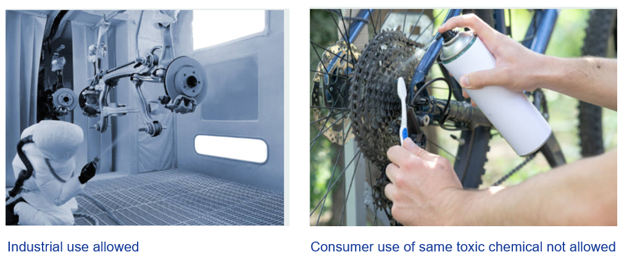
One major way this proposal delivers on the chemical industry’s wish list comes in the form of a broad exemption from the requirement that EPA consider the range of ways a chemical may be used. Currently, EPA must consider how a company says it intends to use a chemical, for example in an industrial setting, as well as other ways the chemical can also be used, such as in a consumer product. If the company asks for an exemption, EPA would be forced to only consider the limited ways a company currently plans to use the chemical, and the chemical would go through an abbreviated review with little transparency. In practice, that could result in a chemical approved for a specific industrial use ending up in a consumer product used in our homes or cars, for example – without having gone through appropriate risk assessments for that use. With this exemption, the majority of all new chemical applications can take advantage of this shortcut and fly through a weak approval process.
If a company doesn’t seek the exemption and undergoes the full review, the proposal would still preclude EPA from considering reasonably foreseen uses. It would no longer be enough for EPA to make the call that another use of a chemical is likely – they’d have to prove it, a likely unattainable bar the agency would not be able to clear.
Hazardous loopholes
Alarmingly, the proposal opens the door to “comparative risk assessments.” In practice, this means if EPA finds significant risk with a chemical, a chemical that is even marginally less harmful than one on the market – say, 5% less toxic, but still incredibly dangerous for people to be exposed to – could sail through approvals. The approval of the new chemical wouldn’t force the existing toxic chemical off the market, and it would impede innovation of safer alternatives. This kind of loophole is how GenX, a toxic chemical thought to be a slightly safer alternative to PFOA, got onto market and subsequently contaminated drinking water for hundreds of thousands of North Carolina residents.
This provision would also allow so-called advanced or chemical recycling – essentially the burning of plastic waste – to cruise through approvals, despite the significant toxicity of what gets produced. That provision alone would clear the runway for this harmful process to be approved under the Toxic Substances Control Act, but here the proposal doubles down and introduces another loophole to allow these harmful products to be considered “equivalent” to chemicals already on the market. For example, if a company wanted to burn waste plastic in the hopes of producing a small amount of naphtha, it would give them a pass to enter the market without undergoing a safety review. They’d be rubberstamped as naphtha, even though the little amount they’ve produced is contaminated with the waste plastic’s toxic additives and harmful byproducts like dioxins – and quite different than naphtha.
Return of the shot clock
The proposal effectively brings back a dangerous relic from pre-2016, before the Toxic Substances Control Act was strengthened with bipartisan support: the shot clock for new chemical reviews. The shot clock permitted companies to manufacture new chemicals after the expiration of a 90-day review period, regardless of whether EPA had reviewed the chemical or made any risk determination. The 90-day “shot clock” resulted in unsafe chemicals like PFAS entering commerce and the environment.
In 2016, by eliminating that default approval and requiring affirmative risk determinations, Congress prioritized the protection of public health and the environment over the 90-day review period. Under the amended law, the only effect of the new chemical review period extending beyond 90 days is that EPA is required to refund applicable fees charged to the submitter for the review of the new chemical.
The proposal would allow industry once again to run out the clock, making it impossible for EPA to fully evaluate and restrict the chemical’s unreasonable risks.
An outsize seat at the table for industry
The proposal puts the chemical industry in the driver’s seat for new chemical reviews, creating exemptions for the industry and delivering the industry more power to override independent science and health protections for families and workers by controlling how and what EPA reviews. At the same time, the proposal ties EPA’s hands in many ways, making it harder for the agency to assess chemical risks, determine whether those risks are unreasonable and restrict them, and adding unnecessary hoops for EPA to jump through.
Americans want chemical safety, transparency and accountability
While changes to the Toxic Substances Control Act are being considered by both chambers of Congress, one thing remains clear: Americans want more transparency, oversight and accountability around the chemicals in their lives, not less.