







This is how the House Republicans’ proposal to weaken the Toxic Substances Control Act hamstrings EPA’s ability to protect us from the worst toxic chemicals already on the market
Posted: in
Chemical exposure, Chemical regulation, Congress, Environmental justice, General interest, Health policy, Public health, TSCA
Written By

Share
In case you missed it, an out-of-touch, industry-first proposal from Republicans in the U.S. House of Representatives threatens to significantly weaken the Toxic Substances Control Act, a popular chemical safety law that helps keep dangerous chemicals out of our homes, workplaces and schools. A similar proposal from the U.S. Senate would also roll back these essential public health protections.
Why does this matter? The Toxic Substances Control Act gives EPA the authority and responsibility to review chemicals more effectively – before and after they enter the market. The law underwent a critical reform 10 years ago because it was not sufficiently protecting millions of Americans. Now, the Toxic Substances Control Act is working, and it’s keeping the most dangerous chemicals out of our lives.
Here are some ways our bedrock chemical safety law is working to protect us, and what’s at stake if Republicans in Congress weaken it. Over the next few weeks, we’ll dive deeper on how industry-first Republican proposals in Congress would put profits over health, and how the Toxic Substances Control Act keeps us safe – and is worth fighting for.
The Toxic Substances Control Act gives EPA the authority to regulate dangerous chemicals to the extent that they no longer pose an unreasonable risk to people or the environment.
Thanks to the 2016 improvements to the Toxic Substances Control Act, many harmful chemicals – including several that cause cancer – are finally being removed from our communities, homes and everyday products. The Toxic Substances Control Act sets a clear public health mandate: EPA must consider real world exposures to chemicals – including the multiple ways people are exposed to them – to determine whether a chemical poses an unreasonable risk to health or the environment. The law explicitly requires EPA to consider risks to workers, children and other people most at risk, and it must make this determination based on science, without considering costs or other non-risk factors.
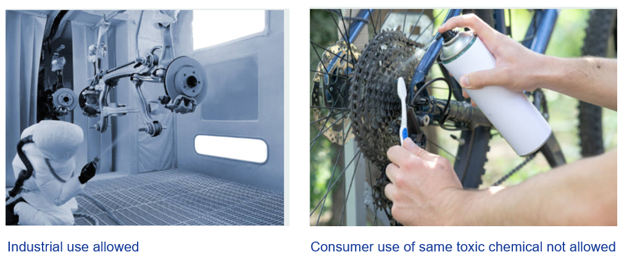
Once EPA determines that a chemical poses an unreasonable risk, the Toxic Substances Control Act requires EPA to regulate that chemical “to the extent necessary so that the chemical substance no longer presents such risk.” And thanks to the 2016 improvements to the law, EPA finally has the tools to take action on some of the most toxic chemicals out there: asbestos, trichloroethylene (TCE) and methylene chloride, all chemicals that have devastated families across the country.
But the House Republicans’ proposal to weaken the Toxic Substances Control Act would strip away EPA’s ability to protect Americans from the worst chemicals already on the market.
The proposed rollbacks would sharply restrict the risks EPA may consider in risk evaluations for chemicals already on the market, and it would take away EPA’s tools for mitigating the unreasonable risk people may face.
The draft legislation does this in a few key ways. First, it lowballs or outright excludes risks to people most likely to be harmed by these chemicals: children, pregnant women, and people who live near or work with these chemicals. It severely narrows EPA’s scientific review, excluding aggregate exposures – the combined exposures someone faces from a chemical – and calling for the exposure pathway to be “more likely than not” to occur for it even to be considered. This is a fundamentally unscientific way to consider our exposure to toxic chemicals.
EPA would also be required to assume workers are protected by OSHA standards – even though OSHA says they are outdated and often not protective – and assume full compliance. This would devolve to an assumption that every person who handles these chemicals is wearing personal protective equipment 100% of the time. Personal protective equipment is the least effective way of protecting workers, and using equipment based on outdated standards leaves workers at risk. And the proposal would expand procedural obstacles – court challenges from the industry on EPA’s scientific assessments, deadline extensions – that could delay implementation of EPA’s protections.
The proposal calls on EPA to minimize risk… but not really
Rather than directing EPA to manage the risk of chemicals so they no longer pose an unreasonable risk to people or the environment, the Republicans’ proposal requires EPA to “minimize [risk], to the extent reasonably feasible.” This murky “reasonably feasible” standard essentially precludes an outright ban of even the most harmful chemicals, allowing restrictions that could only reduce risk by marginal amounts.
The proposal calls for cost-effectiveness for any industry action, pushing EPA to prioritize the industry’s bottom line over protecting people’s health when determining how to regulate a chemical. It also introduces new evidentiary burdens by requiring EPA to demonstrate that alternatives are technically and economically feasible for the specific chemical or condition of use. In practice, if the industry says the reasonable guardrails EPA proposes for a chemical aren’t feasible, then the chemical wouldn’t be approved. This will discourage EPA from considering health-protective controls.
One more loophole
An alarming loophole included in this part of the proposal would create sweeping exemptions and delays for replacement parts for complex durable and consumer goods, like appliances and televisions. The chemicals used in replacement parts would be broadly exempt from regulations unless EPA can show – with substantial evidence – that the part itself independently contributes significantly to unreasonable risk for the chemical. This creates a massive loophole for chemicals used in legacy products and significantly delays even the simplest protection when EPA finds unreasonable risk.
It all adds up to a proposal that would put industry profits ahead of Americans’ health.
Go deeper: Read more about how the House Republicans’ proposal to gut the Toxic Substances Control Act would put our health at risk.