








Toxics for all: The new proposal delivering on the chemical industry’s wish list
Posted: in
Adverse health effects, Chemical exposure, Chemical regulation, Congress, Environmental justice, General interest, Health policy, Industry influence, Risk assessment, TSCA, TSCA reform
Written By

Share
The Toxic Substances Control Act – the primary U.S. chemical safety law – gives the Environmental Protection Agency (EPA) the authority and responsibility to review chemicals for safety, both before and after they enter the market. The law was significantly strengthened in 2016 when Congress passed a bipartisan overhaul of the law. In managing the safety of chemicals, the Toxic Substances Control Act requires EPA to take steps to protect the people most at risk from exposure to toxic chemicals, like children, pregnant women, workers and people living near chemical facilities.
American families should be able to trust that the chemicals in their everyday products have been assessed for safety and won’t cause them serious health problems.
New polling from EDF shows overwhelming support across party lines for the Toxic Substances Control Act. The law is universally popular, with more than four-in-five (82%) favoring it. That support is consistent regardless of gender, race, age, education level or party affiliation.
Despite this popularity, this week, Republicans in the U.S. House of Representatives introduced a discussion draft bill that would fundamentally dismantle the core responsibility for EPA to ensure the safety of chemicals in our economy and everyday lives.
The Toxic Substances Control Act is the country’s bedrock chemical safety law, and it keeps dangerous chemicals out of our homes, workplaces and communities. Americans don’t want potentially toxic chemicals fast-tracked into their lives.
The discussion draft would make sweeping changes to the Toxic Substances Control Act that threaten the public’s health.
No more scientific process for new chemicals
The proposal to reform the Toxic Substances Control Act would remove the requirement for EPA to follow an independent, scientific process to determine if a chemical can be used safely before it can come onto the market.
In addition to eliminating this requirement, the bill would proactively invite industry to participate in reviewing their own products. This would dramatically undermine EPA’s responsibility and authority to protect Americans from the most toxic chemicals and to adhere to a scientifically robust, independent process that Americans can trust.
Sets up a rubber stamp approval process for new chemicals
Many dangerous chemicals, including many PFAS, or “forever chemicals,” entered the market before a bipartisan Congress strengthened the law in 2016. The current proposal would bring back this process that allowed forever chemicals into the market by flipping the safety standard on its head.
Instead of requiring EPA to prove a chemical doesn’t pose an unreasonable risk as is required under the current law, the proposal makes it EPA’s responsibility to prove that a chemical would likely pose an unreasonable risk. This small distinction would have major impacts – it would shift the burden of proof away from safety, effectively turning EPA’s safety review into a rubber stamp for any chemical the industry wants to bring to market.
Blanket approvals for most uses
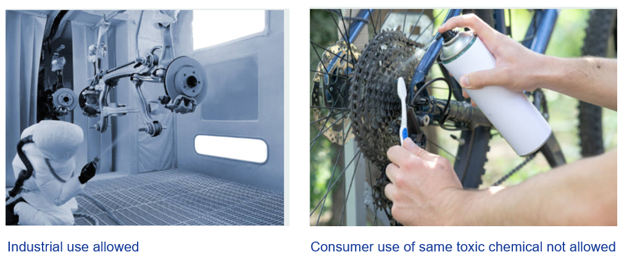
In this proposal, once a chemical is rubber stamped for one use, it could more easily be used in additional unapproved ways. In practice, this could lead to a chemical that was approved for use in industrial settings – with proper worker protections in place – potentially being used in homes, schools and daycares.
Puts industry profits over our health
Republicans’ proposal would severely weaken EPA’s ability to regulate existing chemicals that we know are toxic. The Republicans’ proposed requirement that EPA prove a chemical is likely to pose an unreasonable risk to public health is intended to set a nearly unreachable standard for addressing the risks from dangerous chemicals. The discussion draft bill also diminishes what EPA can consider harmful in the first place when evaluating toxic chemicals, requiring EPA to apply a vague and difficult standard of proof, making it harder to regulate toxic chemicals. It minimizes the estimates of the risks to those living near chemical plants, workers, children and pregnant people by failing to consider their full chemical exposure.
This proposal would also limit the tools EPA can use to eliminate unreasonable risks, putting industry profits ahead of people’s health. This would severely undermine EPA’s ability to protect Americans from the worst toxic chemicals already in use, like cancer-causing formaldehyde and vinyl chloride. These chemicals have long devastated the health of workers and communities on the fenceline of industrial facilities.
The bill also allows the chemical industry and manufacturers to delay for months or years the regulation of existing toxic chemicals by challenging in court any scientific finding by EPA that a chemical is harmful. The proposed process changes would prevent EPA from taking actions to reduce the risks to consumers until after the industry litigation is over.
Limits the information that can be required on dangerous chemicals
The proposal would make it significantly more difficult to produce key information on the hazards of chemicals, how people are exposed to them, and how they harm the environment. It even prohibits EPA from requiring testing for whole groups of chemicals, including highly toxic chemicals. This information is key to properly characterizing the risks we face from groups of toxic chemicals, such as PFAS or “forever chemicals.”
Hazardous loophole
This proposal creates a loophole for so-called advanced or chemical recycling – essentially the burning of plastic waste. It would allow harmful products produced through this process to be considered “equivalent” to chemicals already on the market without undergoing a safety review. Despite the fact that the products are contaminated with plastic’s toxic additives and harmful byproducts such as dioxins, these false equivalents would be rubberstamped as safe.
Why now?
The chemicals industry and manufacturers have advocated for most of the proposals in this bill, and according to news reports EPA “keeps adding former industry lobbyists to the office that manages TSCA.” The Trump EPA has made moves to roll back numerous essential Toxic Substances Control Act protections against toxic chemicals, including altering the way the agency evaluates chemical risk and lowballing the risks from cancer-causing formaldehyde.
Joanna Slaney is Vice President for Political and Government Affairs at Environmental Defense Fund.