








What does EPA’s new soot standard mean for public health?
Written By

Share
The U.S. Environmental Protection Agency’s (EPA) soot rules just got a lot stronger. On February 7, the agency lowered the national limit of annual fine particle pollution—or soot—to 9 micrograms per cubic meter, down from 12, taking a vital step forward for clean air, public health and environmental justice. According to EPA’s own estimates, the new standard will result in 4,500 fewer deaths, 800,000 fewer asthma attacks and up to $46 billion in net health benefits in its first full year of implementation alone.
Now, EPA and states will move to implement the new standard under the familiar cooperative federal-state framework that has a long-running track record of success in cutting fossil fuel emissions and driving down pollution. That will allow families across the country to breathe cleaner, healthier air. Let’s dig deeper into the details of what those health benefits will look like.
Overwhelming scientific evidence points to significant health benefits of protective standards, especially for communities of color and low-income households
Fine particle pollution contains tiny airborne particles like dust and drops of liquids that are so small they penetrate deep into the lungs and can enter the blood, causing and worsening disease. Decades of science document the devastating impact air pollution has on health, the inadequacy of the previous standard to protect health and the need for a more protective standard.
Despite using different methods, EDF’s independent analysis by IEc affirms EPA’s assessment of the health benefits of the more protective standard . It found that a 9 micrograms per cubic meter national standard would avoid thousands of childhood asthma attacks and trips to the emergency room, hospitalizations due to Alzheimer’s disease and heart attacks, and premature deaths.
These health benefits are even greater for communities of color and low-income populations. Our analysis indicates that when the rule is implemented, Black Americans (who experience the heaviest burdens from soot pollution) would see the greatest per capita benefit from meeting a more protective standard, avoiding 61 air pollution deaths per 100,000 people each year. In addition, people living below two times the poverty line stand to experience 25% higher benefits than those with higher incomes.
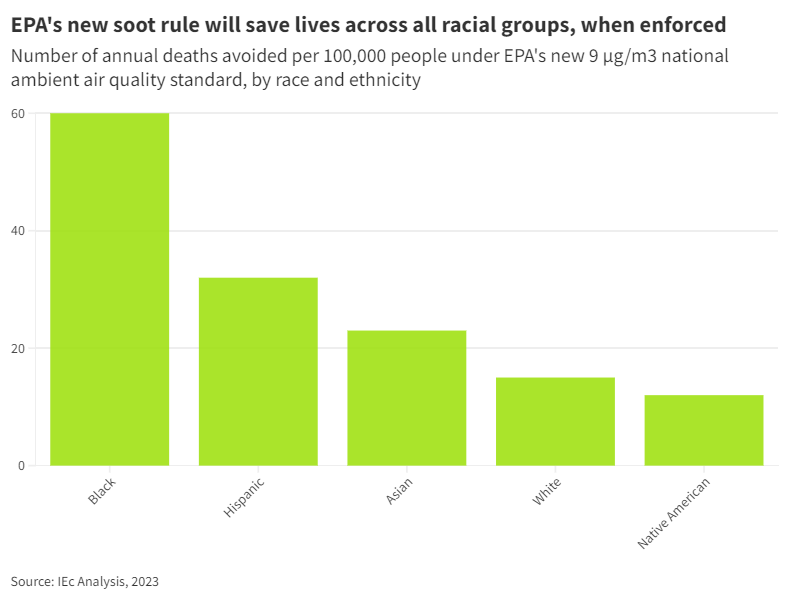
For decades, communities of color and low income areas have been targeted for environmental hazards that other communities did not want: Power plants, landfills, shipping ports, freeways and factories. Our analysis with IEc found that older Black, Asian and Hispanic Americans had greater likelihood (43%, 38% and 27% higher, respectively) than others of living in neighborhoods where air pollution levels were above 9 micrograms per cubic meter.
The resulting inequities in pollution exposure are further aggravated by long standing discriminatory disinvestment, inadequate housing, limited health care and poor educational and economic opportunities which perpetuate health disparities and increase these communities’ vulnerability to the health impacts of air pollution. For example in Pennsylvania, soot is estimated to result in nearly 7,000 deaths per year, of which 30% are in low income populations and nearly 1 in 5 are in Black populations.
New soot rule is a huge first step
EPA’s decision to strengthen our national standards for fine particulate matter is a welcome leap forward that will reduce disparities and prevent health harms. However, a stronger standard alone is not sufficient to eradicate disparities and air pollution’s health burden. Government at all levels must continue to develop complementary policies, strengthen monitoring and invest in historically burdened communities. Further, it’s critical to defend and swiftly implement the rule to ensure communities across the country can benefit from clean air and its health benefits.
Ananya Roy is an Environmental Epidemiologist with expertise in the health effects of air pollution and lead exposure. Read more about her work here.